Introduction: A City Seeking Solutions
In an era where Lima is grappling with an unprecedented surge in criminal activity, the municipal government has taken a bold, albeit controversial, step toward bolstering public safety. A recent survey conducted by the consulting firm Vox Populi reveals that a significant majority of Lima’s residents—over 60%—support the creation of the "Metropolitan Guard," a specialized security unit under the jurisdiction of the Municipal Company for Strategic Projects Support (Emape).
Perhaps most striking is the public’s appetite for a more aggressive approach to security: nearly 90% of those who favor the initiative believe these agents should be authorized to carry firearms. As the capital faces a "critical" security crisis, the discourse surrounding the role of private security in public spaces has reached a fever pitch, forcing a national debate on the boundaries between municipal oversight and law enforcement.
The Chronology of the Metropolitan Guard
The emergence of the Metropolitan Guard did not happen in a vacuum. It is the culmination of a broader strategy by the Municipality of Lima to address the visible gaps in protection for city-managed assets and infrastructure.
- Early September 2026: The municipal administration formally unveiled the first cohort of the Metropolitan Guard. Comprising 40 highly trained security professionals, this unit was designed to provide surveillance, asset protection, and risk prevention across Emape’s extensive network of infrastructure.
- The Launch: During the official presentation, officials emphasized that this group was not intended to be a "parallel police force" or a traditional Municipal Police. Instead, they were framed as a private security entity with a specific mandate: the preservation of municipal property and the safety of those within those specific parameters.
- September 11–14, 2026: Vox Populi conducted an intensive digital survey across Lima to gauge the public’s sentiment toward this new security layer, providing the empirical data that currently fuels the political debate.
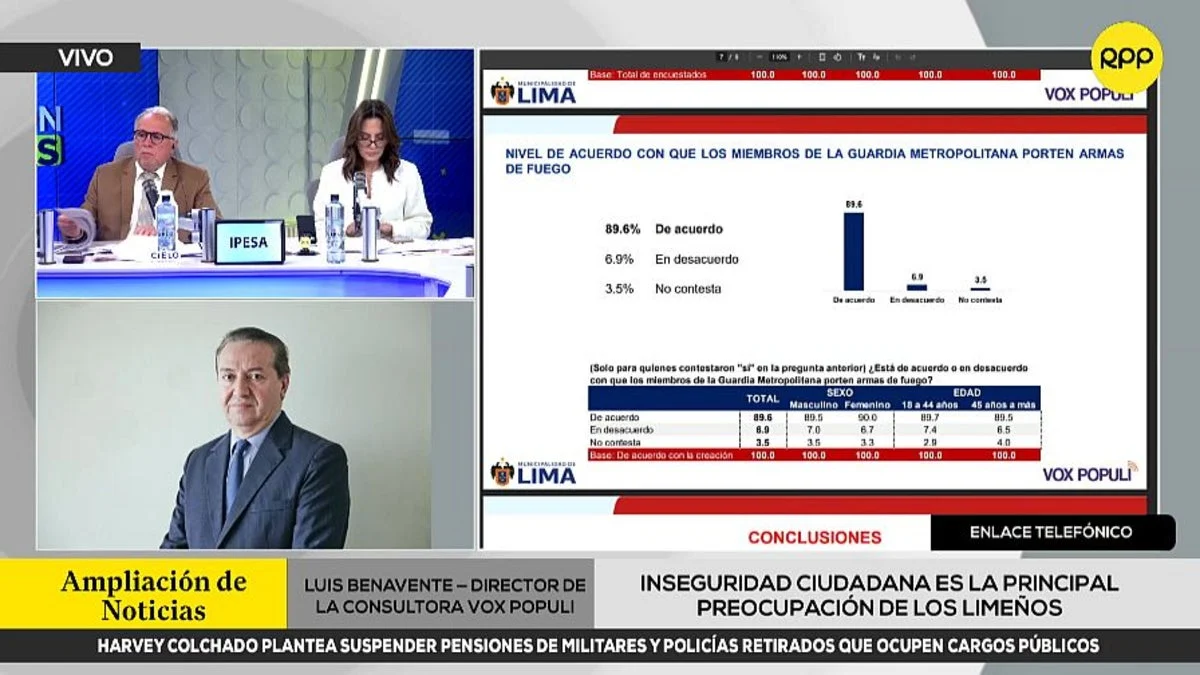
- Mid-September 2026: The survey results were presented in the media by Luis Benavente, director of Vox Populi, sparking immediate public discourse regarding the viability and necessity of arming non-police personnel in the streets of Lima.
Supporting Data: What the Numbers Say
The Vox Populi study provides a granular look at the psyche of a population tired of systemic insecurity. The methodology involved 423 residents of the province of Lima with internet access, surveyed via the SurveyMonkey platform. The study boasts a 95% confidence level with a margin of error of +/- 4.8%.
Key Findings:
- General Approval: 61.5% of respondents favor the existence of the Metropolitan Guard.
- Disapproval: 38.5% of respondents remain skeptical, citing concerns over the militarization of municipal services or the potential for abuse of power.
- The Firearm Factor: Among those who support the guard, an overwhelming 89.6% expressed that they want these agents armed. Only 6.9% of proponents opposed the idea of agents carrying firearms, while a small fraction remained undecided.
Luis Benavente noted that the request for this study came directly from the Municipality of Lima, yet he maintains that the results reflect an undeniable reality of the capital: a deep-seated frustration with the current state of public safety.
Official Responses and Political Context
The political justification for the Metropolitan Guard hinges on the perceived inadequacy of existing security apparatuses. According to Benavente, the high approval ratings are a direct reflection of a "very critical" security climate.
"There is a palpable sense of insufficient action, few results, or scarce results from the traditional Serenazgo (municipal patrol), which has clear limitations in its competencies across districts, and likewise from the National Police," Benavente stated during an interview on Ampliación de Noticias.
The Municipality’s Stance
Municipal authorities, led by figures like Renzo Reggiardo, have been careful to draw a line between the Metropolitan Guard and the National Police (PNP). They argue that the guard operates within the legal framework of private security. Their function is strictly limited to protecting the physical infrastructure of Emape, including construction sites, bus terminals, and major transit routes managed by the municipal entity.
The administration’s argument is purely utilitarian: when the state struggles to provide adequate security, the municipality must fill the gap to ensure that public works and city assets are not sabotaged or looted by criminal organizations. They argue that the presence of armed, trained guards serves as a powerful deterrent.
Implications for Public Safety in Lima
The proposal to arm municipal guards carries profound implications for the legal and social fabric of Peru. Critics argue that allowing private security to carry firearms in urban centers creates a risk of "escalation." If security agents are armed, criminals may respond with more lethal force, potentially leading to more violent confrontations in densely populated areas.
Legal and Operational Challenges
- Jurisdictional Overlap: Can a private entity truly be limited to "infrastructure protection" if they are authorized to carry lethal force? There is a fear that these agents might intervene in broader civil matters, leading to complex legal liabilities for the Municipality of Lima.
- Training and Accountability: The public support for armed guards assumes a high level of training. Critics ask: Are these 40 individuals trained to the same standard as specialized tactical police units? Without robust, transparent oversight mechanisms, the public might lose faith in the guard as quickly as they have gained it.
- The Precedent of Privatized Security: By outsourcing security to an entity like Emape, is the city essentially "privatizing" public order? This shift could signal a long-term trend where the government increasingly relies on private contracts rather than institutional reform of the National Police.
The Psychological Impact on Citizens
The data suggests that Limeños are so desperate for a return to normalcy that they are willing to accept unconventional security measures. This "security at any cost" mindset is a powerful indicator of the failure of traditional policy. Whether the Metropolitan Guard succeeds or becomes a source of further tension remains to be seen.
Conclusion: A Delicate Balance
The Metropolitan Guard is currently a pilot of necessity—a response to the vacuum left by broader institutional challenges in policing. While 61.5% of the population sees the guard as a beacon of hope and a practical solution to rampant crime, the remaining 38.5% raises valid concerns about the risks inherent in arming security forces that operate outside the traditional chain of command.
As the Municipality of Lima continues to refine the roles and training of these agents, the eyes of the nation will be watching. The success of this project will likely depend not just on the effectiveness of the guards in preventing crime, but on the transparency of their operations and their ability to navigate the complex legal landscape of public safety. For now, the people of Lima have spoken: they are demanding a more aggressive stance, and they are looking to their municipal leaders to provide the security that has so far remained elusive.