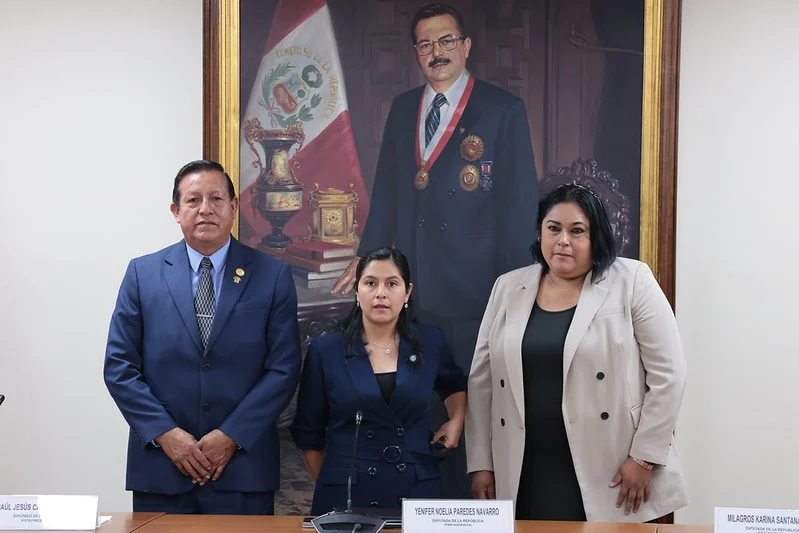
Lima, Peru – [Date of Publication] – The powerful Commission on Energy and Mines of the Chamber of Deputies has elected its new directive board for the 2026-2027 Annual Session Period. In a decisive vote of 18 in favor and with unanimous support, Congresswoman Yenifer Noelia Paredes Navarro, representing the Juntos por el Perú party, has been chosen to preside over this influential committee. Her leadership heralds a new era for the commission, one that promises a strong emphasis on direct engagement with regional stakeholders and a commitment to fostering consensus in Peru’s vital energy and mining sectors.
Congresswoman Paredes Navarro will be joined by a dedicated team aiming to steer the commission’s agenda. Congressman Raúl Jesús Camargo Porta of the Partido Cívico Obras will serve as Vice President, bringing his experience to the operational leadership. The role of Secretary will be filled by Congresswoman Milagros Santana Vega of the Partido del Buen Gobierno, who will be instrumental in managing the commission’s proceedings and documentation.
Upon assuming her new responsibilities, President Paredes Navarro expressed her profound gratitude for the trust placed in her by the commission’s members. She pledged to approach her presidency with a deep sense of responsibility, articulating a clear vision centered on fostering dialogue, enhancing coordination, and diligently pursuing consensus among the diverse sectors intertwined with Peru’s dynamic energy and mining activities.
"I embrace this responsibility with great commitment," stated President Paredes Navarro. "We are committed to developing a comprehensive work plan with the Directive Board, and we stand ready to coordinate and collaborate with all sectors involved. Our aim is to ensure that the commission serves as a truly effective platform for progress and problem-solving."
A New Era of Decentralized Engagement
A cornerstone of President Paredes Navarro’s proposed administration is a bold initiative to bring parliamentary work closer to the regions. This "decentralized agenda" is designed to provide lawmakers with direct, firsthand exposure to the complex challenges and opportunities confronting the mining and energy sectors across Peru. By venturing beyond the capital, the commission seeks to gain a more nuanced understanding of local realities and to foster a more responsive and effective legislative process.
To this end, the commission has announced plans for extensive site visits and decentralized sessions. These engagements will serve as crucial platforms for listening to the concerns of local authorities, community leaders, representatives of productive sectors, and other key stakeholders. The overarching objective is to meticulously identify the most pressing issues and to contribute meaningfully to the formulation of sustainable and equitable solutions.
President Paredes Navarro specifically highlighted Cajamarca and Pataz as among the initial locations earmarked for these decentralized efforts. These regions, known for their significant contributions to and experiences with the mining and energy industries, represent fertile ground for understanding the on-the-ground impacts of national policies.
"We are establishing ourselves as an open forum for dialogue with all sectors," President Paredes Navarro emphasized. "We will be visiting our regions to directly address issues related to energy and mining, to understand the primary problems, and to collaboratively seek effective solutions. This direct engagement is paramount to our mission."
The commission’s agenda will encompass a broad spectrum of concerns, addressing not only the intricacies of mining operations but also the multifaceted challenges facing the electricity and broader energy sectors. This comprehensive approach, President Paredes Navarro asserted, will be guided by a steadfast commitment to dialogue and the cultivation of broad-based consensus. The commission aspires to become a vital hub for deliberation, where the varied perspectives pertinent to these strategically crucial sectors for national development can be effectively gathered and considered.
The ordinary sessions of the Commission on Energy and Mines are scheduled to convene at 10:00 AM in Sala Grau of the Legislative Palace, signaling a structured approach to their legislative endeavors.

Addressing Persistent Scrutiny and Legal Investigations
The ascension of Congresswoman Yenifer Noelia Paredes Navarro to the presidency of the Commission on Energy and Mines has also brought renewed attention to her personal history and ongoing legal investigations. Her public profile gained significant media traction in 2022 following the initiation of fiscal inquiries during the administration of former President Pedro Castillo.
The Public Ministry has been investigating Congresswoman Paredes Navarro for alleged involvement in criminal organizations, money laundering, collusion, and embezzlement. The prosecution’s central thesis posits that she may have been an integral part of a network allegedly engaged in the illicit manipulation of public tenders for construction projects across Cajamarca, Lima, and Amazonas. This complex case led to a period of pre-trial detention for Congresswoman Paredes Navarro in 2022. She was subsequently released to continue the legal process under supervised release. As of mid-2026, judicial authorities are reportedly still evaluating financial transaction analyses, including bank transfers, linked to her immediate family members, indicating that these investigations remain active and subject to ongoing scrutiny.
This legal context inevitably casts a shadow over her new leadership role, raising questions about potential conflicts of interest and the public perception of the commission’s impartiality. Transparency and a rigorous commitment to ethical conduct will be paramount as she navigates the responsibilities of her presidency, particularly in an area as sensitive and economically significant as Peru’s energy and mining sectors. The public will be closely watching how she balances her legislative duties with the ongoing legal proceedings and whether she can effectively inspire confidence in her leadership of this critical congressional body.
Supporting Data and Contextual Background
Peru’s energy and mining sectors are pillars of its national economy, contributing significantly to GDP, export revenues, and employment. The mining sector, in particular, is a major global producer of copper, gold, silver, zinc, and other vital minerals. The energy sector encompasses electricity generation, transmission, and distribution, as well as the exploration and production of hydrocarbons, and increasingly, the development of renewable energy sources.
Key Statistics and Trends (Illustrative, as specific data for 2026-2027 would be speculative):
- Mining Sector Contribution: Historically, mining has accounted for a substantial portion of Peru’s export earnings, often exceeding 50%. The sector also represents a significant source of tax revenue for the national government and sub-national entities.
- Energy Mix: Peru’s energy matrix is undergoing a gradual diversification. While hydropower and thermal power plants (often fueled by natural gas) have traditionally dominated electricity generation, there is a growing investment and policy focus on solar, wind, and other renewable energy sources to meet increasing demand and climate change commitments.
- Investment Landscape: Both sectors attract substantial foreign and domestic investment. However, investment decisions are often influenced by regulatory stability, social license to operate, and commodity price fluctuations.
- Regional Impact: Mining and energy projects are often located in remote or rural areas, leading to significant socio-economic impacts, both positive (employment, infrastructure development) and negative (environmental concerns, social conflicts). This underscores the importance of the commission’s stated commitment to decentralization.
- Regulatory Framework: The legislative and regulatory framework governing these sectors is complex, involving multiple ministries, agencies, and laws. Issues such as environmental protection, community relations, territorial rights, and fiscal regimes are constant areas of legislative attention.
The Commission on Energy and Mines plays a crucial role in shaping this framework. Its mandate includes reviewing proposed legislation, overseeing government policies, and serving as a conduit for public and industry concerns. The decisions made within this commission can have far-reaching consequences for national development, environmental sustainability, and the well-being of communities.
Official Responses and Stakeholder Perspectives
The election of the new Directive Board of the Commission on Energy and Mines is a significant event that will be closely monitored by a wide array of stakeholders.
Government Ministries: Ministries such as the Ministry of Energy and Mines (MINEM) and the Ministry of Environment (MINAM) will be key interlocutors for the commission. Their officials will likely engage with the new leadership to discuss ongoing policy initiatives, regulatory updates, and strategies for the development of the energy and mining sectors. The commission’s focus on dialogue is expected to facilitate closer collaboration between the legislative and executive branches.
Industry Associations: Organizations representing mining companies (e.g., SNMPE – Sociedad Nacional de Minería, Petróleo y Energía) and energy producers will be keen to understand the commission’s priorities. They will likely seek opportunities to present their perspectives on legislative proposals and regulatory changes, advocating for policies that support investment and sustainable operations. Their input will be crucial for the commission’s efforts to build consensus.
Environmental and Social Organizations: Civil society groups focused on environmental protection and social justice will also be paying close attention. They will be looking for the commission to address concerns related to environmental impacts, human rights, and community benefits from extractive industries. The decentralized agenda could provide these groups with more direct avenues to voice their concerns to lawmakers.

Local Communities: Communities located near mining and energy projects, particularly those that have experienced social conflicts or environmental degradation, will see the commission’s decentralized approach as a potential opportunity to have their voices heard more effectively. Their participation in regional sessions will be vital for ensuring that local needs and concerns are integrated into policy discussions.
The success of President Paredes Navarro’s agenda will depend on her ability to effectively engage with this diverse group of stakeholders, fostering an environment of trust and mutual understanding. Her stated commitment to dialogue and consensus-building will be put to the test as she confronts the complex and often competing interests within the energy and mining landscape.
Implications for Peru’s Future Development
The leadership transition within the Commission on Energy and Mines carries significant implications for Peru’s economic trajectory and sustainable development.
Economic Growth and Investment: The energy and mining sectors are critical engines of economic growth. A proactive and well-functioning commission can foster an environment conducive to investment, streamline regulatory processes where appropriate, and ensure that policies are designed to maximize the benefits of these industries for the nation. Conversely, legislative uncertainty or a lack of clear direction could deter much-needed capital.
Social Equity and Community Relations: The historical challenges of social conflicts and equitable benefit-sharing in extractive regions are well-documented. The commission’s emphasis on decentralization and dialogue offers a promising opportunity to address these issues more effectively. By actively listening to and engaging with local communities, the commission can help shape policies that promote greater social inclusion and ensure that the benefits of resource extraction are more broadly distributed.
Environmental Sustainability: The environmental footprint of energy and mining activities is a major concern. The commission’s legislative oversight will be crucial in ensuring that robust environmental regulations are enacted and enforced. A balanced approach that encourages responsible resource development while safeguarding natural resources will be essential for long-term sustainability.
Energy Security and Transition: As Peru navigates the global energy transition, the commission’s work will be vital in shaping the future of its energy matrix. This includes decisions related to the expansion of renewable energy sources, the future of fossil fuels, and the modernization of the electricity grid. The commission’s ability to foster consensus on these complex issues will directly impact Peru’s energy security and its commitment to climate action.
Governance and Transparency: The ongoing investigations involving President Paredes Navarro introduce a layer of complexity to the governance of the commission. Her ability to demonstrate unwavering commitment to transparency, ethical conduct, and impartiality will be crucial in maintaining public trust. The commission’s effectiveness will, in part, be judged by its ability to operate with integrity and to foster a perception of fairness among all stakeholders.
In conclusion, the election of Yenifer Noelia Paredes Navarro as the head of the Commission on Energy and Mines marks a pivotal moment. Her stated commitment to decentralization and dialogue presents a potential pathway to more inclusive and effective policymaking. However, the shadow of ongoing legal investigations necessitates a heightened focus on transparency and accountability. The commission’s work in the coming years will undoubtedly play a significant role in shaping Peru’s economic future, its social fabric, and its environmental stewardship.