In the demanding world of civil engineering, the integrity of a structure is only as reliable as the ground upon which it rests. As global infrastructure expands into increasingly challenging topographies—ranging from steep Andean mountain passes to unstable coastal cliffs—the discipline of slope stabilization has emerged as a cornerstone of modern construction. It is not merely a technical necessity; it is a fundamental pillar of safety, environmental stewardship, and long-term economic viability.
The Foundation of Safety: Why Slope Stabilization Matters
Slope stabilization encompasses a suite of engineering techniques designed to prevent mass movement, such as landslides, rockfalls, and soil erosion. When projects are developed on inclined planes or in areas with complex geotechnical profiles, the risk of structural failure increases exponentially. Without proper intervention, these projects face the constant threat of geological instability, which can lead to catastrophic loss of life, astronomical repair costs, and prolonged operational downtime.
The primary objective of stabilization is to maintain the equilibrium of the soil mass. By controlling water runoff, reinforcing the earth, and managing gravitational forces, engineers can transform volatile landscapes into stable foundations capable of supporting roads, mining operations, and urban developments.
A Historical Perspective: The Chronology of Stabilization Evolution
The history of slope stabilization is a narrative of human ingenuity adapting to the harsh realities of nature.
- Early Civilizations: Ancient engineers understood the basic principles of gravity and retention. The use of simple dry-stone retaining walls was common in agricultural terracing, allowing civilizations to cultivate sloped land without losing topsoil to erosion.
- The Industrial Revolution: As rail and road networks expanded globally in the 19th century, the need for more robust retaining systems became apparent. This era saw the introduction of timber cribbing and the first large-scale earth-moving projects that required engineered drainage systems.
- The 20th Century (The Age of Geosynthetics): The mid-1900s marked a paradigm shift with the advent of synthetic materials. The development of geomembranes, geogrids, and geocells revolutionized the industry. These materials provided lighter, stronger, and more durable alternatives to traditional masonry, allowing for stabilization in environments previously deemed "unbuildable."
- The Modern Era (Digital and Smart Monitoring): Today, we have entered the era of the "Smart Slope." With the integration of satellite imagery, inclinometers, pore-pressure sensors, and AI-driven predictive modeling, engineers no longer react to slope failures—they anticipate them.
Supporting Data: The Geotechnical Variables
Selecting the right stabilization method is an exercise in complex data analysis. Engineers must account for a myriad of variables that interact to determine the stability of a slope:
- Geological Profile: The distinction between cohesive soils (like clay) and cohesionless soils (like sand) dictates the stabilization strategy. Rock mass quality, including fracture density and weathering, determines whether bolting or shotcrete is required.
- Hydrogeological Conditions: Water is the greatest enemy of stability. Excessive pore-water pressure reduces the shear strength of the soil. Therefore, comprehensive drainage systems—ranging from horizontal drains to subsurface collectors—are often as important as the structural retaining elements themselves.
- Environmental Loading: In seismic zones, dynamic loads must be calculated. The stabilization system must be flexible enough to withstand the vibrations of an earthquake without shattering, yet rigid enough to hold the mass in place during static periods.
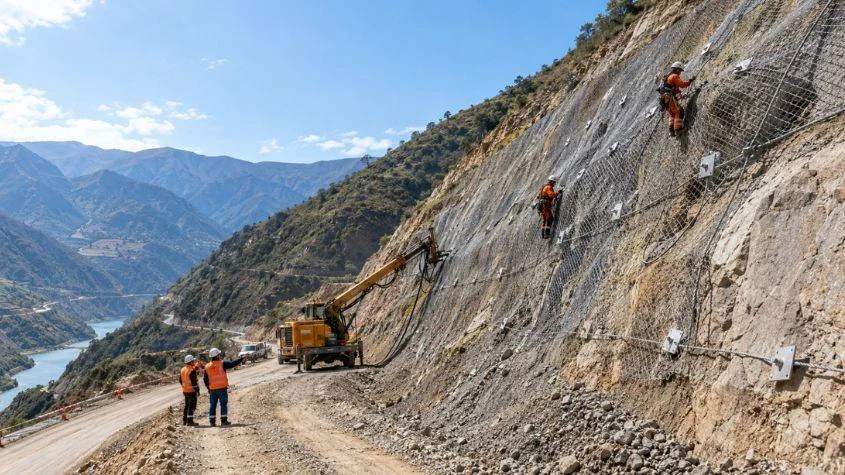
- Topographic Constraints: The steepness of the slope dictates the geometry of the intervention. High-angle slopes often require deep-seated reinforcement, such as soil nails or ground anchors, while lower-angle slopes may benefit from surface-level vegetation and erosion control mats.
The Toolbox of Modern Engineering: Current Solutions
Modern construction offers a diverse portfolio of interventions, each tailored to specific site conditions.

1. Retention Systems: Gavions and Retaining Walls
Gavions—wire mesh containers filled with rocks—remain a gold standard for their flexibility and permeability. Unlike rigid concrete walls, which can crack under pressure, gavions allow for natural drainage and can settle slightly with the terrain without losing structural integrity.
2. Reinforcement: Soil Nailing and Anchors
When a slope is too steep for surface support, engineers look deeper. Soil nailing involves the insertion of steel bars into the ground, which are then grouted to "stitch" the unstable soil mass to the more stable underlying rock. This creates a reinforced gravity structure that effectively resists sliding forces.
3. Surface Control: Geosynthetics and Membranes
Geomembranes are indispensable for controlling water infiltration. By creating a barrier that prevents water from saturating the soil, these materials prevent the internal "lubrication" that often triggers landslides. When paired with hydroseeding and bio-engineering, they offer a hybrid solution that is both stable and ecologically integrated.
Official Industry Perspectives: Insights from PERÚ CONSTRUYE
Recognizing the critical nature of this field, PERÚ CONSTRUYE LATAM CONSTRUCTION recently convened a summit of industry leaders to analyze the state of slope stabilization. The consensus among the experts was clear: Standardization is no longer enough.
The industry is shifting toward a "Total Project Lifecycle" approach. This means that stabilization is not an afterthought but a primary design consideration during the feasibility phase. Official reports from the summit highlighted that:
- Risk Mitigation is an Investment: Proactive stabilization costs a fraction of the cost of remediation after a failure.
- Innovations in Monitoring: Real-time monitoring systems are becoming a mandatory requirement for large-scale mining and infrastructure projects. The ability to receive automated alerts when a slope moves by even a few millimeters allows for proactive maintenance rather than reactive emergency response.
- Sustainability Trends: There is a growing demand for "Green Engineering," where stabilization methods are chosen based on their carbon footprint and ability to support local ecosystems, rather than just their raw structural strength.
Implications for the Future of Infrastructure
The implications of these advancements are profound. As climate change increases the frequency and intensity of extreme weather events—particularly heavy rainfall, which is a leading trigger for landslides—the role of slope stabilization will only grow in importance.

Economic Implications
For governments and private developers, the primary implication is the shift from "lowest cost" to "lowest lifecycle cost." A stabilization project that is cheaper to install but requires high maintenance or carries a high risk of failure is increasingly viewed as a bad investment. The industry is moving toward high-performance materials that offer longevity and resilience.
Social and Safety Implications
The human cost of infrastructure failure is immeasurable. By adopting advanced geotechnical practices, the construction industry is essentially purchasing "social license" to operate. When a road through a mountain pass remains open during a monsoon, or a tailings dam remains stable during an earthquake, the industry proves its value to society.
Technological Implications
The future belongs to the integration of Digital Twins. Imagine a bridge or highway project where the digital twin is fed data from slope sensors in real-time. If the slope shifts, the model predicts the impact on the bridge’s structural integrity and automatically schedules a maintenance crew. This level of synchronization is the next frontier of geotechnical engineering.
Conclusion
Slope stabilization is the silent guardian of our built environment. While bridges and skyscrapers command the public’s attention, the unseen work of anchoring, draining, and reinforcing our slopes is what makes the modern world possible. As we push the boundaries of what is possible in construction, we must remain committed to the science of stability.
Through the combination of robust materials, advanced sensor technology, and rigorous geotechnical analysis, the construction industry is successfully meeting the challenges of our changing planet. For those interested in the deep technical specifications and case studies of these critical systems, the latest developments and insights are documented extensively in industry resources, such as the comprehensive reports found in the latest editions of PERÚ CONSTRUYE.
The safety of our future infrastructure depends on our ability to respect the earth, understand its limits, and apply the innovative solutions that keep our society moving forward, one stable slope at a time.