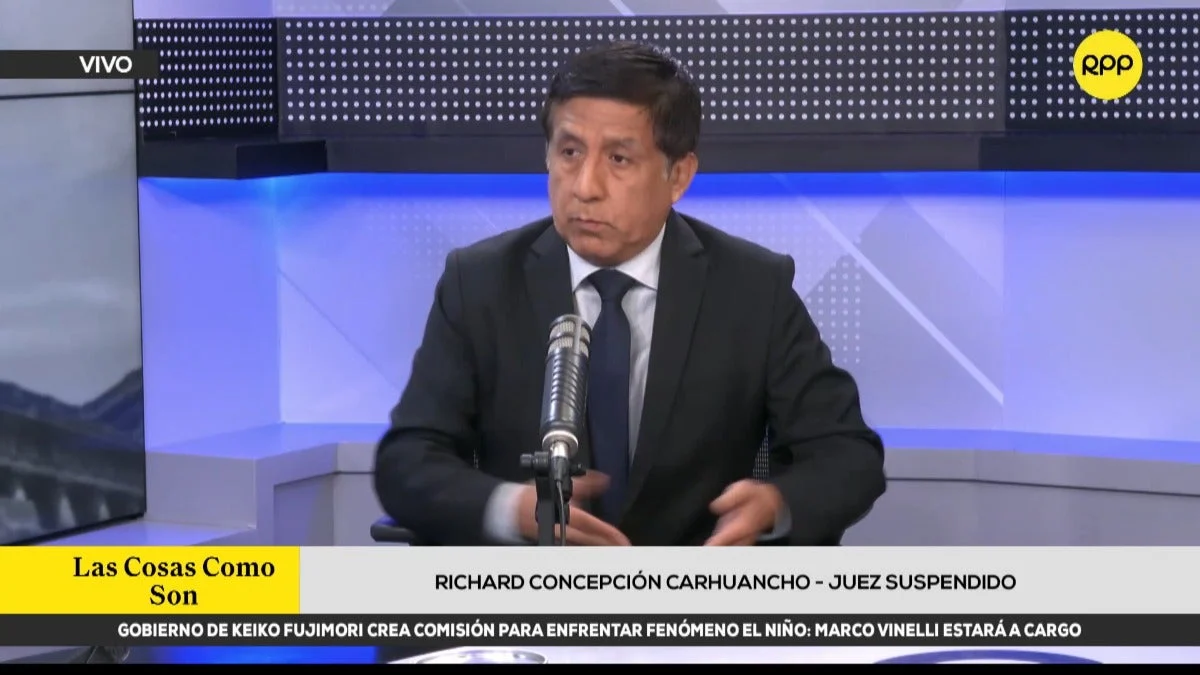
In a high-stakes climate of legal scrutiny, suspended judge Richard Concepción Carhuancho has emerged to defend his judicial record, specifically addressing the controversial pretrial detention orders he issued against former Peruvian presidents and political heavyweights Ollanta Humala and Keiko Fujimori. During a candid interview on RPP’s Las Cosas Como Son, the magistrate sought to clarify the legal landscape under which he operated during the height of the Lava Jato investigations, asserting that his decisions were not personal vendettas, but rather the result of rigorous adherence to the prevailing jurisprudence of the time.
The Core Defense: Jurisprudence and Judicial Autonomy
The crux of Judge Concepción Carhuancho’s argument rests on the principle of judicial independence and the inherent evolution of legal interpretation. Addressing the "fallacy of generalization"—the notion that he reflexively orders pretrial detention in all cases—the judge pointed to a record of nuance. "I have fulfilled my functions in due course, evaluating each case in its concrete reality," he stated. "It is a false premise to suggest that I mandate detention in every instance; there are many cases where I did not."
Concepción Carhuancho emphasized that his rulings against Humala and Fujimori were not isolated actions, but decisions that underwent thorough vetting within the Peruvian judicial hierarchy. His initial orders were reviewed and subsequently ratified by higher courts, suggesting that his legal reasoning was consistent with the standards expected by the appellate system at the time. The transition in the legal status of these cases, he argues, did not stem from an error in his judgment, but rather from a profound shift in the interpretation of law by the Constitutional Tribunal (TC).
A Chronology of Legal Contention
To understand the controversy, one must trace the timeline of the Lava Jato proceedings in Peru:
- The Initial Phase (2017–2018): Judge Concepción Carhuancho issued pretrial detention orders for both Ollanta Humala and Keiko Fujimori, citing the risk of flight and obstruction of justice in relation to the Odebrecht corruption scandal. At this juncture, the prevailing legal consensus—widely accepted by prosecutors and judges alike—was that clandestine campaign contributions could be categorized as a form of money laundering.
- The First Intervention by the Constitutional Tribunal: As the cases moved forward, the defense teams for both political figures brought appeals to the Constitutional Tribunal. In a narrow 4-3 decision, the TC ordered the release of the detainees. Concepción Carhuancho notes that this ruling was tethered to the specific legal line of the era, which still recognized the illicit nature of campaign funds under the money laundering statute.
- The Paradigm Shift (December 2023): The legal landscape underwent a tectonic shift when the current Constitutional Tribunal issued a landmark ruling, explicitly stating that, under existing law, campaign contributions do not automatically constitute the crime of money laundering.
- The Aftermath: This decision essentially pulled the rug out from under the prosecution’s long-standing theory in the "Cocteles" (Fujimori) and Humala cases, leading to the arching of certain processes and creating a public perception that the initial detentions were fundamentally unjust.
Supporting Data: The Evolution of "Money Laundering" Interpretations
The central point of contention is the legal classification of campaign financing. For years, the Peruvian Public Ministry operated under the "autonomous" theory of money laundering, which posited that if funds originated from illicit sources—such as bribes from construction conglomerates—the subsequent concealment of those funds within a political campaign constituted a separate and distinct crime of money laundering.
Concepción Carhuancho points out a critical observation: "During the pretrial detention hearings, no defense lawyer challenged the concept that campaign contributions could be money laundering. It was a settled matter." It was only later, as the cases progressed into the intermediate stage of trial, that the legal theory was robustly challenged by defense attorneys.
The judge’s defense is supported by the reality that law is not static. When a supreme organ like the Constitutional Tribunal changes its criteria, it does not necessarily invalidate the past actions of a lower court judge who acted in good faith based on the law as it was interpreted at the time. This is the bedrock of the "jurisprudential line" argument: a judge cannot be held retrospectively liable for following the legal consensus of the year in which the decision was rendered.
Official Responses and the Spectre of Criminalization
The implications of these developments have reached a fever pitch in the Peruvian legal community. Judge Concepción Carhuancho’s suspension and his subsequent public defense highlight a growing tension between the judiciary and the political class.
The judge’s primary concern, articulated during his interview, is the dangerous precedent being set by the potential "criminalization of judicial criteria." He argues that if judges are to be investigated or penalized every time a higher court or the Constitutional Tribunal alters its interpretation of a statute, the independence of the judiciary will be irrevocably damaged.
"One cannot pursue judges for simply fulfilling their functions," he remarked. "When we begin to equate a dissenting judicial opinion or an interpretation of the law with a criminal act, we threaten the very foundation of the rule of law."
Critics of the judge, however, maintain that his actions were overly aggressive and contributed to a culture of "preventive detention abuse" in Peru. They argue that the judiciary, particularly under the oversight of judges like Concepción Carhuancho, allowed itself to become a political instrument, utilizing the extraordinary measure of detention to satisfy public outcry rather than focusing on the constitutional rights of the accused.
Broader Implications for the Peruvian Justice System
The fallout from this debate has implications that extend far beyond the specific cases of Humala and Fujimori:
- Judicial Chill: There is a significant risk that judges, fearing professional repercussions or investigations for "prevarication" (rendering an unjust decision), may become overly hesitant to grant pretrial detention in legitimate cases where the risk of flight or obstruction is high.
- Institutional Instability: The constant oscillation of the Constitutional Tribunal’s criteria creates uncertainty for both the Public Ministry and the defense. Without a stable jurisprudential framework, the "Lava Jato" cases—and future anti-corruption efforts—risk being trapped in an endless loop of procedural challenges rather than reaching a final verdict on the facts.
- Public Trust: The perception that justice in Peru is subject to the political tides of the moment, rather than the stable application of law, continues to erode public confidence in democratic institutions. When high-profile cases are archived due to shifts in the interpretation of "money laundering," the public is left wondering whether the judicial system is designed to uncover the truth or merely to navigate technical loopholes.
Conclusion
Richard Concepción Carhuancho’s defense is an appeal to the principles of judicial stability and the protection of the judge’s role as an interpreter of the law. By framing his past actions within the context of the legal norms of the time, he forces a necessary conversation about the limits of judicial accountability.
As Peru continues to grapple with the legacy of the Lava Jato scandal, the case of Judge Concepción Carhuancho serves as a mirror for the broader struggle of the Peruvian justice system. It is a struggle between the desire for accountability for political elites and the imperative to maintain a judicial system that is shielded from the political currents of the day. Whether his defense will hold in the court of public opinion—and the court of his peers—remains to be seen, but the debate has undoubtedly marked a turning point in how the nation views the intersection of law, politics, and the judiciary.