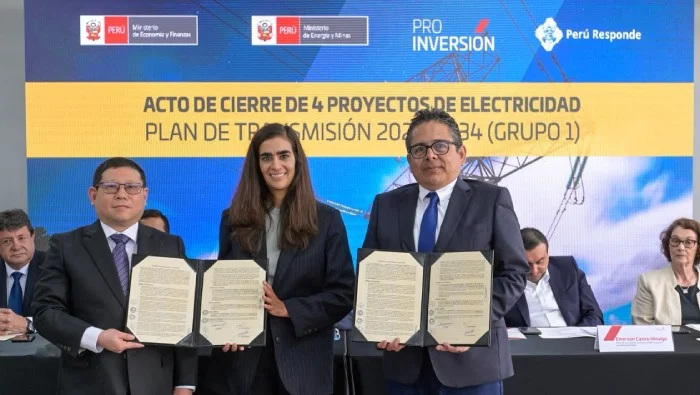
In a landmark move aimed at fortifying Peru’s national energy infrastructure, the Private Investment Promotion Agency (PROINVERSIÓN), under the guidance of the Ministry of Economy and Finance (MEF), has officially signed concession contracts with ENGIE Transmisión Perú S.A. The agreement marks a critical milestone in the government’s ambitious plan to modernize the nation’s electrical grid, promising a more reliable power supply for 1.6 million citizens across four key regions: Ayacucho, Piura, Lambayeque, and Junín.
This multi-million-dollar investment, totaling over US$339 million, represents the successful conclusion of a highly competitive bidding process that drew interest from premier international energy operators. By integrating these projects into the broader National Interconnected Electric System (SEIN), the Peruvian government is not only addressing current consumption needs but also laying the groundwork for sustained industrial and residential growth.
Main Facts: A Strategic Expansion of the National Grid
The signed contracts represent the "Group 1" cluster of a massive, four-part tender initiative. These projects were derived from the Transmission Plans 2023-2032 and 2025-2034, commissioned by the Ministry of Energy and Mines (MINEM). The primary objective is to eliminate bottlenecking in energy distribution, which has historically hindered the development of peripheral regions.
The projects under this agreement are as follows:
- Piura: The 500 kV Miguel Grau–Pariñas transmission line and the Pariñas 500/220 kV substation. This project is vital for integrating renewable energy sources, specifically wind power, into the national grid.
- Lambayeque: The 220 kV Felam–Tierras Nuevas–Salitral transmission links. This project is set to provide critical support to the agro-industrial hubs of Olmos, Motupe, and Jayanca.
- Junín: The new Palián 220/60 kV substation and associated links. This will significantly reinforce energy continuity for the Huancayo, Orcotuna, and Pucará areas.
- Ayacucho: The 220 kV Muyurina–Mollepata transmission link, which will stabilize electrical flow and enhance operational resilience against potential system failures.
These projects will be executed under the Public-Private Partnership (PPP) model. ENGIE Transmisión Perú S.A. will be responsible for the entire project lifecycle, including design, financing, construction, operation, and maintenance. Each concession entails a construction period followed by a 30-year operational commitment.
Chronology: From Planning to Execution
The journey toward this investment began with the long-term vision of the Ministry of Energy and Mines (MINEM) at the start of 2023 and 2025.
- 2023–2025: MINEM identifies critical gaps in regional transmission capacity and commissions the development of updated Transmission Plans.
- Mid-2026: PROINVERSIÓN launches the tender for "Group 1," establishing a transparent and competitive bidding environment.
- Late 2026: After vetting multiple international operators, ENGIE Transmisión Perú S.A. is selected as the winning bidder, offering a robust financial and technical proposal.
- October 2026: Official signing of the concession contracts, formalizing the start of the investment phase.
- Future Roadmap: PROINVERSIÓN is already looking ahead, with plans to adjudicate "Groups 2 and 3" by the fourth quarter of 2026, and "Group 4" by the first quarter of 2027.
Supporting Data: Why Transmission Matters
The necessity of this investment is underscored by the current state of Peru’s energy landscape. While generation capacity has expanded, transmission—the "highways" of electricity—has struggled to keep pace.
Economic Impact
The investment of US$339 million is not merely an infrastructure expense; it is a catalyst for economic stimulation. Reliable energy is the lifeblood of modern industry. For example:
- Agro-industry: The northern projects in Lambayeque and Piura will support high-tech irrigation systems and processing plants that require consistent, non-fluctuating power.
- Industrial Parks: Stable voltage levels are essential for the operation of sensitive machinery in new industrial developments.
- Residential Stability: With 1.6 million beneficiaries, the reduction in service interruptions will lead to significant gains in household productivity and quality of life.
Technical Reliability
The inclusion of 500 kV lines in Piura indicates a shift toward higher-capacity transmission, allowing for the integration of intermittent renewable energy—a key component of Peru’s commitment to lowering its carbon footprint. The redundancy provided by the new substations in Junín and Ayacucho will ensure that, in the event of a localized failure, the system can reroute power, preventing large-scale blackouts.
Official Responses and Strategic Vision
The signing ceremony was attended by high-level government officials, underscoring the national importance of the event. Among the attendees were Luis Enrique Santillán (Vice Minister of Electricity), Dalia Miroslava Suárez (Vice Minister of Communications), and Carlos Alberto Lezameta (Vice Minister of Construction and Sanitation).
Luis Del Carpio, Executive President of PROINVERSIÓN, provided the keynote perspective during the signing:
"Inverting in electrical transmission is investing in competitiveness, decentralization, and territorial development. An irrigation project needs energy to power the agro-industry; a port requires it to operate and scale; and an industrial park needs it to attract new investment. Reliable energy is the bedrock that allows us to transform the raw potential of our regions into tangible, sustainable development."
Del Carpio emphasized that this is part of a broader, decentralized strategy to ensure that progress is not concentrated solely in the capital, but is felt across the entirety of the Peruvian territory.
Implications: The Path to 2030 and Beyond
The success of this contract signing sends a strong signal to the international investor community: Peru remains a reliable and attractive destination for long-term infrastructure projects. By utilizing the PPP model, the state minimizes its immediate financial burden while leveraging private sector efficiency, technology, and management expertise.
Strengthening the National Interconnected Electric System (SEIN)
The cumulative effect of these four projects is a more robust, flexible, and efficient SEIN. As the grid becomes more interconnected, the "cost" of energy distribution drops, and the reliability of the system increases. This makes the country more resilient to external shocks, such as fluctuating climate patterns that impact hydroelectric generation.
Future Opportunities
The upcoming tender groups (Groups 2, 3, and 4) suggest that the government is committed to a multi-year investment cycle. This creates a predictable environment for suppliers, contractors, and regional planners. As these projects move from the drawing board to the field, we can expect:
- Job Creation: The construction and maintenance phases will require a significant workforce, providing employment opportunities in the four target regions.
- Regional Development: With power stability guaranteed for the next three decades, local governments and chambers of commerce can pitch their regions to national and international investors with confidence.
- Technological Integration: These projects represent the "Smart Grid" of the future, incorporating advanced monitoring and control systems that will allow for better demand management.
Conclusion
The collaboration between PROINVERSIÓN and ENGIE Transmisión Perú S.A. is more than a technical contract; it is a promise of stability for millions of Peruvians. By systematically upgrading the nation’s electrical backbone, Peru is positioning itself as a leader in regional infrastructure development. As the construction phases begin, the focus will shift to execution, but the blueprint for a modernized, electrified, and competitive nation is now clearly in place. The coming years will be definitive as these transmission lines become the arteries through which the country’s economic future will flow.