By International News Desk
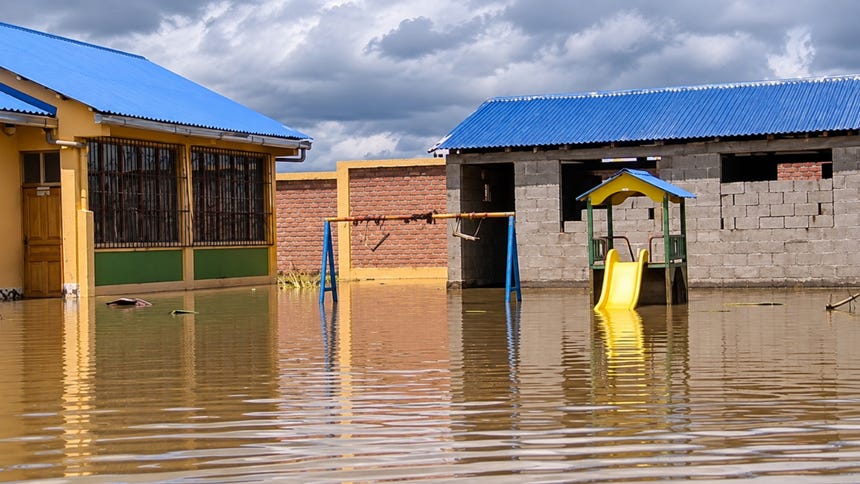
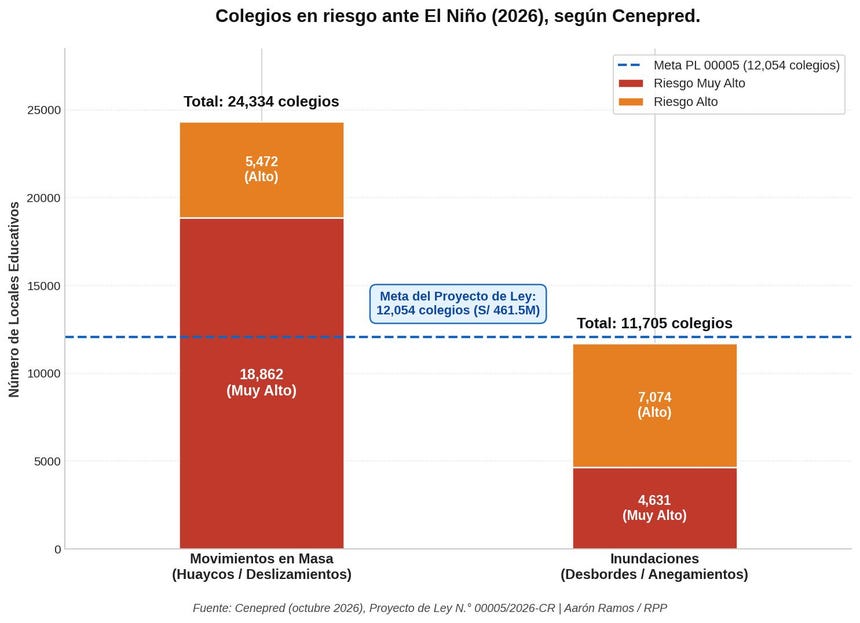
As the shadow of the 2026-2027 El Niño (FEN) phenomenon looms over Peru, the government has launched an urgent, multi-faceted fiscal strategy to safeguard the nation’s most vulnerable infrastructure. At the heart of this initiative is a massive allocation of resources aimed at protecting the backbone of the country’s future: its schools. A comprehensive review by RPP has uncovered that over 23,000 educational facilities across the country are currently situated in high-risk zones, susceptible to catastrophic landslides, mudflows (huaicos), and severe flooding.
In response, the executive branch, led by President Keiko Fujimori, has submitted a supplementary credit project to Congress requesting S/8.2 billion in funding. Within this legislative proposal, S/461.5 million is specifically earmarked for the preventive and corrective maintenance of more than 12,000 schools, a critical move to mitigate the damage expected from the intensifying climatic events.
The Geography of Risk: A National Emergency
The data provided by the National Center for Estimation, Prevention, and Disaster Risk Reduction (Cenepred) paints a grim picture for the upcoming school years. Between October and December 2026, climate modeling indicates that a significant portion of Peru’s geography will face extreme weather conditions.
Mapping the Danger Zones
Cenepred’s analysis identifies two primary threats: movements in mass (landslides and rockfalls) and catastrophic flooding.
- Movements in Mass: These events, exacerbated by the steep terrain of the Andean regions, pose a threat to over 18,000 schools. The agency has identified 702 districts across 22 departments as being at "very high risk."
- Flooding: Low-lying areas and floodplains, particularly in coastal and northern regions, threaten approximately 4,600 schools. This risk spans 112 districts across 20 departments.
Regional Breakdown of Exposure
The vulnerability of educational infrastructure is not uniform across the nation; it is deeply tied to regional topography and climate patterns.
- In the Andes and High Jungle: The risk of landslides is paramount. Cajamarca stands out as the most exposed region, with over 6,000 schools located in high-risk zones. It is followed by the Cusco region with 3,413 schools and Puno with 2,835.
- The Coastal Front: For flooding, the northern region of Piura bears the heaviest burden, with 2,111 schools located in hazardous terrain. Lambayeque and Ucayali are also identified as major areas of concern, where infrastructure is frequently compromised by overflow from swollen rivers and flash floods.
Chronology of the Crisis: From Warning to Action
To understand the current urgency, one must look at the timeline of the climate forecasting and the subsequent governmental response.
- Early 2026: Scientific bodies, including ENFEN (The Multisectoral Commission in charge of the National Study of the El Niño Phenomenon), began releasing projections suggesting an 88% probability of an extraordinary El Niño event.
- Mid-2026: As the probability solidified, the Ministry of Education (MINEDU) began coordinating with Cenepred to cross-reference school location data with risk maps. The revelation that over 23,000 schools were "at risk" sent shockwaves through the cabinet.
- October 2026: The government finalized its supplementary credit proposal. This move was not just a reaction to the climate, but part of a broader, comprehensive fiscal package designed to stabilize national infrastructure and social programs.
- Present Day: The proposal is currently under legislative review, with the Ministry of Economy and Finance (MEF) pushing for rapid approval to ensure that funds reach schools before the peak of the rainy season.
The Mechanics of Protection: Direct Subsidies
A critical element of the government’s plan is the distribution of funds. Rather than relying on a complex, centralized bureaucratic chain that could delay implementation, the administration has opted for a decentralized model.
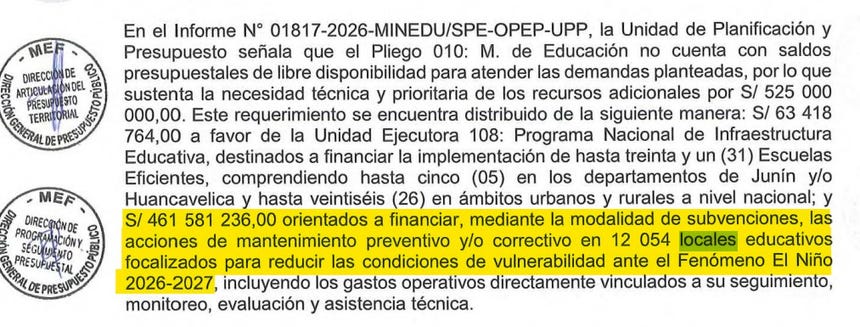
The S/461 million will be transferred directly to the educational institutions through the "Subvention Model." Under this system, funds will be deposited into the Banco de la Nación in accounts specifically designated for the school’s management. School directors and their respective administrative committees will be held accountable for the direct execution of these maintenance tasks.
This approach aims to ensure that "on-the-ground" repairs—such as clearing drainage channels, reinforcing roofs, waterproofing walls, and fortifying perimeter fencing—can begin immediately. By empowering local school leadership, the government hopes to cut through red tape and foster community involvement in the protection of local assets.
Beyond Schools: The Broader Scope of the Supplementary Credit
While the S/461 million for school maintenance is a highlight, it is only a small fraction of the total S/8.22 billion supplementary credit request. The government’s proposal reflects a wide array of fiscal priorities aimed at stabilizing the country amid economic and security challenges.
Defense and Security Spending
A significant portion of the budget is allocated to the nation’s security apparatus. The government has requested:
- S/847 million for the Police Pension Fund.
- S/499 million for the Military Pension Fund.
- S/1.2 billion for the "Fighter Jet Phase II" project, an investment aimed at modernizing the fleet of the Peruvian Air Force.
Social Programs and Economic Stimulus
The proposal also touches on social welfare and economic recovery, acknowledging the post-pandemic strains and the rising cost of living:
- Pension 65: An extraordinary subsidy of S/350 will be granted to beneficiaries, requiring an investment of S/288.5 million.
- MYPErú Program: S/501.9 million is set aside for the purchase of school kits—including uniforms, shoes, and stationery—produced by local micro and small enterprises. This serves a dual purpose: supporting public education and stimulating local manufacturing.
- Infrastructure for the Future: S/237 million has been earmarked for the logistical preparations of the 2027 Pan American and Parapan American Games in Lima.
- Economic Debts: The plan also includes S/250 million to settle accumulated debts with fuel importers and producers, ensuring that energy supply chains remain operational during the upcoming climate crisis.
Official Stance and Implications
Government officials have defended the size of the supplementary credit as a necessary intervention. During initial hearings, representatives from the Ministry of Economy argued that delaying these investments would lead to far higher costs in the future. "If we do not reinforce these schools now, the cost of reconstruction after an El Niño event will be three to four times the current cost of maintenance," a ministry spokesperson noted.
However, the proposal is not without its critics. Some members of the opposition have questioned the prioritization of military spending, such as the fighter jets, while others argue that the maintenance budget, though helpful, is insufficient given the sheer volume of schools—23,000—that are at risk. With only 12,000 schools covered by the current maintenance plan, nearly half of the schools in high-risk zones may remain exposed.
Implications for the Educational System
The implications of this initiative are long-term. Beyond just "preventing damage," the government’s move is an attempt to address the chronic infrastructure deficit that has plagued Peru’s public education system for decades. By focusing on maintenance, they hope to avoid the total collapse of classrooms, which would result in the loss of millions of teaching hours and exacerbate the educational gap that already exists between urban and rural, affluent and impoverished, districts.
Conclusion: A Race Against the Clock
As the 2026-2027 El Niño cycle approaches, the Peruvian government finds itself in a race against the elements. The data provided by Cenepred is a clear warning: the status quo is no longer sustainable.
The success of the proposed S/461 million maintenance program will depend on two critical factors: the speed of Congressional approval and the efficiency of the school-level management teams tasked with executing the repairs. If the funds are deployed effectively, the country may avoid a humanitarian and educational catastrophe. If, however, the process is bogged down by political friction or administrative failure, thousands of students across the Andean and coastal regions face a precarious future, with their classrooms literally in the path of the coming storm.
For now, the nation watches, waiting to see if these billions in investment will translate into resilient infrastructure or if the coming weather will reveal the limits of the state’s capacity to protect its most vulnerable citizens.