Introduction: A Paradigm Shift at EXCON 2026
The construction industry in Peru, long perceived as a bastion of traditional masculinity, is undergoing a profound structural evolution. As the industry gathers for EXCON 2026, the focus has shifted beyond architectural innovation and material technology toward a more human-centric challenge: the professional integration of women.
Under the auspices of the Committee for Labor Formalization in the Construction Sector—a collaborative effort between the Peruvian Chamber of Construction (CAPECO) and the Federation of Civil Construction Workers (FTCCP), with support from CONAFOVICER—the upcoming forum "Building Equality: Participation, Employability, and Development of Women in the Construction Sector" marks a watershed moment. This high-level dialogue, scheduled for October 15 at the Jockey Exhibition Center, seeks to dismantle the systemic barriers that have historically kept women on the periphery of one of the nation’s most vital economic engines.
The Current Landscape: Data and Reality
Despite the symbolic progress seen in recent years, the statistical reality remains stark. According to data provided by the National Institute of Statistics and Informatics (INEI) for the second quarter of 2025, the construction sector accounted for a mere 0.8% of the total female workforce in Peru. This figure serves as a sobering indicator of the work ahead.
While women are increasingly represented across various sectors of the Peruvian economy, construction remains an outlier. This is not necessarily due to a lack of interest, but rather a combination of ingrained cultural norms, lack of awareness regarding opportunities, and an industry structure that has not historically prioritized gender-inclusive infrastructure or recruitment pipelines.
Supporting Data: A Growing Talent Pool
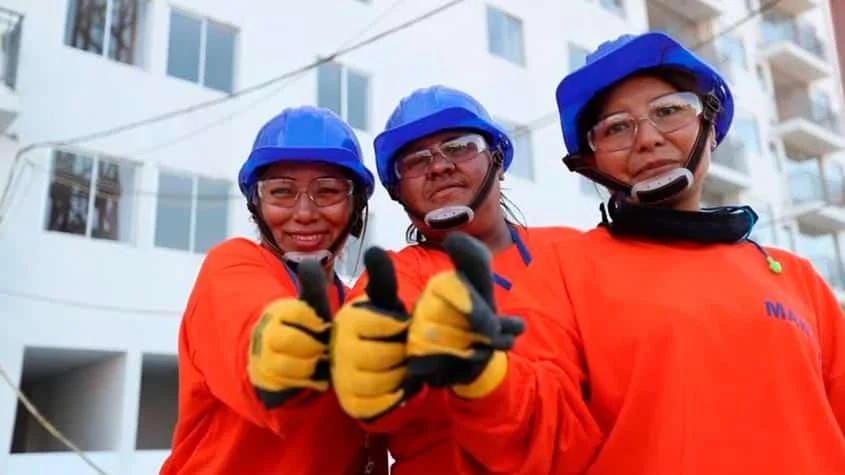
However, the narrative is not entirely one of exclusion. Data from the 2024–2026 period reveals an encouraging trend in skill acquisition. Nearly 600 women have successfully completed professional certifications in technical construction trades, including masonry, heavy machinery operation (specifically dump trucks), ironwork, industrial painting, and formwork.
Furthermore, CONAFOVICER’s role in workforce development has been pivotal. Between 2017 and 2026, the institution trained over 10,000 workers; notably, 22.1% of these participants were women. These figures challenge the conventional wisdom that women are uninterested in manual or technical labor in the field. Instead, they demonstrate that when training is accessible, women are eager to acquire the specialized skills necessary to thrive in high-stakes construction environments.
Chronology of Change: From Training to Opportunity
The journey toward a more inclusive sector did not happen overnight. The following timeline illustrates the maturation of the movement:

- 2017–2023: Foundational Training: CONAFOVICER begins systematic efforts to include women in technical workshops, establishing the initial base of female operators and tradespeople.
- 2024: Scaling Certification: The formalization of competency-based certifications for women begins to pick up speed, providing formal recognition of skills for nearly 600 women in specialized areas.
- 2025: Statistical Assessment: INEI data highlights the 0.8% participation rate, serving as the "call to action" for industry leaders to address the persistent recruitment gap.
- October 15, 2026: The EXCON Forum: The industry convenes to formalize a national strategy through the "Pact for the Participation of Women in Construction," aimed at converting training successes into long-term, high-quality employment.
Official Perspectives and Strategic Leadership
The success of this initiative hinges on the collaboration between the public sector, unions, and private enterprise. The EXCON 2026 forum will feature a panel of high-profile leaders whose influence is expected to shape national policy and corporate practice.
Confirmed speakers include the Minister of Women and Vulnerable Populations, María Seminario Maron, and the Minister of Labor and Employment Promotion, Juan Sheput Moore. Their presence underscores the government’s commitment to viewing gender inclusion in construction as a matter of economic development rather than just social policy.
Joining them are figures such as Deputy Indira Huilca and former Deputy Ministers of Construction and Transport, including Fiorella Molinelli and Elsa Carrera. This assembly of experts represents a cross-section of political and technical experience, essential for crafting legislation and corporate guidelines that address the specific challenges of the construction environment—such as workplace safety, discriminatory hiring practices, and the need for mentorship programs.
Implications: The "Pact for the Participation of Women"
The most significant outcome expected from EXCON 2026 is the formal signing of the "Pact for the Participation of Women in Construction." This agreement is not merely a symbolic gesture; it is intended to serve as a roadmap for stakeholders.
1. Breaking the Employment Barrier
The primary goal of the pact is to bridge the gap between certification and hiring. Companies signing the pact will be encouraged to adopt "inclusive hiring" quotas or initiatives, ensuring that the 600-plus women recently certified have a direct pathway into active project sites.
2. Ensuring Safety and Sustainability
A critical component of the dialogue involves workplace culture. The construction site can be a challenging environment. The forum will address the implementation of zero-tolerance policies regarding harassment and discrimination, as well as the need for appropriate site facilities, which are essential for retaining female talent.
3. Professional Mobility
Beyond entry-level positions, the strategy aims to move women into leadership, engineering, and managerial roles. By supporting professional development and long-term career paths, the industry hopes to foster a generation of female project managers and technical directors.

The Economic Necessity of Inclusion
It is important to emphasize that this push for gender equality is not just a social imperative—it is an economic one. The Peruvian construction sector faces a recurring shortage of skilled labor. By ignoring half of the population, the industry has effectively been operating with a self-imposed talent cap.
Integrating women into the workforce expands the available talent pool, improves workplace diversity (which is proven to increase productivity and innovation), and aligns the Peruvian construction industry with international ESG (Environmental, Social, and Governance) standards. As global investors place greater weight on social equity, firms that demonstrate a commitment to inclusivity will likely see benefits in their ability to secure capital and talent.
Conclusion: A New Foundation
The EXCON 2026 forum serves as the definitive signal that the era of the "all-male" construction site is coming to an end. By aligning the efforts of the Ministry of Labor, private construction giants, and labor unions, the sector is laying a new foundation—one built on the principle that competence knows no gender.
As the industry prepares for the October 15 event, the message is clear: the integration of women is not an act of charity, but a necessary evolution for a competitive, modern, and robust construction industry. If the commitments made at EXCON 2026 are upheld, the next decade of Peruvian construction will be defined not just by the height of its buildings, but by the diversity and equality of the hands that build them.
For those interested in participating in the ongoing dialogue, the Committee for Labor Formalization encourages industry professionals to join the official bulletin and WhatsApp channels managed by Peru Construye to stay updated on the developments emerging from the October 15 summit.