A groundbreaking study conducted by the Lima Chamber of Commerce (CCL), in collaboration with the European Union, has shattered the long-standing myth that Peru’s youth unemployment crisis is solely a result of a "lack of willingness" or insufficient experience. Instead, the data reveals a far more complex, structural reality: for the majority of young Peruvians, the primary obstacle to entering the formal labor market is not found in the office, but within the walls of their own homes.
The research, which meticulously examined the labor landscape for individuals aged 18 to 29 across eight diverse regions of Peru, paints a sobering picture of how domestic caregiving duties effectively function as a "glass ceiling" for the next generation of workers.
The Core Findings: A Crisis of Caregiving
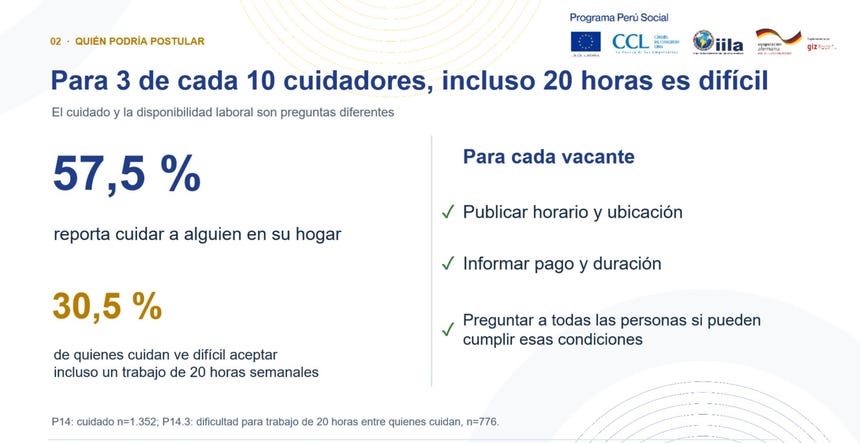
The study’s most striking statistic is that 57.5% of young people in Peru are currently engaged in caregiving responsibilities for family members. This demographic reality creates an immediate, rigid constraint on their availability. For these individuals, the prospect of committing to even a part-time position—defined as a 20-hour work week—becomes a logistical impossibility. Among those tasked with caregiving, 31% reported that they simply could not accept a part-time job, let alone a full-time career path, due to the inflexible demands of their domestic duties.
Arístides Vara-Horna, the lead investigator behind the study, emphasizes that these are not merely lifestyle choices but systemic barriers. "The necessity of attending to other people is a powerful barrier that affects nearly 60% of our youth," Vara-Horna stated. "When we analyze the regional data, we see that these barriers are most intensive in areas like La Libertad, Arequipa, and Moquegua, where between 32% and 40% of young people are essentially locked out of the workforce by imposed caregiving obligations."
Chronology of a Structural Failure
To understand how this situation evolved into a national crisis, one must look at the intersection of economic stagnation and traditional social roles:
- Pre-Pandemic Baseline: Before 2020, youth unemployment was already a concern, but it was largely blamed on "skills gaps" or "educational misalignment."
- The 2023-2024 Labor Exodus: Economic instability saw approximately 215,000 young people abandon the labor market entirely within a single year. During this period, the informal sector absorbed 84% of those who remained employed, highlighting the lack of quality jobs.
- 2025 Study Initiation: Recognizing that previous policy interventions were failing, the Lima Chamber of Commerce and the European Union commissioned this study to pivot away from traditional metrics and look at the "hidden" reasons for labor exclusion.
- Current Findings (2026): The data confirmed that domestic care is the single largest non-economic factor keeping youth—particularly women—out of the formal economy.
Gender Disparities and the "Double Burden"
Perhaps the most alarming takeaway from the research is the gendered nature of this barrier. While the challenge of caregiving is widespread, it falls disproportionately on the shoulders of young women.

"By reason of gender, women are the ones facing the greatest difficulties in finding employment," explains Vara-Horna. "Regardless of their desire to work, their motivation, or their level of formal education, these structural restrictions act as a permanent tether. We are witnessing a waste of human capital on a massive scale, where qualified young women are forced to choose between the survival of their families and their own economic independence."
This "double burden"—the pressure to be both the primary caregiver and a potential income generator—creates a cycle of poverty that is difficult to break without state-sponsored support systems, such as universal childcare or flexible workplace legislation.
The "15-Day Ready" Paradox: Connecting Talent to Opportunity
Perhaps the most significant revelation from the study is the debunking of the "laziness" narrative. When examining the cohort of young people who are currently neither working nor studying (the "NEET" population), the research found that 7 out of 10 would be ready to start a job within 15 days if the right opportunity presented itself.
This suggests that the labor market is not suffering from a lack of willing hands, but from a total failure of connectivity.
The Disconnect:
- The Resume Gatekeeping: Companies continue to rely on traditional CVs, formal networks, and university degrees.
- The Informal Experience Gap: Because most young people have gained their work experience in the informal sector, they often lack the "certificates" or the corporate social networks required to pass the initial screening processes of formal companies.
- The Matching Failure: While companies complain of a "skills shortage," the study shows that there is actually a "matching shortage." The talent exists, but the bridges to reach that talent—such as recognizing informal work experience or offering flexible, remote, or part-time roles—remain largely unbuilt.
Implications for Public Policy and Private Industry
The findings from the CCL and EU study carry profound implications for how Peru must restructure its labor policy moving forward.
1. Reimagining the Workplace
For the private sector, the message is clear: if businesses want to tap into a motivated and ready-to-work youth population, they must evolve. Rigid 9-to-5 models are excluding the most reliable, motivated workers who simply cannot afford to leave their vulnerable family members unattended. Flexible hours, hybrid work, and job-sharing programs are no longer "perks"—they are economic imperatives for inclusion.
2. State-Led Social Infrastructure
The government must address the "care economy." Without public investment in affordable, accessible childcare and eldercare services, the burden of care will continue to fall on the shoulders of young women. This is a public health and an economic development issue. Policies that incentivize the formalization of caregiving or provide subsidies for working caregivers could significantly increase the labor force participation rate.
3. Rethinking "Experience"
Educational institutions and recruitment agencies must find ways to validate informal work. A young person who has spent three years managing a family business or navigating the informal economy possesses skills—resilience, negotiation, time management—that are highly transferable. Companies that continue to filter applicants based solely on formal degrees are actively choosing to ignore a vast pool of capable, hard-working talent.
Conclusion: A Call to Action
The study by the Lima Chamber of Commerce and the European Union serves as a wake-up call. The narrative that young Peruvians are disengaged or unwilling to work is demonstrably false. The reality is that they are trapped by structural constraints—caregiving responsibilities, gender inequality, and an outdated recruitment system that fails to recognize the value of their experience.
To unlock the potential of the next generation, Peru must look beyond the boardroom. It must address the household. By acknowledging that labor participation is inextricably linked to social support, the country can move toward a more inclusive, productive, and equitable future. The talent is there; the barriers to that talent are, at long last, clearly defined. It is now up to policymakers and corporate leaders to remove them.