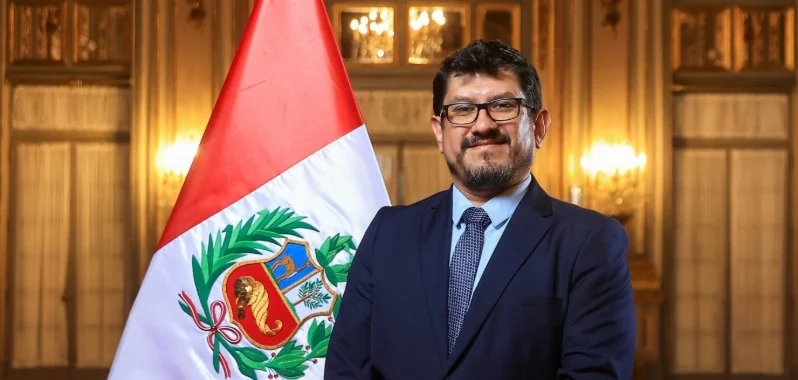
In a move signaling a pivotal adjustment in the current administration’s infrastructure policy, President Keiko Fujimori has appointed economist José Angello Tangherlini Casal to lead the Ministry of Transport and Communications (MTC). This transition marks the first significant modification to the cabinet since the administration took office.
The Transition: A Change at the Helm of the MTC
In a formal ceremony held at the Palacio de Gobierno, President Keiko Fujimori presided over the swearing-in of José Angello Tangherlini Casal as the new Minister of Transport and Communications. The appointment comes in the wake of the resignation of Rafael Rey, who had served as the MTC chief since the administration’s inauguration on July 28.
The departure of Rafael Rey after less than two months in office has drawn significant attention from political analysts and stakeholders within the infrastructure sector. During the transfer ceremony, the outgoing minister was present to officially pass the baton, marking a brief but high-impact tenure that concluded with his farewell to the ministerial cabinet.
Profile of the New Minister: A Technical Background
José Angello Tangherlini Casal enters the Ministry of Transport and Communications with a robust background in economic management and institutional oversight. An economist by training from the Universidad Nacional Mayor de San Marcos, Tangherlini brings over two decades of professional experience to the table. His career has been defined by high-level managerial roles in both the public and private sectors, with a particular focus on the development and regulation of critical national infrastructure.
Before ascending to the ministerial position, Tangherlini served as the Viceminister for the Development of Family Agriculture and Agrarian Infrastructure and Irrigation. This role provided him with essential experience in navigating the complexities of large-scale infrastructure projects and inter-ministerial coordination—a skill set that will be directly applicable to the challenges facing the MTC.
Furthermore, his resume includes pivotal roles in key regulatory bodies:
- Ositrán (Organismo Supervisor de la Inversión en Infraestructura de Transporte de Uso Público): Where he gained insight into the oversight of national transport networks.
- Osiptel (Organismo Supervisor de Inversión Privada en Telecomunicaciones): Providing him with a firm grasp of the communications sector, a vital component of the MTC’s portfolio.
- Agroideas (Programa de Compensaciones para la Competitividad): Demonstrating his experience in economic competitiveness and program management.
Chronology of a Short-Lived Tenure
The rapid succession from Rafael Rey to Tangherlini highlights the administration’s proactive stance on governance.

- July 28: The administration takes office, with Rafael Rey appointed as the Minister of Transport and Communications.
- Late September: Internal reports suggest a shift in the government’s approach toward key infrastructure projects, leading to the decision to transition leadership at the MTC.
- Current Date: Formal resignation of Rafael Rey and the immediate swearing-in of José Angello Tangherlini Casal by President Keiko Fujimori.
This rapid transition reflects a move to minimize institutional downtime. The Ministry of Transport and Communications is arguably the most critical engine of economic development in Peru, responsible for connectivity, regional integration, and the regulation of the telecommunications landscape.
Supporting Data: The MTC’s Mandate and Challenges
The MTC manages one of the largest budgets within the Peruvian state. The incoming minister faces a portfolio that includes the expansion of the national highway network, the modernization of regional airports, and the digitalization of rural telecommunications.
Infrastructure Priorities
With his experience at Ositrán, Minister Tangherlini is expected to accelerate the execution of public-private partnerships (PPPs) that have historically faced bureaucratic bottlenecks. His background suggests a focus on:
- Efficiency in Project Delivery: Reducing the gap between project planning and the commencement of construction.
- Regulatory Harmony: Leveraging his knowledge of Ositrán and Osiptel to bridge the gap between regulatory requirements and operational feasibility.
- Rural Connectivity: Drawing on his work in the agricultural sector, he is uniquely positioned to prioritize the extension of communication networks to underserved regions.
Economic Impact
Economists have noted that the transport sector accounts for a significant percentage of national GDP growth. By appointing a career technician rather than a purely political figure, the administration appears to be prioritizing stability and technical competence to ensure that national development goals remain on track.
Official Responses and Political Implications
The appointment has been met with a mix of cautious optimism and intense scrutiny. Political observers note that this is the first "adjustment" of the cabinet, and it sends a clear signal that President Fujimori intends to demand high performance from her ministers.
"The President is not afraid to recalibrate her team to meet the goals set for this administration," noted a government spokesperson. "Mr. Tangherlini’s appointment is a strategic choice meant to ensure that our infrastructure agenda is executed with precision and technical rigor."
Opposition leaders, however, have questioned the brevity of Rafael Rey’s tenure, suggesting that it may indicate underlying disagreements regarding the prioritization of projects or the speed of reforms within the ministry. Nonetheless, the professional reputation of Tangherlini Casal has mitigated much of the initial criticism, as he is widely regarded as a technocrat capable of handling complex administrative hurdles.

Implications for Future Governance
The appointment of Tangherlini Casal sets a new precedent for the Fujimori administration: a shift toward "technocratic pragmatism."
1. Strengthening Institutional Trust
By selecting a professional with deep roots in regulatory bodies like Osiptel and Ositrán, the government is signaling to international investors that it values expertise and regulatory stability. This is crucial for maintaining confidence in the Peruvian market, especially in the infrastructure sector.
2. Accelerating Decentralization
Given the new minister’s experience in regional agricultural infrastructure, it is highly probable that the MTC will place a renewed emphasis on "last-mile" infrastructure projects. This will be critical for regional governments seeking to connect their local markets to the broader national and international supply chains.
3. A Focus on Digital Transformation
The Ministry of Transport and Communications is also the governing body for telecommunications. Tangherlini’s past roles suggest that the government will likely push for faster implementation of 5G infrastructure and expanded internet access in the provinces—an essential move for economic democratization.
Conclusion
As José Angello Tangherlini Casal steps into his office, he faces the dual challenge of maintaining continuity while implementing the necessary corrections to accelerate project delivery. His mandate is clear: improve the efficiency of the MTC, resolve the bottlenecks that have hindered infrastructure development, and ensure that the government’s transport and communications policies reach the most vulnerable sectors of the population.
For President Keiko Fujimori, this cabinet change is not merely a personnel decision; it is a tactical pivot toward a more results-oriented governance model. As the country looks toward the remainder of the fiscal year, all eyes will be on the MTC to see if this new leadership can translate its technical expertise into tangible, nation-wide progress. The transition marks the start of a critical chapter for the administration, one where the focus on infrastructure may well define the legacy of this government.