Byline: ProActivo Editorial Desk
Date: August 2026
Southern Copper Corporation (SCC), a subsidiary of the global mining conglomerate Grupo México, has announced an unprecedented financial performance for the second quarter (Q2) of 2026. Despite facing operational headwinds in its Peruvian production facilities, the company has leveraged a robust global commodities market to reach historic highs in sales, net income, and EBITDA. This performance reinforces the company’s position as a cornerstone of the global copper industry and highlights its unwavering commitment to its multi-billion dollar investment pipeline in Peru.
Financial Performance: A Record-Breaking Quarter
The Q2 2026 financial report paints a picture of a company capitalizing on favorable price cycles for its primary metal portfolio. According to the company’s official filing, Southern Copper saw its net sales soar to US$ 4.289 billion between April and June 2026, representing a substantial 40.6% increase compared to the same period in 2025.
This revenue surge translated directly into bottom-line growth. The company reported a net income of US$ 1.670 billion, a staggering 71.6% rise year-over-year. Furthermore, the adjusted EBITDA—a key indicator of operational profitability—climbed to an all-time high of US$ 2.856 billion, marking a 59.5% improvement.
The primary driver of these results was the international price environment. The global surge in the value of copper, molybdenum, zinc, and silver provided a powerful tailwind that more than offset the challenges encountered in the extraction and processing phases.
Operational Challenges: A Look at Production Trends
While financial metrics reached peak levels, the company’s operational output faced moderate contraction. Southern Copper reported a total copper production of 230,662 tonnes, a 3.5% decrease compared to the previous year.
A closer examination of the data reveals that the company’s Peruvian assets, namely the Toquepala and Cuajone mines, were the primary contributors to this decline. These operations experienced a 12% drop in quarterly production, largely attributed to lower mineral grades found in the ore bodies currently being extracted.
In addition to copper, the company faced a reduction in the production volumes of other critical by-products:
- Silver: Production volumes were lower in both Toquepala and Cuajone.
- Molybdenum: A systemic decline was observed across all mining units, leading to a overall drop in output.
These results underscore the cyclical nature of mining, where geological variability and mineral grade fluctuations often require operational adjustments that can temporarily impact production volume even when market prices remain favorable.
Chronology and Strategic Development: The Tía María Project
Despite the temporary production dip, Southern Copper’s long-term strategy remains firmly focused on aggressive expansion within the Peruvian territory. The company has reaffirmed its intention to invest over US$ 10.3 billion in projects across Peru over the next decade.
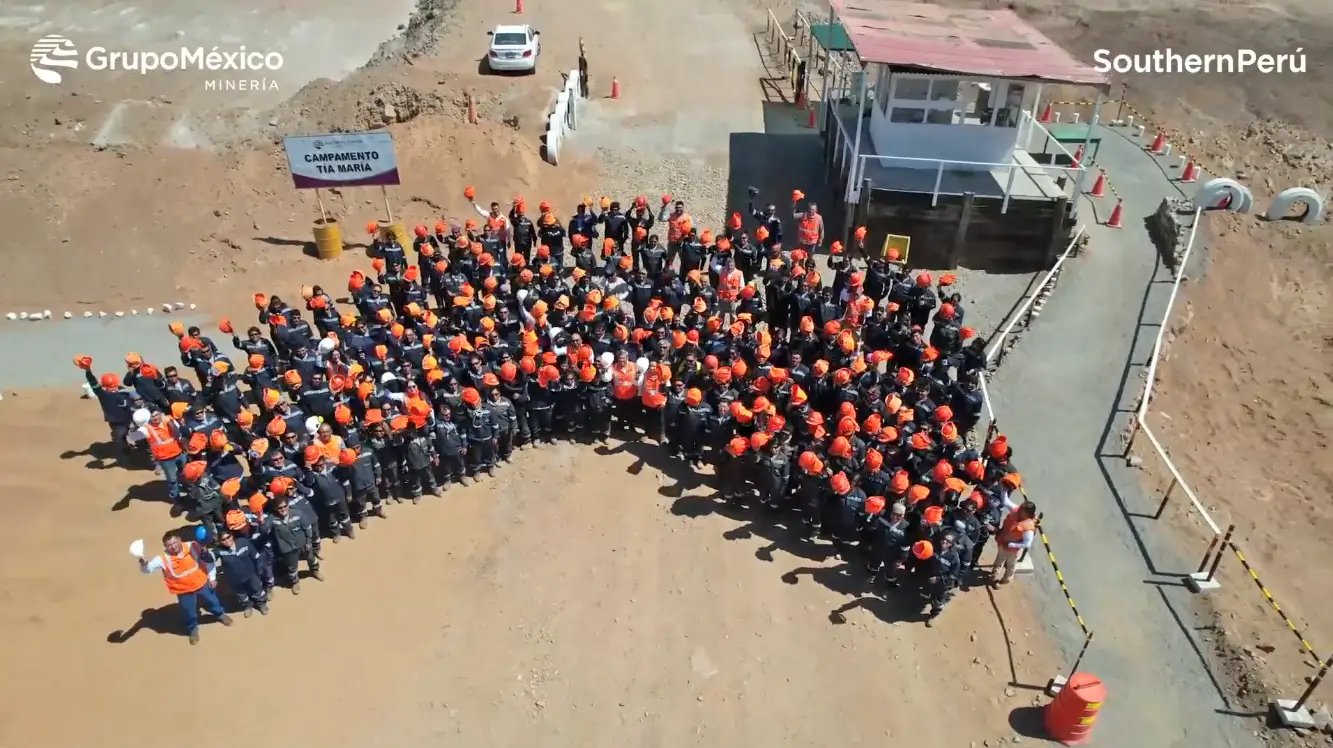
The jewel in the crown of this investment plan is the Tía María project in the Arequipa region. The project represents a critical pillar for the company’s future growth and has seen significant, tangible progress throughout the first half of 2026.
The Timeline of Progress (As of June 2026):
- Capital Commitment: To date, Southern Copper has committed US$ 1.101 billion to the project.
- Execution: Of the committed capital, US$ 693 million has already been deployed.
- Earthworks: Movement of earth at the "La Tapada" deposit has reached a 71% completion rate.
- Procurement: A vast majority of purchase orders for major equipment have been placed and processed.
- Infrastructure: Construction is actively underway for electrical substations and a 220 kV transmission line.
- Overall Completion: The project stands at a 42% total completion rate.
- Employment: Tía María has become a significant economic engine for the region, currently supporting 5,817 jobs, with 1,254 of these roles filled by local community members.
The company maintains its ambitious target to initiate production during the second half of 2027. Once fully operational, Tía María is expected to produce 120,000 tonnes of copper cathodes annually, utilizing advanced solvent extraction and electrowinning (SX-EW) technology.
Financial Strategy: Securing the Future
To ensure the continuity of its investment program, Southern Copper has demonstrated astute capital management. In June 2026, the company successfully issued bonds totaling US$ 1.25 billion. These instruments carry a ten-year maturity with an annual interest rate of 5.35%.
These funds have been earmarked specifically for Southern Peru Copper Corporation to advance the Tía María project, support the broader investment portfolio, and address other corporate initiatives within the country. This issuance signals strong investor confidence in both the project’s viability and the company’s ability to navigate the complex social and political landscape of Peru.
Official Responses and Political Outlook
The intersection of mining and politics remains a focal point for Southern Copper’s leadership. The company has expressed optimism regarding the political transition in Peru, particularly in light of recent statements from the incoming administration.
Germán Larrea, Chairman of the Board of Southern Copper, addressed the current climate, stating: "As Peru nears another executive power transition, we are encouraged by the initial declarations made by President-elect Keiko Fujimori. Consequently, SCC reiterates its commitment to working with the incoming administration to promote economic growth and social development in Peru through the advancement of our projects, which represent a combined investment of approximately US$ 10.3 billion."
The company emphasizes that its ongoing success and future growth are underpinned by three key pillars:
- Community Support: Building social license through local engagement.
- Rule of Law: Adherence to regulatory frameworks and legal certainty.
- Institutional Cooperation: Constant coordination with government authorities to ensure the timely issuance of necessary permits.
Implications: The Road Ahead for the Peruvian Mining Sector
The record-breaking performance of Southern Copper serves as a bellwether for the Peruvian mining sector. While the global demand for copper—driven by the energy transition and the rise of electric vehicles—positions Peru as a vital global player, the industry faces the dual challenge of declining ore grades and the necessity of building long-term social contracts with local populations.
Economic Impact
The investment of US$ 10.3 billion, if realized, will have a profound effect on the Peruvian economy. Beyond the direct tax revenue, the multiplier effect on local supply chains, infrastructure development, and professional training is immense. The success of Tía María will likely be viewed as a litmus test for the viability of future large-scale mining projects in the region.
The Technological Edge
The use of SX-EW technology at Tía María highlights the industry’s shift toward more efficient and environmentally conscious extraction methods. By producing cathodes on-site, the company reduces the logistical footprint and adds value to the product before it leaves the country.
Social and Regulatory Stability
The company’s focus on local hiring and community-oriented infrastructure (such as electricity and water initiatives) is designed to mitigate the historical tensions that have historically hampered projects in the Arequipa region. The transition to the new administration will be a critical period where the company’s ability to align its corporate goals with national developmental priorities will be tested.
In conclusion, Southern Copper Corporation’s Q2 2026 results demonstrate a resilient and highly profitable operation that is successfully navigating a complex global market. By balancing the realities of lower production grades with massive capital investment and a forward-looking strategy for the Tía María project, the company is positioning itself to remain a dominant force in the Peruvian mining landscape for the next decade. The coming months will be pivotal as the project moves toward its 2027 production target, marking a potential turning point for both the company and the regional economy.