Main Facts: A Targeted Disturbance
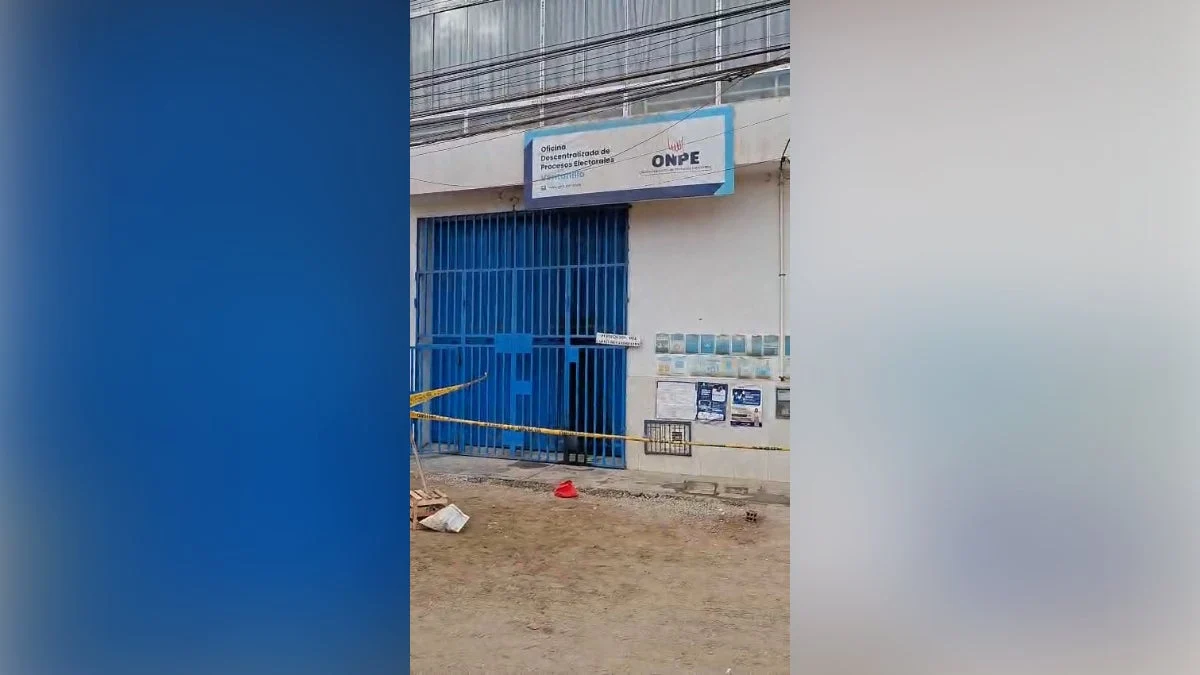
In an alarming incident that has raised concerns regarding the security of electoral infrastructure, an unknown group targeted the Decentralized Office of Electoral Processes (ODPE) in Pachacútec, Ventanilla, Callao. The facility, situated on Avenida Constructores, became the site of a targeted act of vandalism when a makeshift incendiary device—identified by authorities as a bottle containing flammable liquid—was hurled against the building’s main entrance.
The attack, which occurred during a period of heightened vigilance for electoral bodies, resulted in a localized fire. While the flames caused minor damage to the facility’s entrance gate, the prompt intervention of on-site personnel prevented the incident from escalating into a full-scale catastrophe. Authorities have confirmed that there were no injuries or fatalities, and the structural integrity of the office remains intact.
Chronology of the Incident
The sequence of events unfolded rapidly, highlighting both the sudden nature of the attack and the efficient response of the local security apparatus.
The Initial Breach
According to preliminary reports provided by the Peruvian National Police (PNP), the incident took place under the cover of the environment surrounding the Pachacútec sector. Witnesses or security personnel detected a sudden flare-up at the frontispiece of the ODPE building after the projectile—a small bottle filled with an accelerant—made impact.
Immediate Containment
The primary fire suppression was conducted by the staff stationed inside the ODPE facility. Utilizing internal fire safety protocols and manual extinguishers, the personnel managed to neutralize the threat before it could spread to the internal administrative offices, which house sensitive electoral documentation and equipment.
The Response Effort
- Initial Alarm: Following the suppression of the flames, local Serenazgo (municipal security) units were alerted. They immediately established a perimeter to secure the scene and preserve potential forensic evidence.
- Forensic Deployment: The Unidad de Desactivación de Explosivos (UDEX)—the elite police unit tasked with handling hazardous materials and explosive devices—was dispatched to the scene. Their arrival signaled a high-priority investigation, as the incident was treated as a potential act of intimidation against state institutions.
- Surveillance Review: Throughout the immediate aftermath, Serenazgo teams conducted a sweeping search of the surrounding streets, looking for private and public CCTV footage that might have captured the perpetrators’ movements.
Supporting Data and Technical Assessment
The incident in Ventanilla is being analyzed not merely as a common crime, but as a potential "low-tech" act of sabotage. The use of a flammable liquid device—often referred to as a "Molotov cocktail"—suggests an intent to intimidate rather than cause mass destruction, as the device lacked the sophistication required for a major industrial explosion.
The Site Analysis
The ODPE Pachacútec facility serves as a critical node in the electoral process for the Callao region. Its location on Avenida Constructores makes it a highly visible government installation. The forensic team focused on several key technical aspects:
- Chemical Residue: UDEX personnel collected samples of the accelerant to determine if the substance used was common fuel (gasoline or kerosene) or a more volatile chemical compound.
- Projectile Analysis: The glass shards recovered from the scene are being analyzed for fingerprints or DNA evidence that could lead to the identification of the suspects.
- Security Gaps: The investigation is currently assessing why the facility’s exterior perimeter did not deter the perpetrators, leading to discussions about upgrading security cameras and increasing physical barriers at decentralized offices across the country.
Official Responses and Institutional Statements
As of this report, the National Office of Electoral Processes (ONPE) has remained in close contact with law enforcement. While a formal, detailed press release is pending, sources within the agency indicated that they are cooperating fully with the Ministry of the Interior to ensure the safety of all regional electoral offices.
Police Stance
The Callao police division has categorized the event as a "provocation." A spokesperson for the PNP stated that while no specific group has claimed responsibility, the methodology is consistent with individuals seeking to generate public alarm. "We are treating this with the utmost seriousness," the officer remarked. "Any attempt to destabilize the electoral process through intimidation will be met with the full force of the law."
Local Government and Security
The Mayor’s office in Ventanilla has issued a statement expressing solidarity with the staff of the ODPE. They have pledged to provide the municipal security camera footage to the police to assist in the identification of the suspects. The local government has also called for increased patrols around government buildings in the Pachacútec area to prevent a recurrence of such incidents.
Implications: A Broader Security Context
The attack on the ODPE office in Pachacútec is not an isolated event but rather a reflection of the challenges facing democratic institutions in high-density, rapidly growing urban areas.
Impact on Electoral Trust
The primary goal of such an attack is often the erosion of public trust. By targeting an electoral office, the perpetrators aim to create an atmosphere of instability. However, electoral analysts suggest that such incidents rarely impact the actual mechanics of an election, provided that the state responds with transparency and security. The resilience of the ODPE staff in this instance has served as a positive counter-narrative, showing that the institution is prepared to handle localized threats.
Security Upgrades
This incident will likely trigger a nationwide review of security protocols for all decentralized electoral offices. Experts in physical security recommend a three-tiered approach:
- Hardening Targets: Increasing the use of fire-resistant exterior materials and shatterproof glass for ground-level windows.
- Active Monitoring: Implementing real-time remote monitoring systems that alert central police stations the moment a perimeter is breached.
- Community Intelligence: Engaging with the local neighborhood watch groups in districts like Pachacútec, who often provide the first line of defense against criminal elements.
Political Climate
In the current political climate, where skepticism toward state institutions can run high, the incident has been used by various political commentators to advocate for greater police presence. However, there is a delicate balance to strike. Turning electoral offices into "fortresses" can sometimes be perceived as a sign of weakness or fear, potentially inviting more unwanted attention. The goal, according to security consultants, is to create "invisible security"—a robust presence that discourages threats without disrupting the accessibility of the democratic process.
Conclusion: The Path Forward
The investigation into the attack at the ODPE in Pachacútec continues. As the UDEX completes its forensic report and the police follow leads from surveillance footage, the focus remains on identifying the individuals responsible and understanding their motives.
For the residents of Ventanilla, the incident serves as a stark reminder of the importance of vigilance. For the state, it serves as a wake-up call to bolster the security of those institutions that form the backbone of the electoral system. While the damage caused was minimal, the implications for security policy are significant. The resilience shown by the facility’s staff is a testament to their commitment to their duties, ensuring that despite the threat of violence, the administrative work of the electoral process continues unabated.
As the authorities continue their work, the public is encouraged to report any suspicious activity in the vicinity of public buildings. In a democratic society, the security of the electoral process is a shared responsibility, and the swift resolution of this case will be a critical test for the local justice system in the Callao region.