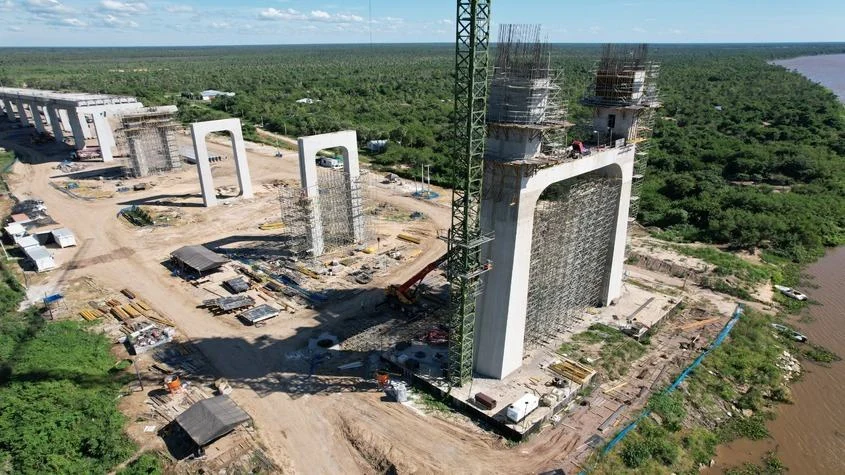
In a pivotal development for Paraguay’s logistics and transportation landscape, the Ministry of Public Works and Communications (MOPC) has announced that the critical grade-separated junction at Pedrozo, located on the strategic Route PY02, has surpassed 94% completion. This landmark project, designed to address chronic traffic bottlenecks and safety concerns in one of the country’s most transit-heavy corridors, is officially slated for inauguration by the end of 2026.
As Paraguay continues to position itself as a key logistics hub in the Southern Cone, the Pedrozo project represents more than just a bridge; it is a fundamental pillar of the nation’s commitment to modernizing its road network. By eliminating surface-level intersections, the government aims to drastically reduce the high accident rates that have historically plagued this segment of the route, while simultaneously facilitating the seamless flow of heavy cargo and civilian transit.
The Genesis and Chronology of the Project
The journey toward the realization of the Pedrozo grade separation was neither quick nor simple. The project was the result of a rigorous evaluation process that scrutinized nine distinct engineering alternatives before settling on the current design. This selection process prioritized not only structural efficiency but also social integration and environmental sustainability.
Key Chronological Milestones:
- December 2024: The formalization of the project agreement marked the official start of the institutional commitment, setting the legal and regulatory framework for the construction.
- Early 2025 – Q1 2026: This period was dedicated to the painstaking work of detailed engineering, hydraulic studies, and the finalization of the financial closure, ensuring that the project would be adequately funded throughout its lifecycle.
- April 2026: The MOPC issued the formal order to commence construction. Since this date, the site has been a hive of activity, characterized by intensive, 24-hour construction shifts.
- August 2026: Recent updates confirm the project has reached 94% completion, with final paving and safety signal installation underway.
- End of 2026 (Target): The scheduled completion and full opening of the junction to public traffic.
Engineering Challenges and Land Acquisition
One of the most significant hurdles in executing a project of this magnitude in a populated corridor was the acquisition of land. The MOPC confirmed that the completion of the project required the expropriation of 220 separate properties. The successful and peaceful resolution of these land negotiations was a critical success factor; the Ministry reports that all necessary parcels have now been secured and cleared, allowing construction teams to work across all sectors without logistical interference.

To meet the ambitious year-end deadline, the construction consortium adopted an aggressive labor schedule. By implementing 24-hour, multi-shift operations, the contractors have maintained momentum despite the geographical and technical complexities of the terrain. The design itself is sophisticated, incorporating high-speed incorporation lanes, optimized acceleration and deceleration ramps, and advanced drainage systems designed to handle the heavy rainfall typical of the region.
Safety Protocols and Transit Management
The construction phase has necessitated a temporary, yet stringent, traffic management plan. Because the work is being conducted on a vital national artery, the total closure of the route was not an option. Instead, authorities reduced traffic flow from two lanes to one, enforcing a strict manual control system to manage the throughput.
To mitigate the risks inherent in such a narrowed transit zone, the following safety measures have been implemented:
- Speed Restrictions: Limits have been capped at 50 km/h for heavy-duty freight vehicles and 80 km/h for passenger vehicles.
- Active Monitoring: The Patrulla Caminera (Highway Patrol) has maintained a permanent, 24/7 presence at the site to ensure compliance with speed limits and provide emergency response services.
- Pedestrian Support: Recognizing that the construction zone impacts local residents, the project includes specific pedestrian pathways and "bus-accompanying" services to ensure that the local population can cross the area safely while the heavy machinery is in operation.
The MOPC has explicitly stated that the final geometry of the road—including the gradients, sight distance for drivers, and the placement of signage—adheres strictly to international road safety standards.

Official Responses and Accountability
The project comes at a time of increased scrutiny regarding road safety in Paraguay. Following a significant traffic accident in the vicinity of the construction zone earlier this year, the Paraguayan Public Prosecutor’s Office (Fiscalía) launched an investigation.
Government officials have cooperated fully with the investigation, providing technical documentation to the authorities to determine whether the accident resulted from mechanical failure, driver error, or environmental conditions. The Fiscalía is currently evaluating the site’s conditions during the construction phase to ensure that all safety mandates were followed by the contractors. This transparency is seen as a vital step in maintaining public trust in the MOPC’s infrastructure program.
Economic and Social Implications
The implications of the Pedrozo grade-separated junction extend far beyond the immediate reduction of accidents. Route PY02 is a backbone of the Paraguayan economy, connecting the capital, Asunción, with the eastern agricultural heartlands and the border with Brazil.
Boosting National Logistics
For the logistics sector, the completion of this junction means a reduction in "idle time." Freight trucks, which are the lifeblood of the Paraguayan economy, currently lose hours to congestion at the existing intersections. By enabling a continuous flow of traffic, the project will effectively lower the cost of transport for agricultural commodities, making Paraguayan exports more competitive on the global market.

Social Integration
Beyond the logistics, the design of the project reflects a shift in how the government approaches urban planning. By considering the social impact and integration with local communities, the project ensures that the highway acts as a bridge for commerce rather than a wall that isolates neighborhoods. The inclusion of modern lighting and pedestrian-friendly infrastructure near the junction is intended to foster safer transit for the local community that relies on this corridor for their daily livelihoods.
Future Outlook: The Path Ahead
As the final 6% of the work is completed, the focus for the MOPC is shifting toward the final safety audits and the integration of the junction into the national traffic management system. The completion of this project is expected to serve as a blueprint for future infrastructure interventions along the Route PY02 corridor.
The government’s ability to successfully navigate the complex social, financial, and engineering challenges of the Pedrozo project is a testament to the maturation of Paraguay’s public works sector. As the year-end inauguration approaches, the anticipation among the trucking industry, local residents, and government planners is palpable.
With 94% of the work finalized, the vision of a safer, faster, and more efficient Route PY02 is no longer a distant goal, but an imminent reality. This achievement marks a significant milestone in Paraguay’s long-term strategy to modernize its infrastructure, foster sustainable economic growth, and ensure the safety of its citizens on the road. The Pedrozo grade-separated junction is set to become the standard-bearer for future highway engineering projects across the nation.