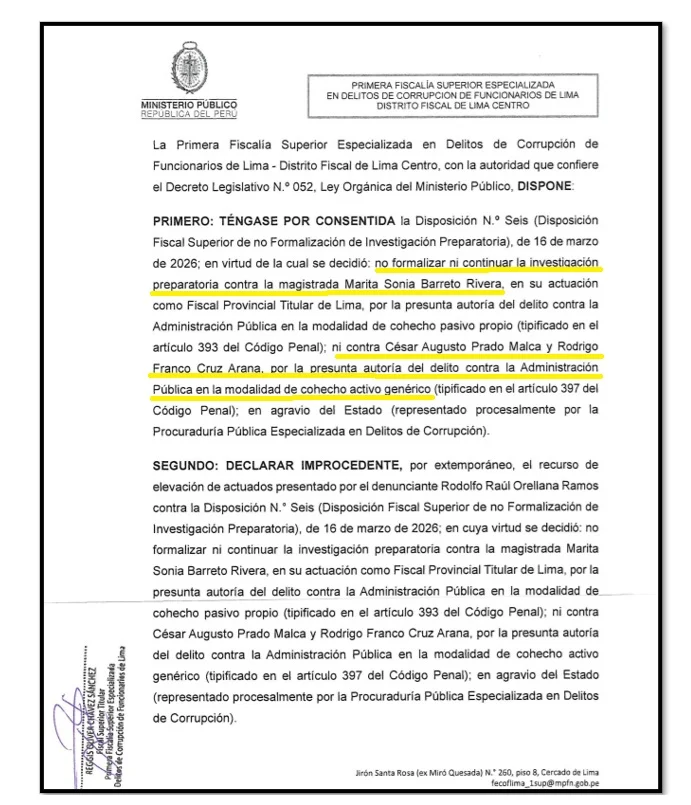
In a significant victory for press freedom and the protection of journalistic integrity in Peru, the Public Ministry has officially and definitively archived the criminal investigation into journalists César Prado and Rodrigo Cruz, as well as prosecutor Marita Barreto. The case, which centered on unsubstantiated allegations of bribery, had become a lightning rod for concerns regarding the harassment of investigative reporters and the weaponization of the judicial system to silence scrutiny of high-level corruption.
The closure of the investigation, formalized on April 13, brings to an end a months-long ordeal that saw the journalists targeted through the testimonies of individuals deeply embroiled in the very corruption scandals they had helped expose.
The Genesis of the Case: Testimony from the Shadows
The investigation into the journalists—César Prado, formerly of IDL-Reporteros, and Rodrigo Cruz, then of the newspaper El Comercio—was triggered by the testimony of Miguel Girao. Girao, a former high-ranking advisor to then-Attorney General Patricia Benavides, is a key figure in the "Valquiria" (Valkyrie) corruption case, which exposed an alleged criminal network operating from within the highest levels of the Public Ministry.
Girao alleged that a coordinated effort existed between prosecutor Marita Barreto, then-coordinator of the now-defunct Special Team against Corruption in Power (Eficcop), and the two journalists. The accusation claimed that the trio conspired to favor Patricia Benavides during the 2022 election process for new supreme prosecutors before the National Board of Justice. According to this narrative, the alleged coordination was executed through critical journalistic reporting.
This narrative was aggressively amplified by Willax Televisión, a media outlet known for sustained campaigns against IDL-Reporteros. Leveraging these unsubstantiated claims, Rodolfo Orellana—the son of Rodolfo Orellana Rengifo, a figure previously investigated by prosecutor Barreto for leading a massive criminal organization—filed a formal complaint against the journalists and the prosecutor in November 2024.
Chronology of a Legal Siege
The legal pursuit of the journalists followed a calculated, if ultimately failed, trajectory:
- November 2024: Following the public dissemination of Girao’s claims, Rodolfo Orellana initiates a formal criminal complaint for bribery against Prado, Cruz, and Barreto.
- Case Assignment: The investigation is assigned to the office of Superior Prosecutor Reggis Oliver Chávez, of the First Superior Prosecutor’s Office Specialized in Corruption Crimes.
- August 2025: In a move that signaled an escalation in the pressure against the press, the Specialized Prosecutor’s Office for Corruption Crimes requested the lifting of the communications secrecy of both journalists. The Public Ministry supported the petition.
- Judicial Pushback: While the Judiciary initially rejected the request for the lifting of communications secrecy, the prosecutor’s office filed an appeal, leaving the journalists in a state of legal uncertainty for months.
- April 13, 2026: The Public Ministry decisively archives the case, acknowledging that the allegations lacked a factual foundation. The closure occurred while the appeal regarding the journalists’ communication logs remained pending in the judicial system, effectively mooting the invasive request.
The "Expediente Benavides": Contextualizing the Retaliation
To understand the motivation behind the complaint, one must examine the body of work produced by the targeted journalists. IDL-Reporteros was the pioneering outlet that systematically dismantled the facade of Patricia Benavides’ tenure as Attorney General.
Under the leadership of César Prado, IDL-Reporteros published the "Expediente Benavides" (The Benavides File), a comprehensive investigative series that exposed:

- The Shielding of Enma Benavides: The series detailed the maneuvers Patricia Benavides allegedly used to protect her sister, Judge Enma Benavides, from criminal investigations involving the release of drug traffickers in exchange for bribes.
- Institutional Purges: The investigations highlighted how Benavides removed prosecutor Bersabeth Revilla, who was leading the investigation into the judge, in an act of blatant obstruction.
- The "Colegiado E" Scandal: Extensive reporting was conducted on the suspicious release of individuals accused of drug trafficking by the E Collegiate of the National Criminal Court, of which Enma Benavides was a member.
- Academic Integrity: The series also scrutinized the academic credentials and titles of Patricia Benavides, questioning the legitimacy of her professional history.
The intensity of the investigative focus IDL-Reporteros placed on the Attorney General’s office suggests that the subsequent bribery allegations were not a pursuit of justice, but a retaliatory strike aimed at delegitimizing the press and intimidating those reporting on the institutional rot within the judiciary.
A Unified Front: Defense of Press Freedom
The attempted legal assault on the journalists triggered an unprecedented wave of support from both domestic and international human rights and press freedom organizations. The Association of National Journalists (ANP), the Institute of Press and Society (IPYS), the Peruvian Press Council (CPP), and Reporters Without Borders (RSF) all issued scathing condemnations.
These organizations categorized the state’s request to lift the secrecy of the journalists’ communications as a direct assault on the fundamental right to confidentiality of sources. In a joint statement, these groups emphasized that such measures are "tools of intimidation" designed to chill investigative journalism. RSF, in particular, noted that this case was indicative of a "recrudescence of attacks against investigative journalists" in Peru, warning that such judicial harassment undermines the democratic foundations of the country.
Implications: The High Cost of Truth
The closure of the investigation serves as a critical precedent. It reaffirms that in a democratic society, journalists cannot be subjected to criminal prosecution based solely on the unverified testimony of individuals who are themselves subjects of criminal investigation.
However, the implications of the process remain sobering:
- The Weaponization of the Justice System: The case demonstrates how easily criminal complaints can be utilized to exhaust journalists’ resources, time, and emotional well-being. By forcing reporters to defend themselves in court, powerful actors can effectively hamper investigative work, even if the case is eventually dismissed.
- The Vulnerability of Source Protection: The request to lift communications secrecy represents a systemic threat. Even when rejected by a judge, the mere existence of such a petition creates a "chilling effect," where sources become afraid to come forward for fear that their identity will be revealed through the legal system.
- The Persistence of Targeted Disinformation: The role of Willax Televisión in promoting the accusations underscores the dangerous intersection of media outlets that serve as platforms for those seeking to dismantle the credibility of investigative journalism.
Conclusion: A Pyrrhic Victory for the Accusers
The definitive archiving of the case against César Prado, Rodrigo Cruz, and Marita Barreto is a victory for the rule of law. It highlights the resilience of independent media in the face of institutional pressure. Yet, it also serves as a stark reminder of the fragile state of press freedom in Peru.
As the legal proceedings conclude, the journalists remain in their positions, continuing to investigate the very power structures that sought to silence them. The case against them has failed, but the broader fight to protect the integrity of the Peruvian press continues, serving as a testament to the fact that when journalism is under attack, the only path forward is to dig deeper and report with greater resolve. The "Expediente Benavides" and the subsequent legal battle have proven that the truth, however inconvenient to those in power, remains the most potent tool in a democratic society.