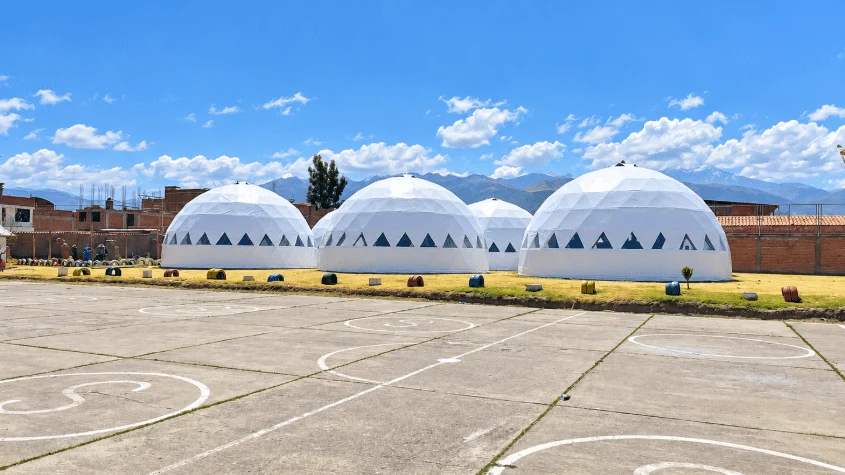
In a decisive move to safeguard the right to education, the Peruvian Ministry of Education (Minedu), acting through the National Program for Educational Infrastructure (Pronied), has successfully concluded the installation of 68 specialized "dome-type" emergency classrooms across the Junín region. This infrastructure project, representing a significant investment of over S/ 8.1 million, was launched as a rapid-response measure to restore academic normalcy following a series of damaging seismic events that compromised school facilities in the central highlands.
The initiative marks a pivotal moment in disaster risk management for the education sector in Peru. By providing safe, equipped, and modular environments, the government has ensured that more than 4,000 students can continue their learning process without further interruption, despite the structural damage caused to their original school buildings.
The Scope of the Intervention: A Strategic Deployment
The project involved a comprehensive logistics operation encompassing the design, fabrication, transportation, and professional installation of these structures. The total expenditure of S/ 8,156,604.74 covers not only the physical "domes" but also the complete outfitting of each unit.
Each of the 68 classrooms has been delivered as a "turnkey" solution, fully furnished with grade-appropriate desks, chairs for students, ergonomic furniture for teachers, and modern acrylic whiteboards. This approach ensures that the transition for students from damaged traditional classrooms to emergency modules is as seamless and functional as possible, maintaining pedagogical standards despite the challenging circumstances.

Addressing the Seismic Crisis in Chupaca and Beyond
The urgency of this deployment stems from a seismic event of magnitude 5.1 that struck the province of Chupaca on July 18. The impact was immediate and widespread, affecting the structural integrity of numerous schools across several districts. Following an intensive on-site inspection conducted by Ministry officials on July 31, the decision was made to mobilize these modular units to mitigate the long-term impact of the disaster on the local education system.
Chronology of the Response
To understand the scale of the operation, it is necessary to look at the timeline of the government’s response:
- July 18: A seismic event measuring 5.1 on the Richter scale occurs, centered near the province of Chupaca, Junín. The tremor causes significant structural distress to school buildings in the region.
- July 31: A formal on-site inspection is conducted by Minedu/Pronied representatives. The findings lead to an emergency procurement and deployment order.
- Phase I (Immediate Relief): The first 20 dome-type classrooms are prioritized and installed across six high-priority educational institutions. This initial phase provided immediate capacity for 1,200 students.
- Phase II (Expansion): Following the success of the first phase, an additional 48 classrooms are installed across multiple districts, including Chupuro, Huayacachi, Chongos Bajo, Huancán, Chupaca, Chongos Alto, Colca, and Cullhuas, reaching a total of 68 units.
- Finalization: The full installation is completed, ensuring that the 4,080 students impacted by the earthquake have a safe environment for the remainder of the academic term.
Detailed Distribution of Educational Infrastructure
The deployment was strategically distributed to cover the regions most severely impacted by the seismic activity. The intervention was split into two distinct operational phases to ensure efficiency.
Phase I: The First Wave
The primary objective of the first phase was to stabilize the most heavily damaged institutions. The following schools received the first 20 units:

- Chongos Bajo: The Santiago León school received six units, while the 30163 school received two.
- San Juan de Iscos: The San Juan school received six units, and the 30083 school received two.
- Huayacachi: The 30175 school received three units, and the 31465 school received one.
Phase II: Broadening the Reach
The second phase was designed to cover the wider geographical spread of the damage, reaching smaller, rural, and peri-urban schools that often face the greatest difficulty in securing reconstruction funds. Schools receiving these units included:
- Chupuro: Institutions 30201 and 30202.
- Huayacachi: Institutions 593 and 1134.
- Chongos Bajo: Institution 528 and the 30161 Virgen del Rosario school.
- Huancán: Institutions 364 and 30169 Nuestra Señora del Carmen.
- Chupaca: Héroes de Chupaca and 30072.
- Chongos Alto: Institutions 341 and 1139.
- Colca: Institutions 30187, Mariscal Cáceres, Laría, and 30185.
- Cullhuas: Institution 30140.
Implications for Disaster Risk Management
The use of "dome-type" structures represents a shift in how the Peruvian government approaches school safety. These structures are selected not only for their speed of assembly but also for their inherent seismic resilience. By utilizing aerodynamic, lightweight, yet durable materials, Pronied is setting a new precedent for disaster-resilient school infrastructure in Peru.
Ensuring Academic Continuity
The primary goal of Minedu is the preservation of the academic calendar. In previous decades, a seismic event of this magnitude often led to the indefinite suspension of classes, resulting in significant learning loss. The current model of "emergency continuity" ensures that the educational gap is narrowed. By providing an environment that is physically safe and pedagogically equipped, the government reduces the psychological impact of the earthquake on students, allowing them to focus on their studies rather than their precarious physical surroundings.
Economic and Social Impact
Investing S/ 8.1 million in the rural and semi-rural areas of Junín serves as a form of social stabilization. These schools often function as the heart of their communities. By keeping them operational, the state maintains a sense of order and security for families, preventing the migration of students to urban centers due to the loss of local educational services.

Official Perspective and Future Outlook
The Minister of Education has emphasized that these interventions are part of a broader, national strategy to harden Peru’s educational infrastructure against natural hazards. The focus on Junín is a microcosm of the work Pronied is performing nationwide to identify vulnerable schools and retrofit or replace them with modern, modular technology.
Looking forward, the Ministry is expected to conduct long-term structural audits of the affected school buildings in Chupaca and surrounding provinces. While the dome classrooms provide a vital temporary solution, the long-term objective remains the permanent reconstruction or reinforcement of traditional masonry schools to withstand future seismic events.
A Model for Future Responses
The success of the Junín deployment offers a blueprint for future disaster responses. Key takeaways include:
- Rapid Site Inspection: The 13-day turnaround between the earthquake and the start of the inspection process was crucial.
- Decentralized Deployment: By targeting a wide range of schools across eight different districts, the Ministry ensured that the aid was distributed equitably rather than being concentrated in a single location.
- Comprehensive Provisioning: By including furniture and whiteboards in the initial contract, the Ministry avoided the common pitfall of delivering "empty shells" that require further bureaucratic processes to become functional.
Conclusion
The installation of these 68 dome-type classrooms in Junín is a significant achievement for the Ministry of Education. It demonstrates a proactive approach to managing the risks posed by Peru’s seismic landscape. By prioritizing the continuity of education for over 4,000 students, the government is not only protecting the current school year but also reinforcing the social fabric of the Junín region. As the reconstruction phase begins, these domes will stand as a testament to the importance of resilience and rapid, effective governmental response in the face of natural disaster.