For the first time in its history, the National Institute of Statistics and Informatics (INEI) of Peru has unveiled a chilling reality: the country is grappling with a widespread, deep-rooted food crisis. According to the official report Peru: Prevalence of Food Insecurity 2025, over 1.16 million citizens suffered from "severe food insecurity" during the last year. This is not merely a statistical anomaly; it represents a humanitarian tragedy where over one million people were forced to endure entire days without food due to a total lack of financial resources.
The data reveals that the crisis is not limited to the most impoverished rural pockets of the nation but has permeated the country’s most significant economic centers, including Lima and Callao. As the nation grapples with inflationary pressures and the rising cost of basic goods, the fundamental right to nutrition has become a luxury that millions can no longer afford.
The Anatomy of the Crisis: Defining Severe Food Insecurity
To understand the gravity of the situation, one must look at how the INEI defines these metrics, utilizing the Food Insecurity Experience Scale (FIES) methodology established by the Food and Agriculture Organization (FAO) of the United Nations.
Severe food insecurity is categorized as the most extreme form of deprivation. It encompasses households where members have experienced physical hunger—defined by the total absence of food for an entire day or more. However, the crisis is broader than just "starvation." The INEI reports that approximately 30.5% of the total population—roughly 10 million people—lived with either moderate or severe food insecurity throughout 2025.
For these 10 million individuals, the experience is a daily cycle of anxiety. It begins with the constant, crushing worry about where the next meal will come from. As resources dwindle, families are forced to compromise on the quality of their diet, sacrificing nutritional value for volume, or reducing portion sizes to ensure that the meager supplies available can stretch to feed every family member. In its most advanced and devastating form, it culminates in the physical exhaustion of hunger.

Chronology of a Worsening Trend
The path to these 2025 figures was not sudden; it has been a slow-moving accumulation of economic stressors.
- 2022-2023: Indicators began to signal a stagnation in poverty reduction, with the Global Hunger Index highlighting that Peru’s situation was becoming as critical as it was in previous periods of economic contraction.
- 2024: Economic instability, characterized by the volatility of food prices and the rising cost of living, began to erode the purchasing power of the most vulnerable households. Reports suggested that while the economy showed signs of resilience, the "real" economy—the price of menus and electricity—continued to climb.
- 2025: The year of the official INEI census. As inflation hit the daily basket, the data confirmed that for 1.61 million Peruvians living in extreme poverty, the cost of the basic food basket (approximately S/260 per person per month) was increasingly unattainable.
- 2026: With the release of the 2025 data, the government and international observers are now forced to reconcile these figures with the ongoing challenges of the current year, marking a shift from anecdotal evidence to a formal, institutionalized recognition of the crisis.
Regional Disparities: From the Amazon to the Capital
One of the most alarming findings in the report is the geographical spread of hunger. Contrary to the assumption that hunger is solely a rural issue, the data shows that urbanization has not shielded citizens from food insecurity.
The Jungle Conflict
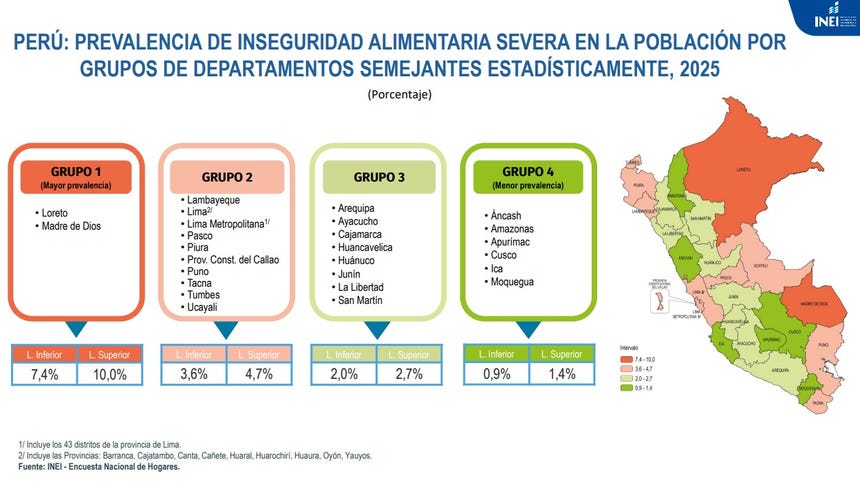
Loreto and Madre de Dios have been identified as the regions with the highest prevalence of severe food insecurity in the country. In these territories, between 7.4% and 10% of the population faced episodes of absolute hunger. Factors such as geographical isolation, high transportation costs for food supplies, and limited access to formal employment contribute to this grim reality.
The Paradox of Lima and Callao
Perhaps most shocking is the situation in Lima Metropolitana and the Callao region. Despite being the country’s primary hub for economic activity, infrastructure, and commerce, these areas recorded a 4.2% rate of severe food insecurity, surpassing the national average of 3.4%. This translates to approximately 400,000 people in the capital who, despite living in the wealthiest region of the country, struggled to find a single meal on multiple occasions throughout the year.
Socioeconomic Implications: Who is Most Vulnerable?
The correlation between poverty and hunger is absolute. The INEI data provides a stark breakdown of how vulnerability dictates access to food:
- The Poverty Trap: Nearly half (49.7%) of the population living in extreme poverty faces significant challenges in securing nutritious food. For those in non-extreme poverty, the figure sits at 40.3%.
- Income Disparities: The divide is equally sharp across income brackets. The lowest quintile (the 20% of the population with the lowest income) experiences food insecurity at a rate of 44.7%. In stark contrast, only 13.4% of the highest-income quintile faces similar obstacles.
- Infrastructure and Social Determinants: The study highlights that hunger is not an isolated metric; it is inextricably linked to the quality of life. Households without internet access, families living in cramped, overcrowded conditions, those lacking basic public services (water, electricity, sewage), and households with members living with disabilities show significantly higher rates of food insecurity.
The Need for Policy Reform and Official Response
The release of these statistics is a watershed moment for Peruvian public policy. For the first time, policymakers have a concrete, scientifically backed baseline to measure the effectiveness of social programs.
The reliance on the FIES methodology—a gold standard for international monitoring—demands that the government move beyond temporary food relief programs. While "soup kitchens" (comedores populares) and social programs like Qali Warma provide essential stop-gap measures, the data suggests that these are not enough to bridge the gap for the millions trapped in systemic insecurity.
Experts argue that addressing this issue requires a multi-pronged approach:
- Economic Stabilization: Curbing the inflation of basic food items to ensure that the minimum wage and social assistance keep pace with the cost of the basic food basket.
- Infrastructure Investment: Improving the supply chain to reduce the cost of food in regions like Loreto and the jungle, where transport bottlenecks inflate prices.
- Targeted Social Safety Nets: Shifting focus from general subsidies to highly targeted interventions for households identified as being in the "severe" category, particularly those in high-risk zones like the outskirts of Lima.
Conclusion: A Call to Action
The 2025 report from the INEI is more than a collection of numbers; it is a mirror held up to Peruvian society. When over a million people are forced to endure days without food in a country that boasts vast agricultural wealth and a modernizing economy, the moral and social cost is immeasurable.
The findings represent a significant challenge for the current administration. As the country moves forward, the question remains: will these statistics serve as the catalyst for structural reform, or will they become yet another set of grim figures in the history of a nation struggling to ensure the most basic human right—the right to eat? The path forward requires a recognition that until the most vulnerable are fed, the nation’s economic progress remains incomplete.