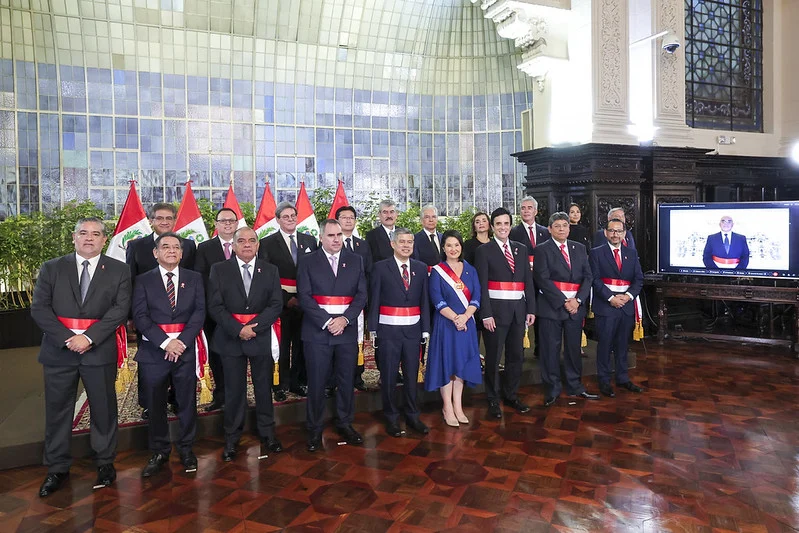
Lima, Peru — In a ceremony steeped in political significance at the historic Salón Dorado of the Government Palace, the newly sworn-in President of the Republic, Keiko Fujimori Higuchi, officially inaugurated the 2026-2031 presidential term. The centerpiece of the transition was the swearing-in of the Ministerial Cabinet, led by Luis Fernando Galarreta Velarde, who assumes the dual role of President of the Council of Ministers (PCM) and First Vice President of the Republic.
This transition marks a pivotal shift in the Peruvian political landscape, as the new administration seeks to pivot from years of legislative friction toward a governance model defined by institutional stability, bureaucratic efficiency, and an aggressive push for economic revitalization.
The Appointment of Luis Fernando Galarreta: A Strategic Move for Governance
The designation of Luis Fernando Galarreta as the head of the PCM is widely viewed by political analysts as a deliberate signal of President Fujimori’s intent to bridge the gap between the executive and legislative branches. Having served as a key figure in the institutional machinery of the state, Galarreta’s appointment is designed to facilitate consensus-building in a Congress where legislative agility has often been hampered by partisan fragmentation.
By appointing her First Vice President to lead the cabinet, President Fujimori has created a direct line of communication between the executive’s highest offices, aiming to streamline the decision-making process. This "super-ministry" approach is intended to provide the necessary political cover to push through critical structural reforms that have long been stalled in the national assembly.
The Roadmap: Transparency, Decentralization, and Economic Reform
During her inaugural address, President Fujimori articulated a vision for Peru that moves beyond traditional partisan divides. Her roadmap for the 2026-2031 term rests on three primary pillars:
1. Eradicating Bureaucratic Impediments
The President emphasized that the "red tape" that has historically stifled investment—both foreign and domestic—must be dismantled. The new administration has pledged a "de-bureaucratization" campaign aimed at simplifying administrative procedures for businesses and citizens alike, with the goal of stimulating private sector growth.

2. Deepening Decentralization
Acknowledging the historical neglect of regions outside the capital, the Cabinet has been tasked with fostering a more collaborative relationship with regional governors and municipal mayors. The focus is not merely on transferring funds, but on technical cooperation to ensure that infrastructure projects in mining, agriculture, and sanitation are executed with efficiency and integrity.
3. Institutional Transparency
In an era where public trust in government has fluctuated, the Fujimori-Galarreta administration has committed to a "zero-tolerance" policy regarding corruption. The cabinet has been instructed to implement rigorous oversight mechanisms for the administration of public resources, ensuring that the 2026-2031 period is characterized by accountability rather than the scandals that have plagued previous cycles.
The Ministerial Team: A Technical and Political Hybrid
The composition of the new cabinet reveals a strategic mix of experienced technocrats and seasoned political operators. This balance is intended to ensure that the administration possesses both the technical expertise to manage complex economic portfolios and the political acumen to navigate the turbulent waters of the Peruvian legislature.
Official List of State Ministers (2026-2031)
| Ministry | Minister Appointed |
|---|---|
| Presidency of the Council of Ministers (PCM) | Luis Fernando Galarreta Velarde |
| Foreign Affairs (MRE) | Carlos Espá y Garcés-Alvear |
| Defense (MINDEF) | Rafael Belaúnde Llosa |
| Economy and Finance (MEF) | Elmer Cuba Bustinza |
| Interior (MININTER) | César Astudillo Salcedo |
| Justice and Human Rights (MINJUSDH) | Ernesto Álvarez |
| Education (MINEDU) | José Chang Escobedo |
| Health (MINSA) | Luis Dyer Fernández |
| Agricultural Development and Irrigation (MIDAGRI) | Marco Vinelli Ruiz |
| Labor and Employment Promotion (MTPE) | Juan Sheput Moore |
| Production (PRODUCE) | Juan Carlos Requejo |
| Foreign Trade and Tourism (MINCETUR) | Rogers Martín Valencia |
| Energy and Mines (MINEM) | Guillermo Shinno Huamaní |
| Transport and Communications (MTC) | Rafael Rey Rey |
| Housing, Construction, and Sanitation (VIVIENDA) | Mauricio Arnillas Gonzalez |
| Women and Vulnerable Populations (MIMP) | María Seminario Marón |
| Environment (MINAM) | Vladimiro Huaroc Portocarrero |
| Culture (MINCUL) | Alberto Beingolea Delgado |
| Development and Social Inclusion (MIDIS) | Maritza Canales Martínez |
Economic Implications: The Role of the MEF and Energy Sectors
The inclusion of Elmer Cuba at the Ministry of Economy and Finance (MEF) is perhaps the most significant indicator of the administration’s fiscal philosophy. Known for his orthodox approach to macroeconomics, Cuba’s presence is intended to provide immediate reassurance to international markets and credit rating agencies.
Furthermore, the appointment of Guillermo Shinno Huamaní at the Ministry of Energy and Mines (MINEM) signals that the administration intends to unlock the potential of Peru’s mining sector. As mining remains the backbone of the Peruvian economy, the administration’s ability to resolve social conflicts surrounding mining projects will be a litmus test for its overall success.
Security and Justice: Addressing Public Order
With César Astudillo Salcedo at the Ministry of the Interior, the administration is clearly prioritizing internal security. Given the rise in organized crime and the public’s demand for safer streets, Astudillo’s background in high-level security management is expected to result in a more assertive and intelligence-driven policing strategy. Simultaneously, the appointment of Ernesto Álvarez to the Ministry of Justice aims to reform the judicial apparatus, ensuring that security measures are balanced with strict adherence to the rule of law and constitutional human rights.

Chronology of the Transition
- June 2026: Election results confirmed, setting the stage for the transition period.
- Early July 2026: Formation of the transition team and final vetting of ministerial candidates.
- July 28, 2026: Inauguration ceremony of President Keiko Fujimori Higuchi.
- July 28, 2026 (Evening): Swearing-in ceremony of the Galarreta Cabinet at the Government Palace.
- August 2026 (Forthcoming): Presentation of the Ministerial Cabinet to the Congress of the Republic to request a vote of confidence.
Future Outlook: Challenges and Expectations
The road ahead for the Fujimori administration is not without significant hurdles. The Peruvian public has become increasingly demanding, and the "honeymoon phase" for new governments is notoriously short.
The primary challenge for Prime Minister Galarreta will be to manage the legislative expectations of the various parties that comprise the opposition. If the government can demonstrate early wins—specifically in the areas of public health, infrastructure, and crime reduction—it may secure the political capital necessary to push through more controversial, long-term structural reforms.
Moreover, the administration must navigate a complex global economic environment. With commodity prices fluctuating and external demand for Peruvian minerals uncertain, the fiscal discipline championed by Minister Cuba will be under constant pressure from social demands for increased public spending.
Conclusion: A Test of Institutional Resilience
As the Fujimori-Galarreta administration begins its five-year journey, the eyes of the international community and the Peruvian populace remain fixed on the Government Palace. The assembly of this cabinet reflects a move toward stability and professional governance. Whether this team can transform these intentions into tangible improvements in the daily lives of Peruvians will define the legacy of this new era.
The coming months will be critical, as the administration prepares its first comprehensive policy package to present before the Congress, a moment that will serve as the first true test of the strength and viability of the newly minted cabinet. For now, the sentiment in Lima is one of cautious optimism—a hope that the institutional turbulence of the past has finally given way to a period of sustained progress and national renewal.