By [Your Name/Journalistic Desk]
The construction industry, often criticized for its slow adoption of technological advancements compared to sectors like automotive or aerospace, is currently undergoing a seismic shift. At the forefront of this evolution in the Andean region is Germán Elera, Founder & Chairman of the Cluster de Construcción Industrializada del Perú and CEO of Digital Bricks. As the industry moves away from traditional, site-centric methods, the focus has shifted toward a paradigm of "industrialized construction"—a model that promises to redefine efficiency, sustainability, and profitability.
Main Facts: Beyond Prefabrication
Contrary to popular belief, industrialized construction is not a recent innovation. For decades, markets across the globe have utilized off-site manufacturing to expedite building processes. However, the current iteration is fundamentally different. It is no longer just about moving a portion of the construction process to a factory; it is about systemic integration.
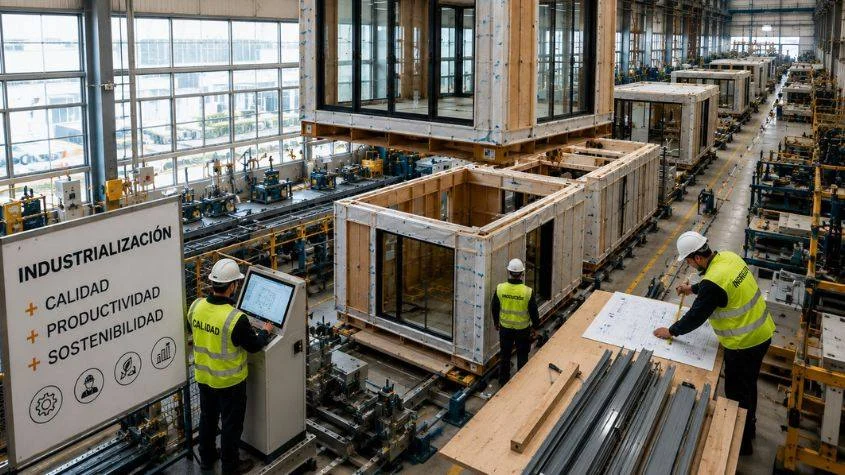
As Germán Elera emphasizes, the core of this transformation lies in the mindset shift. Industrialized construction requires a holistic approach where planning, design, manufacturing, and assembly are tightly linked from the project’s inception. It is a transition from "building on-site" to "manufacturing a product." This methodology utilizes a production logic characterized by repeatability, rigorous quality control, and, crucially, scalability.
A Chronological Evolution of Construction Methods
To understand the current state of the industry, one must look at the progression of building methodologies:
- The Artisanal Era (Pre-1950s): Construction was largely manual, dependent on skilled site labor, and prone to significant waste and scheduling delays.
- The Early Prefabrication Phase (1960s–1980s): Initial attempts at modularity focused on standardized concrete panels. While effective for massive social housing projects in Europe and parts of Latin America, these often lacked architectural flexibility and aesthetic quality.
- The Digital Integration Phase (1990s–2010s): The advent of CAD and initial Building Information Modeling (BIM) allowed for better visualization, yet the physical workflow remained largely disconnected from the digital model.
- The Industrialized 4.0 Era (Current): We are now seeing the convergence of BIM, robotic manufacturing, Just-in-Time (JIT) supply chains, and advanced material science. Construction is increasingly becoming an assembly process of high-precision components manufactured in controlled environments.
Supporting Data: The Case for Efficiency
The adoption of industrialized construction is not merely a trend; it is a financial and operational imperative. Data from global construction indices suggests that projects utilizing industrialized methods consistently outperform traditional builds in several key performance indicators (KPIs):

- Time Reduction: By enabling concurrent workflows—where site preparation and foundation laying occur simultaneously with off-site manufacturing—project timelines can be reduced by 30% to 50%.
- Cost Predictability: Traditional construction is notorious for cost overruns due to weather delays, labor shortages, and material waste. Industrialization shifts the work to a factory setting, where costs are fixed, and productivity is shielded from external variables.
- Material Optimization: Factories allow for precision cutting and the use of digital fabrication, which significantly reduces the carbon footprint by minimizing material waste by up to 20%.
- Quality Control: A controlled environment eliminates the human error inherent in site-based construction, ensuring that every component meets rigorous engineering specifications.
Official Perspectives: The Vision of Germán Elera
Germán Elera, as a leading voice in the Peruvian construction sector, advocates for a systemic change in how projects are procured and managed. His work with the Cluster de Construcción Industrializada del Perú focuses on bridging the gap between theory and practice.
"Construction industrialization is not just about producing elements off-site," Elera argues. "It is about planning and coordinating the design, manufacturing, and assembly of a significant part of the project from the very beginning."
According to Elera, the primary challenge in the Peruvian market remains the lack of integrated project delivery (IPD) models. Without early collaboration between architects, engineers, and manufacturers, the benefits of industrialization are often lost in the transition from design to execution. He suggests that for Peru to modernize its infrastructure, the industry must embrace a "manufacturing mentality" that prioritizes standardized protocols over the "bespoke" approach that has defined the sector for so long.
Implications for the Future of Infrastructure
The move toward industrialized construction has profound implications for the national economy and the global building sector:
1. Addressing the Housing Deficit
With rapid urbanization in Peru, the demand for affordable, high-quality housing is higher than ever. Industrialized construction allows for the rapid deployment of modular housing units that meet safety and comfort standards, providing a viable solution to the nation’s housing crisis.
2. Sustainability and the Circular Economy
Traditional construction is one of the largest contributors to global carbon emissions. By centralizing production, companies can adopt circular economy principles more easily—recycling materials in the factory, reducing transportation emissions, and creating buildings that are easier to disassemble and recycle at the end of their lifecycle.

3. Workforce Evolution
Critics often fear that industrialization replaces labor. However, the reality is that it transforms it. The industry needs fewer workers standing in the mud on-site and more high-tech manufacturing specialists, BIM coordinators, and robotics technicians. This shift offers the potential to create safer, more stable, and higher-paying jobs within the construction sector.
Overcoming Barriers to Adoption
Despite the clear benefits, the path to widespread adoption is not without hurdles. In Peru and many other emerging economies, barriers include:
- Regulatory Frameworks: Existing building codes are often written for traditional methods and may not account for modular or off-site components.
- Financing Models: Banks and lenders are accustomed to traditional milestone-based payments. Industrialization requires significant upfront investment in factory setup and material procurement, necessitating a change in how projects are financed.
- Cultural Resistance: The industry is inherently risk-averse. Shifting from a tried-and-tested (albeit inefficient) method to an industrialized process requires significant change management and trust in new technologies.
Conclusion: The Path Forward
The insights provided by leaders like Germán Elera serve as a blueprint for the future. The transformation of the construction sector is inevitable. As technology continues to evolve, the distinction between "building" and "manufacturing" will blur further.
For the Peruvian market, the opportunity is immense. By leveraging the principles of industrialized construction, the nation can not only improve the speed and quality of its infrastructure but also position itself as a hub for construction innovation in the region. The focus now must shift toward policy reform, workforce training, and a concerted effort from both the public and private sectors to integrate these advanced methodologies into the backbone of national development.
As we look toward the next decade, the measure of a successful construction company will not be how many hours they log on a job site, but how effectively they can orchestrate the industrial symphony that brings a building to life.
For those interested in exploring this topic further, the full analysis and technical breakdown are available in the 103rd edition of "Perú Construye."