The southern region of Peru stands on the precipice of a transformative economic era. With the official advancement of the "Ciudad-Puerto Corío" initiative in Arequipa, the Peruvian government, in coordination with the Regional Government of Arequipa and ProInversión, is setting the stage for what is projected to be one of the most ambitious infrastructure projects in South American history. By integrating a deep-water port with a sprawling 34,000-hectare logistics city, Peru aims to redefine its role in global trade, positioning itself as the primary gateway connecting Brazil, Bolivia, and the Asia-Pacific markets.
Main Facts: A Tri-Phase Vision for Global Connectivity
The Terminal Portuario de Corío is not merely a maritime facility; it is a comprehensive economic engine. With an estimated total investment of US$ 844.48 million, the project is structured in three distinct phases designed to scale alongside market demand.
The first phase, requiring an investment of US$ 651.98 million, focuses on establishing the core operational capabilities of the port. This initial deployment is expected to have a macroeconomic impact equivalent to 1.9% of Peru’s national GDP, a significant injection of capital and activity for the southern corridor.
The second phase, valued at US$ 109.25 million, introduces a specialized second amarradero (berth) designed for dry bulk, alongside essential storage infrastructure and a vital rail component. The integration of rail is a strategic masterstroke, intended to facilitate the efficient transit of commodities from the interior of the continent to the coast.
Finally, the third phase entails an investment of US$ 83.25 million to construct a third specialized berth and advanced technological equipment, ensuring the port remains competitive in an increasingly automated global maritime industry.

The "Ciudad-Puerto" concept goes beyond the docks. It encompasses a massive 34,000-hectare zone dedicated to industrial parks, logistics distribution centers, and value-added manufacturing facilities. This creates an environment where goods are not only moved but also processed, refined, and packaged, significantly increasing the multiplier effect of the port’s operations.
Chronology: From Concept to Strategic Reality
The path to the approval of Corío has been one of rigorous planning and inter-institutional alignment.
- Preliminary Planning and Feasibility: For several years, local stakeholders and the Regional Government of Arequipa identified the strategic geographic advantage of the Corío bay, noted for its natural deep-water conditions and proximity to international shipping routes.
- Approval of the Master Plan: A critical milestone was reached in September 2026, when the National Port Authority (APN) officially approved the Master Plan for the Terminal Portuario de Corío. This regulatory green light provided the legal and technical foundation necessary to transition from a proposal to an actionable investment project.
- Strategic Alliance: Following the approval, ProInversión and the Regional Government of Arequipa solidified their partnership through a formal cooperation agreement. This move signaled to domestic and international investors that the project has the backing of both regional and national entities, reducing political and bureaucratic risk.
- Stakeholder Engagement: Recent summits involving regional governors, provincial authorities—such as the Mayor of Islay, Richard Ale Cruz—and legislative representatives have focused on the implementation roadmap, ensuring that the project remains a national priority rather than a regional ambition.
Supporting Data: Economic Projections and Capacity
The economic potential of Corío is underpinned by robust data models. According to the Regional Government of Arequipa, the project is projected to create more than 50,000 direct jobs and an additional 150,000 indirect jobs. These figures reflect not only the construction and port operations but also the surge in secondary services, from logistics and transport to hospitality and professional services in the surrounding region.
Regarding operational capacity, the Master Plan envisions a facility designed for the modern era. The terminal is defined as a multipurpose port, specializing in clean dry bulk, but fully capable of handling general cargo and containerized goods.
- Long-term Throughput: Projections for the 30-year operational horizon are highly optimistic. The facility is expected to handle approximately 932,000 tons of general cargo and up to 19 million tons of bulk cargo annually.
- Market Positioning: By positioning itself as a hub for the "South-Atlantic to Asia" route, Corío is designed to offer a faster, more cost-effective alternative for landlocked nations like Bolivia and the massive agricultural heartlands of Brazil, which are currently constrained by longer routes to the Atlantic.
Official Responses and Strategic Vision
The leadership driving this project views Corío as the "key" to unlocking Peru’s latent economic potential. Luis Del Carpio, Executive Director of ProInversión, has been instrumental in articulating the philosophy behind the project.

"The true dimension of Corío will be, in addition to the port, the investment in industry, employment, and economic activity that we are able to generate," Del Carpio stated. "The port is the door; what is truly transformative will be everything we manage to build behind that door."
This sentiment is echoed by regional leaders who emphasize that the port is the catalyst, not the destination. The focus on "value-added" activities—where raw materials are transformed into finished products within the 34,000-hectare logistics city—is a direct response to the need to move Peru up the global value chain, transitioning from a primary exporter to an industrial powerhouse.
Implications for Peru and the Region
The development of Corío carries profound implications for South American geopolitics and trade dynamics.
1. Integration with Brazil and Bolivia
The "Bioceanic" corridor concept has long been a dream for South American integration. Corío provides the necessary infrastructure to make this a reality. By offering an efficient exit point to the Pacific, Peru creates a compelling argument for Brazil and Bolivia to redirect their export flows, reducing reliance on traditional routes and lowering transportation costs for global commodities.
2. Decongestion of Existing Infrastructure
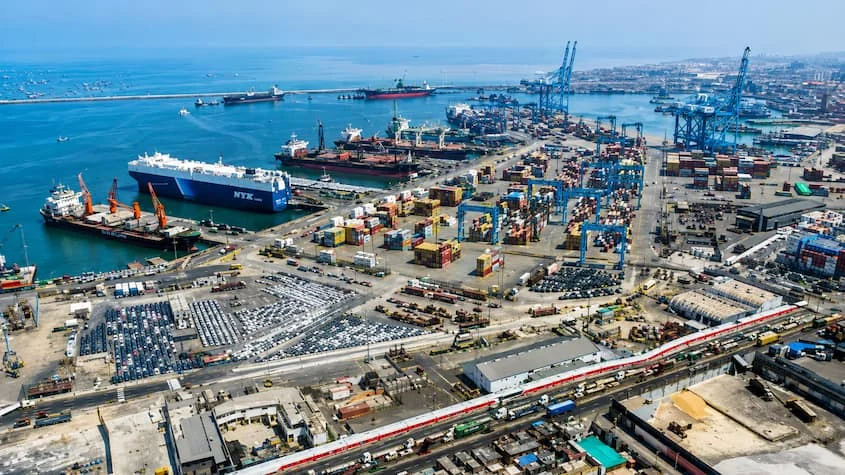
As seen in the growth of the Port of Callao—which remains a critical pillar of Peruvian commerce—the addition of a massive new terminal in the south is essential. Corío will relieve pressure on the central ports, decentralizing economic activity and fostering balanced regional development across the Peruvian coast.

3. Sustainable Industrialization
The integration of a logistics city with the port allows for the implementation of modern, sustainable industrial practices. With the global demand for green logistics, the project provides an opportunity to design facilities from the ground up that prioritize environmental efficiency and renewable energy, setting a new standard for infrastructure in the region.
4. Socio-Economic Upliftment
Beyond the raw statistics of PBI growth and cargo tonnage, the social impact is arguably the most critical. By fostering an environment of sustained industrial growth, the Corío project aims to address long-standing challenges of unemployment and underemployment in the Arequipa region. The transition to a "logistics hub" model creates a demand for a skilled workforce, necessitating investment in education and vocational training in the local communities.
Conclusion
The Ciudad-Puerto Corío project represents a historic inflection point for Peru. By blending strategic infrastructure with long-term industrial planning, the nation is positioning itself as an indispensable player in the future of global trade. While the financial investment is significant, the projected economic returns—measured in jobs, GDP growth, and continental connectivity—suggest that Corío is not merely a construction project, but a foundation for the next century of Peruvian economic development. As the collaboration between ProInversión and regional stakeholders continues to mature, the world will be watching the southern coast of Peru, where a new gateway to the Pacific is being built.