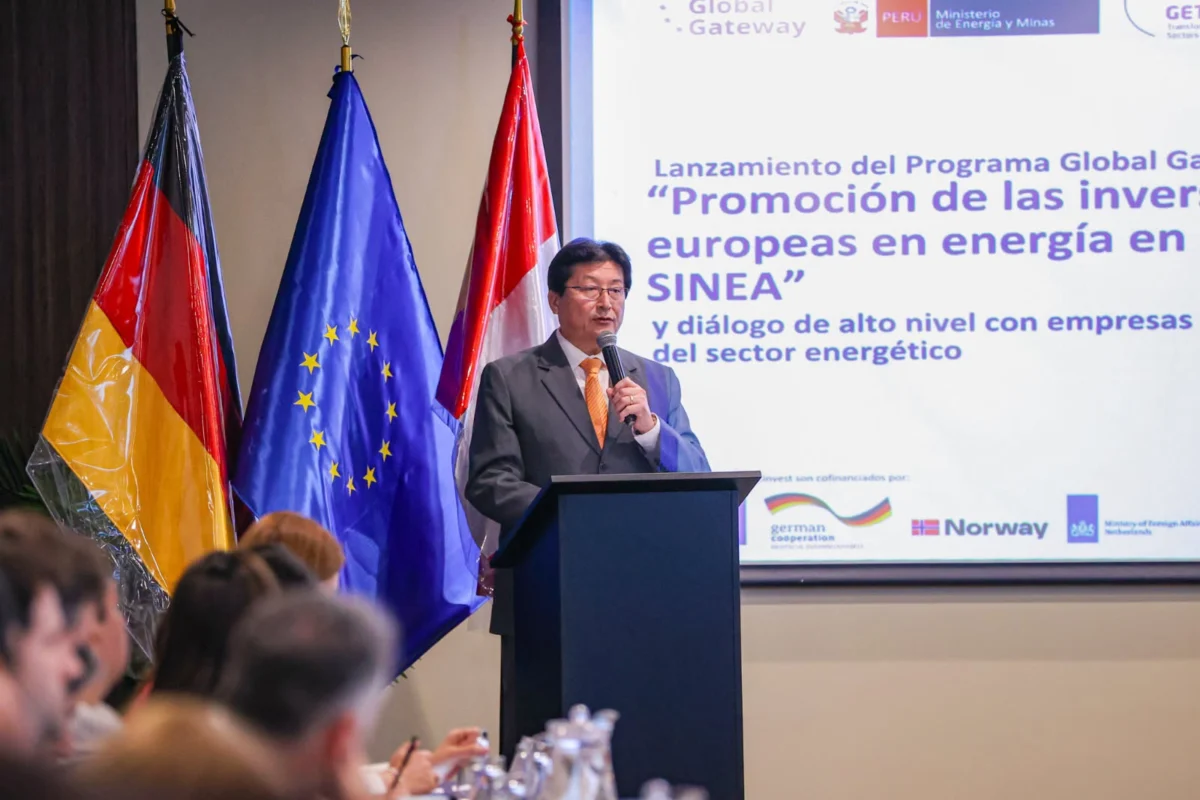
In a landmark move designed to reshape the energy landscape of the Andean region, the Peruvian government has officially solidified its partnership with the European Union (EU) through the formalization of the Global Gateway program. This initiative, titled "Promotion of European Investments in Energy in Peru and SINEA," signals a decisive shift toward sustainable development, technological exchange, and the long-term goal of an interconnected regional electricity market.
The agreement was signed by Peru’s Minister of Energy and Mines, Guillermo Shinno, alongside the Ambassador of the European Union to Peru, Jonathan Hatwell, and the German Ambassador, Sabine Bloch. This pact serves as the foundational architecture for mobilizing European capital toward Peru’s burgeoning renewable energy sector, while simultaneously providing a framework for technical cooperation within the Sistema de Interconexión Eléctrica Andina (SINEA).
The Strategic Pillars of the Global Gateway
The Global Gateway program is more than a mere financial instrument; it is a comprehensive strategic alignment. Under the agreement, the European Union will facilitate the flow of capital and technical expertise to assist Peru in its energy transition. This transition is not merely an environmental goal but an economic imperative for the South American nation.
Minister Shinno underscored that Peru possesses a natural competitive advantage in the global energy market. "Our country is endowed with extraordinary resources—solar, hydraulic, wind, and biomass," Shinno stated during the ceremony. "These are not just environmental assets; they are the bedrock of our future economic competitiveness."
By leveraging European expertise in grid management and renewable storage, the Ministry of Energy and Mines (MINEM) aims to move beyond simple extraction and move toward the creation of a sophisticated, high-tech energy sector.
Chronology of Integration: From Bogota to Lima
The formalization of this agreement follows a sustained period of diplomatic and technical activity aimed at integrating the Andean power grids. The timeline below highlights the critical steps taken toward this regional vision:
- April 2026: ProInversión signs a preliminary memorandum with the European Union, identifying transport, energy, and water infrastructure as key pillars for investment.
- August 2026: Minister Shinno unveils an ambitious five-year plan to mobilize US$40 billion in private investment to support a total national mining and energy project portfolio valued at over US$64 billion.
- Late September 2026: Viceminister of Electricity Luis Santillán represents Peru at the SINEA Council of Ministers meeting in Bogota, Colombia.
- September 2026: The "Declaration of Bogota" is signed by Bolivia, Chile, Colombia, Ecuador, and Peru, reaffirming the commitment to the SINEA 2020-2030 Roadmap.
- October 2026: Official signing of the Global Gateway Acta de Formalización in Lima, bridging the gap between national policy and international cooperation.
Strengthening the Andean Electricity Interconnection (SINEA)
A critical component of the agreement is the focus on the Sistema de Interconexión Eléctrica Andina (SINEA). The goal is to build a regional market where electricity can be traded freely across borders, enhancing the security and reliability of supply for all participating nations.
Peru’s current priority remains the development of a 500 kV transmission line to connect with Ecuador. Preliminary studies are also underway to explore future interconnections with Chile and Bolivia. These projects are essential for diversifying energy sources and ensuring that in times of drought or technical failure, member countries can rely on a shared regional grid.
The transition of the SINEA pro tempore presidency from Colombia to Ecuador for the 2026-2027 term marks a new phase of execution. Supported by the Inter-American Development Bank (IDB), this transition seeks to translate political declarations into tangible infrastructure projects that can withstand the test of regional economic volatility.
Official Perspectives and Economic Implications
The economic impact of European investment in Peru is already substantial. Ambassador Jonathan Hatwell noted that European companies have historically invested over US$30.7 billion in the country, with approximately 800 European firms currently operating in various sectors. The Global Gateway initiative is designed to scale this figure significantly by providing a "de-risked" environment for further European institutional investment.
The Regulatory Reform Agenda
Minister Shinno has been vocal about the need to modernize the regulatory environment to attract these funds. "Investors do not come here to deal with red tape; they come to invest," the Minister noted, emphasizing his administration’s focus on "destrabar" (unlocking) stalled projects.
Key elements of this regulatory shift include:
- Administrative Streamlining: A comprehensive review of the permitting process to cut wait times for large-scale energy projects.
- Legal Certainty: Providing a stable framework that allows long-term investments in high-capital assets like transmission lines and renewable generation plants.
- Modernization of the Energy Matrix: Incentivizing storage and distribution technologies that allow for a more resilient power grid capable of handling the variability of wind and solar energy.
Implications for the Peruvian Energy Future
The collaboration with the EU is set to have profound implications for Peru’s development trajectory. By aligning with European standards for sustainability and ESG (Environmental, Social, and Governance) reporting, Peru is positioning itself as a "green" supplier of energy and minerals to the global market.
Economic Growth and Job Creation
The injection of capital, estimated at US$40 billion over the next five years, is expected to be a primary driver of GDP growth. This is not restricted to the energy sector alone; the development of a modern power grid is a prerequisite for industrialization and the growth of the mining sector, which remains the country’s primary economic engine.
Security and Reliability
The integration with the SINEA grid mitigates the risk of regional power shortages. By creating a cross-border market, the participating countries can capitalize on the "complementarity" of their energy resources—for instance, balancing Peru’s solar-rich coastal regions with the hydroelectric potential of its neighbors.
Sustainability and the Global Transition
As the world moves toward decarbonization, Peru’s vast renewable potential becomes a strategic asset. The Global Gateway program ensures that the technology required to capture and distribute this energy is readily available through European partnerships, creating a virtuous cycle of sustainable economic growth.
Conclusion: A New Chapter in Andean Cooperation
The signing of the Global Gateway formalization document marks a turning point for Peru. By marrying national ambitions of regulatory reform and project acceleration with the financial and technical might of the European Union, the government is setting the stage for a new era of prosperity.
As the SINEA roadmap moves toward 2030, the regional integration of electrical grids will likely be remembered as one of the most important developments in South American infrastructure. For Peru, the path forward is clear: through the dual strategy of streamlining domestic investment and embracing regional energy cooperation, the nation is solidifying its role as a key player in the global energy transition.
Minister Shinno’s focus on results—reducing administrative hurdles and prioritizing the completion of major transmission projects—will be the litmus test for the success of this international alliance. If the government can match the European commitment with consistent, transparent, and efficient implementation, Peru stands to benefit from a decade of unprecedented energy growth and regional influence.