In a move that marks a watershed moment for Peruvian constitutional law and fiscal governance, the Lima College of Economists (Colegio de Economistas de Lima) has formally initiated legal action against the Peruvian State. On July 14, the institution filed its first-ever constitutional challenge before the Constitutional Tribunal (TC), signaling a direct confrontation with the legislative legacy of the previous Congress. This intervention, led by the College’s president, José Manuel Mesía Herrera, seeks to invalidate specific pension reforms that the professional body argues threaten the nation’s macroeconomic stability and long-term fiscal health.
The legal challenge is not an isolated event but rather the opening salvo in a broader strategy to curb what many financial experts characterize as "populist legislative spending." As the government faces mounting pressure to manage a growing fiscal deficit, the actions taken by the College of Economists underscore a deepening divide between legislative initiatives and the country’s fiscal reality.
The Core of the Dispute: Law 32561 and the "Cédula Viva"
The initial lawsuit filed by the College targets Law 32561, a controversial piece of legislation that significantly modified the pension regime for the National Police and the Armed Forces. The law, which mandates monthly increases for retired personnel ranging from S/237 to S/1,038, has been criticized by economists not for the intent to support veterans, but for the mechanism used to calculate these benefits.
According to José Manuel Mesía Herrera, the primary grievance lies in the law’s reliance on the "cédula viva" (living pension) system. This mechanism, which effectively links the pensions of retirees to the salaries of active-duty personnel, had been constitutionally abolished in previous years to prevent the very fiscal imbalances currently being observed. By reinstating this indexation through Law 32561, the legislature has created an open-ended financial obligation that is susceptible to future salary hikes, thereby making the long-term cost to the public treasury unpredictable and potentially catastrophic.
Chronology of a Fiscal Standoff
The tension between the executive branch’s fiscal prudence and the legislature’s spending mandates has been building for months.
- Mid-2024: The previous Congress pushes through a series of laws aimed at increasing pension benefits for specific sectors, including military, police, and educational personnel, despite warnings from the Ministry of Economy and Finance (MEF).
- Early July 2024: Minister of Economy and Finance, Elmer Cuba, publicly declares that the administration will seek to overturn four specific laws approved by the previous Congress, citing their unsustainable fiscal burden.
- July 14, 2024: The Lima College of Economists makes history by filing its first-ever constitutional challenge against Law 32561 at the Constitutional Tribunal.
- Late July 2024 (Projected): The College prepares to file a second constitutional challenge, this time targeting Law 32581, which mandates a pension of S/3,500 for retired teachers.
Supporting Data and the Macro-Fiscal Context
The central argument presented by the College of Economists is rooted in the concept of "fiscal responsibility." Peru has historically been praised for its macro-fiscal stability, yet the recent legislative trend threatens to erode this reputation.
Economists argue that the country is currently benefiting from historically high exchange prices for its exports, a windfall that should be treated as a buffer for economic downturns or invested in high-yield capital projects. Instead, these resources are being earmarked for current expenditures—specifically, permanent pension increases that do not generate economic growth.
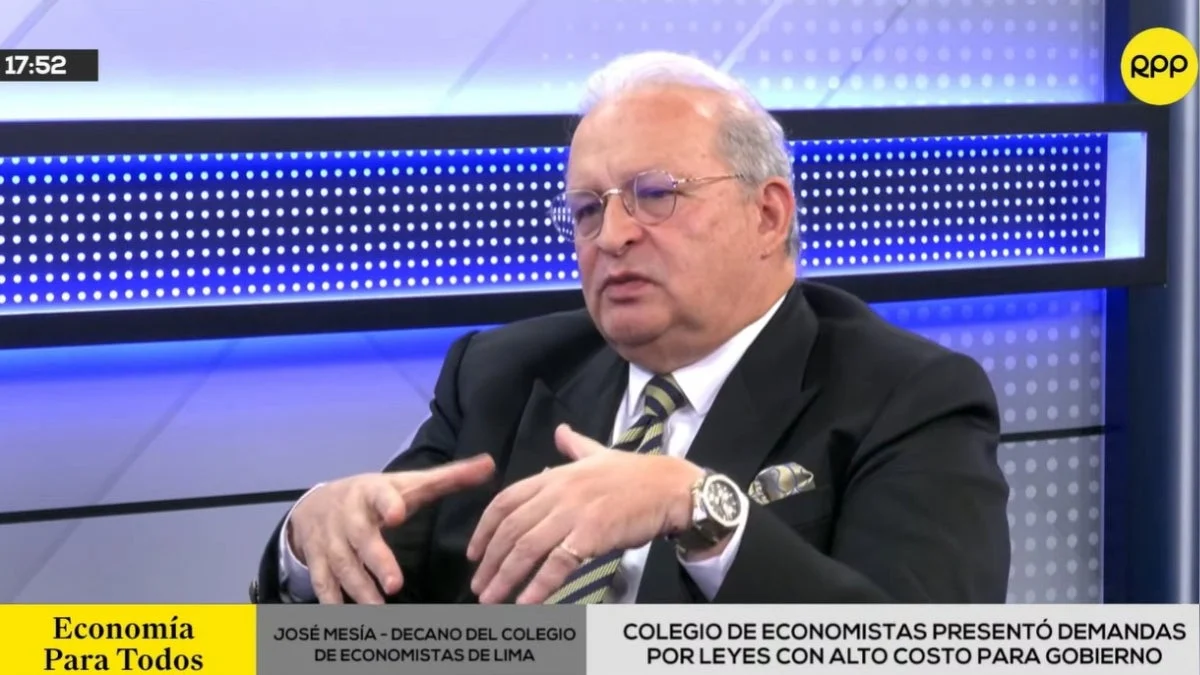
"We are acting on the fiscal front," Mesía Herrera clarified in an interview with RPP’s Economía para Todos. He was careful to emphasize that the legal challenge is not an attack on the beneficiaries themselves—be they military personnel or educators—but rather a critique of the legislative process that ignores the mathematical reality of the national budget. The danger, according to the College, is that by committing future revenues to fixed pension obligations, the State loses the ability to respond to emergencies or invest in infrastructure, healthcare, and education for the broader population.
The Impending Second Challenge: Law 32581
While the legal battle over military and police pensions is underway, the College is already preparing its second strike. Law 32581, which grants a fixed pension of S/3,500 to retired teachers, is under intense scrutiny.
Mesía Herrera confirmed that the documents for this second challenge have already been signed and are currently undergoing final review. The filing is expected within the week. The College views this law as a textbook example of "unfunded mandates," where the legislature creates a right without providing a corresponding, sustainable source of funding. By compelling the State to pay a fixed amount that does not account for actuarial variables, the legislature has once again prioritized immediate political gain over the integrity of the public pension system.
Official Responses and Institutional Positioning
The Ministry of Economy and Finance (MEF), under the leadership of Minister Elmer Cuba, has found an unlikely but powerful ally in the Lima College of Economists. While the MEF often faces political backlash for attempting to contain spending, the College provides an independent, technical validation of the government’s concerns.
The Constitutional Tribunal now holds the ultimate authority to determine the constitutionality of these laws. The proceedings will likely focus on whether the legislature exceeded its powers by creating laws that impose financial burdens on the State without sufficient technical backing or revenue streams.
Legal analysts suggest that this case could set a significant precedent for the "separation of powers" in Peru. If the TC rules in favor of the College of Economists, it would effectively curtail the ability of the Congress to pass legislation that unilaterally alters the fiscal landscape. Conversely, a ruling against the College could embolden future congresses to continue bypassing the MEF’s fiscal oversight.
Implications for Peru’s Economic Future
The broader implications of these legal challenges extend far beyond the specific pension amounts. At stake is the credibility of Peru’s fiscal framework.
1. Investor Confidence
International credit rating agencies monitor these developments closely. A trend toward unsustainable fiscal policies, particularly when they are protected by legislative mandates, can lead to credit downgrades, increased borrowing costs, and reduced foreign direct investment.
2. The Opportunity Cost of Spending
Every Sol spent on pension indexation is a Sol taken away from other areas of the national budget. As Mesía Herrera noted, these funds are effectively "spent" on current obligations rather than "invested" in the future. In a country where infrastructure gaps remain a primary barrier to development, the long-term impact of these laws could be a stagnation in economic competitiveness.
3. The Role of Professional Associations
The College of Economists of Lima is breaking new ground by exercising its constitutional prerogative to challenge laws. This signals a shift toward a more active civil society that demands technical rigor in policy-making. If professional associations continue to take on this role, it may foster a more disciplined approach to legislative drafting in the future.
Conclusion
The actions taken by the Lima College of Economists represent a critical intervention in a period of fiscal uncertainty. By utilizing the Constitutional Tribunal to address the legislative impulse toward unsustainable spending, the College is advocating for a return to the principles of long-term economic planning.
As the TC prepares to hear these cases, the nation watches closely. The outcome will not only determine the fate of specific pension regimes but will also define the boundaries of legislative authority and the future of fiscal responsibility in Peru. The message from the College is clear: the state’s resources are finite, and their management must be dictated by sound economic principles rather than political expediency. Whether this message resonates within the halls of the Constitutional Tribunal remains to be seen, but the precedent of this legal challenge has already permanently altered the landscape of the Peruvian economic debate.