Executive Summary: A Milestone in Global Integration
In a landmark development for South American diplomacy and economic policy, Peru has been officially recognized by the Organization for Economic Cooperation and Development (OECD) as the most advanced candidate nation among the eight countries currently navigating the complex accession process. This assessment, delivered by high-level OECD representatives, marks a turning point for the Andean nation as it seeks to align its regulatory frameworks, institutional integrity, and economic policies with the "gold standard" of global governance.
The announcement was confirmed by the President of the Council of Ministers (PCM), Luis Arroyo Sánchez, who characterized the progress as a testament to the continuity of state policy across successive administrations. As Peru nears a 40% completion rate in its roadmap toward membership, the country is positioning itself not merely as a candidate, but as a regional model for structural reform and modernization.
The Chronology of an Ambitious Roadmap
The path to OECD membership is notoriously rigorous, involving a multi-year audit of a nation’s legal, economic, and social standards. Peru’s journey toward this goal has been defined by three years of sustained, cross-ministerial effort.
Phase 1: Institutional Foundation (2022–2023)
The process began with the formation of a multisectoral commission led by the Presidency of the Council of Ministers (PCM), working in tandem with the Ministry of Foreign Affairs and the Ministry of Economy and Finance. This foundational phase focused on mapping the "gap analysis"—identifying where Peruvian legislation differed from the OECD’s acquis communautaire.
Phase 2: Structural Harmonization (2024–2025)
During this period, the commission acted as an internal engine, pushing for reforms in governance, anti-corruption measures, and environmental sustainability. By establishing a permanent representation in Paris, Peru ensured that its legislative agenda remained synchronized with the OECD’s technical committees.
Phase 3: The Paris Milestone (2026)
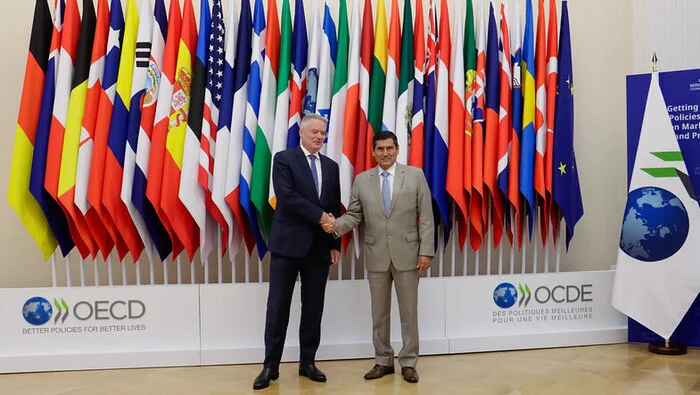
The current juncture represents the culmination of these efforts. During recent high-level meetings in Paris, the OECD Secretary-General, Mathias Cormann, formally acknowledged Peru’s superior pace of progress compared to its peers in the Latin American region. This validation serves as a critical morale booster for the domestic political landscape and a signal to international investors that Peru is committed to long-term regulatory stability.
Supporting Data: Why Peru Leads the Pack
The 40% advancement metric is not merely a symbolic figure; it represents a significant body of work across several technical domains.
- Multisectoral Synergy: The involvement of the PCM ensures that the accession process is not siloed within the Ministry of Finance but is instead treated as a whole-of-government priority.
- Regulatory Alignment: Peru has successfully integrated dozens of OECD best practices into its domestic legal code, particularly in areas concerning market competition, corporate governance of state-owned enterprises, and digitalization of public services.
- The "Permanent Representation" Factor: By maintaining a dedicated diplomatic and technical mission in Paris, Peru has effectively bridged the geographic and bureaucratic gap between Lima and the OECD headquarters. This has allowed for real-time adjustments to policies, preventing the delays that have hindered other candidate nations.
Official Responses and Strategic Vision
During his visit to Paris, Premier Luis Arroyo Sánchez emphasized that the progress achieved is a collective success. "This recognition is possible thanks to the diverse organizations and the different governments we have had, all of whom have worked to advance very rapidly along this path," Arroyo noted during his address.
The Mandate for Continuity
A central theme of the Premier’s statements was the necessity of political continuity. As Peru faces upcoming electoral cycles, the government is stressing the importance of treating OECD accession as a "State Policy" rather than a "Government Project."
"We are fulfilling the roadmap with rigor," Arroyo asserted. "It is essential that the next administration prioritizes this process to ensure we stay on the same path." This plea for continuity is directed at both domestic stakeholders and international partners, aiming to mitigate the risks associated with political volatility.
Implications of Accession: A Modernized State
The OECD, often referred to as the "club of developed nations," offers more than just prestige. For Peru, membership implies a profound transformation of the state apparatus.
1. Strengthening the International Image
Participation in the OECD Council at the Ministerial level allows Peru to shape the global economic agenda. It provides a platform to advocate for the specific needs of Latin American and Caribbean (LAC) economies, effectively elevating the country’s profile in the eyes of global credit rating agencies and multinational corporations.
2. The Transformative Impact of Policy Reforms
During the panel titled "The Transformative Impact of OECD Accession," Premier Arroyo highlighted that the process acts as a catalyst for internal reforms. By adhering to OECD standards, Peru is forced to improve:
- Institutional Transparency: Reducing the room for corruption in public procurement.
- Market Efficiency: Eliminating regulatory barriers that stifle competition and entrepreneurship.
- Environmental Governance: Aligning extraction and industrial standards with global green initiatives.
3. Mobilizing Multilateral Resources
At the 18th edition of the Latin America and Caribbean (LAC) Forum, Arroyo underscored the critical role of multilateral financial institutions. Accession to the OECD is expected to unlock better access to development credit, as the country’s creditworthiness and institutional maturity will be certified by the organization’s rigorous peer-review processes.
Deep Dive: The Role of the PCM and Technical Commissions
The success of Peru’s candidacy can be attributed to the "articulatory role" played by the Secretariat of the Commission. This body has acted as a bridge between the OECD’s technical committees and the various Peruvian ministries.
By fostering a culture of accountability, the PCM has managed to harmonize the disparate interests of different sectors. For instance, the Ministry of Economy and Finance has been able to push for fiscal transparency, while the Ministry of Foreign Affairs has managed the complex diplomatic maneuvering required to keep the candidacy high on the OECD agenda.
Challenges Ahead: The Road to 100%
While the 40% milestone is a cause for celebration, the remaining 60% represents the most difficult phase of the accession process.
- Legislative Hurdles: Many of the remaining reforms require significant changes to domestic laws, some of which may face opposition in the Peruvian Congress.
- Social Inclusion: A key criticism often leveled against OECD-style reforms is their potential to widen the gap between urban economic hubs and rural, underserved populations. The challenge for the next administration will be ensuring that "modernization" translates into tangible improvements in the quality of life for all citizens.
- Political Consensus: Maintaining a unified front regarding the OECD accession during an election year will require exceptional statesmanship. The current administration is working to build a broad consensus that cuts across ideological lines, framing OECD membership as the essential tool to escape the "middle-income trap."
Conclusion: A Future-Proofing Strategy
As Premier Luis Arroyo Sánchez concluded his series of meetings in Paris, the message from the Peruvian government was clear: the path to the OECD is not just about joining an organization; it is about "future-proofing" the Peruvian state.
By committing to international standards of governance, transparency, and economic stability, Peru is signaling to the world that it is open for business and ready for a new era of integration. The progress achieved over the last three years is more than a diplomatic achievement; it is a structural roadmap that, if followed with consistency, will define the economic trajectory of the nation for the next generation.
The focus now shifts to the implementation of the remaining roadmap, the continuity of the current multisectoral efforts, and the ability of the Peruvian political class to keep the country’s eyes on the horizon of global development. As the OECD looks to Latin America, Peru has positioned itself firmly at the forefront, turning a challenging accession process into a masterclass in national modernization.