As the dust settles on the initial voting days of the 2026 Regional and Municipal Elections, citizens across the country are watching the tally boards with bated breath. While the National Office of Electoral Processes (ONPE) has successfully processed a significant majority of electoral records, the question remains: When will the official, definitive results be declared?
The path to a final tally is not merely a mathematical summation; it is a rigorous, legally mandated process designed to safeguard the integrity of every single vote. Understanding why some regions are still in flux—and why others are already bracing for a potential second round—requires a deep dive into the complex machinery of electoral justice.
Main Facts: The Anatomy of an Electoral Record
At the heart of the electoral system lies the "acta electoral" (electoral record). This physical document is the DNA of the election; it contains the precise tally of votes for each candidate, as well as the count of blank and null ballots cast at a specific polling station.
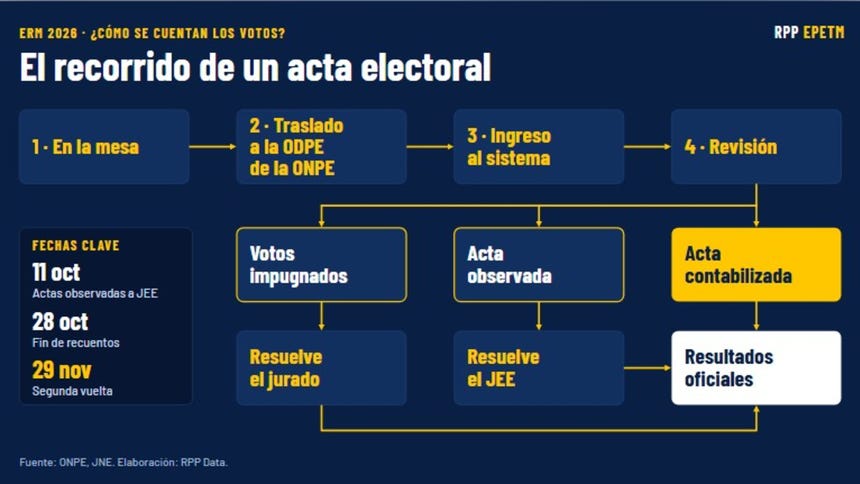
Once a polling station closes, the record is transported to the corresponding Decentralized Office of Electoral Processes (ODPE). Upon entry into the digital system, the document is classified as a "processed record." However, a common point of public confusion is the distinction between a "processed" record and a "counted" record.
The Critical Distinction: Processed vs. Counted
An electoral record is considered processed once it has been digitized and entered into the ONPE’s system. However, being processed does not automatically mean the votes are added to the final, official tally.
For a record to be counted, it must pass rigorous quality control checks. According to former ONPE chief Fernando Tuesta, "A counted record signifies that the scrutiny conducted at the polling station was flawless. There were no arithmetic errors, no missing signatures, and no challenges. Once these are entered into the system, those votes are finalized; they are immutable and cannot be modified."
The gap between "processed" and "counted" is precisely where the electoral suspense resides. It is the administrative filter that separates raw data from legally validated electoral outcomes.
Chronology: The Lifecycle of a Challenged Vote
The timeline of an electoral record is dictated by strict procedural deadlines designed to ensure transparency.
- The Scanning Phase (Immediate): Upon receipt at the ODPE, the record is digitized.
- The Verification Phase (Ongoing): If the system detects inconsistencies, the record is flagged.
- The Referral Deadline (October 11, 2026): By this date, the ONPE must have handed over all flagged or "observed" records to the Special Electoral Juries (JEE).
- The Adjudication Phase (Until October 28, 2026): During this window, JEEs conduct public hearings to resolve controversies and perform manual recounts if necessary.
- The Final Certification: Once the JEE issues a resolution, the record is returned to the ONPE to be formally incorporated into the national count.
This structured timeline ensures that the transition from initial reports to final results follows a predictable, albeit methodical, pace.
Supporting Data: Why Records Get "Observed"
When an electoral record is flagged as "observed," it enters the jurisdiction of the National Jury of Elections (JNE). Yéssica Clavijo, Secretary General of the JNE, explains that these observations are not necessarily signs of fraud, but often procedural hiccups that require judicial intervention.
"Errors can arise from a variety of sources at the polling station," Clavijo notes. "We frequently see arithmetic errors, material oversights, or records that lack the required signatures. Sometimes, the handwriting is simply illegible. These issues prevent the data from being entered into the system, and therefore, the document is moved to the ‘observed’ pile until the Special Electoral Jury can rule on it."
The Mechanism of Resolution: The Special Electoral Juries (JEE)
The JEEs serve as the first line of electoral justice. Alexandra Marallano, former Secretary General of the JNE, explains that the JEEs act as a check-and-balance system. They compare their physical copies of the record against the ones submitted by the ODPE.
"The resolution issued by the JEE is the final word on the status of that specific record," Marallano explains. "Once the controversy is cleared and the resolution is firm, the record is sent back to the ONPE for the votes to be officially counted."
In cases of significant discrepancies, the law provides for a manual recount. Introduced as a formal mechanism in the 2026 General Elections, this process involves opening the ballot boxes and counting the physical ballots one by one. This is conducted in a public hearing, with representatives from political parties and the Public Ministry present to ensure absolute transparency.
Official Responses: The Case of Impugned Votes
Beyond simple clerical errors, there is the issue of impugned votes. These occur when, during the live counting process at a polling station, a political party representative challenges the validity of a specific ballot—perhaps claiming the mark is ambiguous or that the voter’s intention is unclear.
In these instances, the local polling station officials cannot unilaterally decide the fate of the vote. The ballot is set aside, and the decision is escalated to the plenary of the JNE. These challenges are often decisive in close races, where a handful of disputed ballots can determine the outcome of a municipal seat or, in some cases, the thresholds required to avoid a second round of voting.
Implications: The Road to the Second Round
The resolution of these electoral records carries immense weight. The outcome of the regional elections depends on these final figures, as they determine whether a candidate has reached the necessary percentage of the vote to claim victory or whether the region must head to a second round.
The Stakes of November 29
The second round of the 2026 elections is currently scheduled for November 29. However, the path to this date is contingent upon the completion of the JNE’s work. If the resolution of observed records and impugned votes shifts the final percentages beyond the legal thresholds, regions that initially appeared to have a clear winner might suddenly find themselves back in the electoral arena.
The electoral authorities are acutely aware of the pressure. By adhering to the October 28 deadline for the completion of recount hearings, the JNE and ONPE aim to provide the electorate with the certainty they demand while upholding the democratic principles of fairness and accuracy.
Conclusion: Trust in the Process
The complexity of the electoral system—from the initial count at the ballot box to the judicial review at the JNE—is a testament to the effort invested in protecting the "one person, one vote" principle. While the wait for 100% of the results may cause frustration, it is a necessary buffer against error.
As the nation waits for the final official tally, citizens are reminded that every observed record, every contested vote, and every manual recount is a step toward ensuring that the final, published result is a true and accurate reflection of the public will. In the 2026 elections, the law remains the ultimate arbiter, ensuring that justice is not just done, but seen to be done.