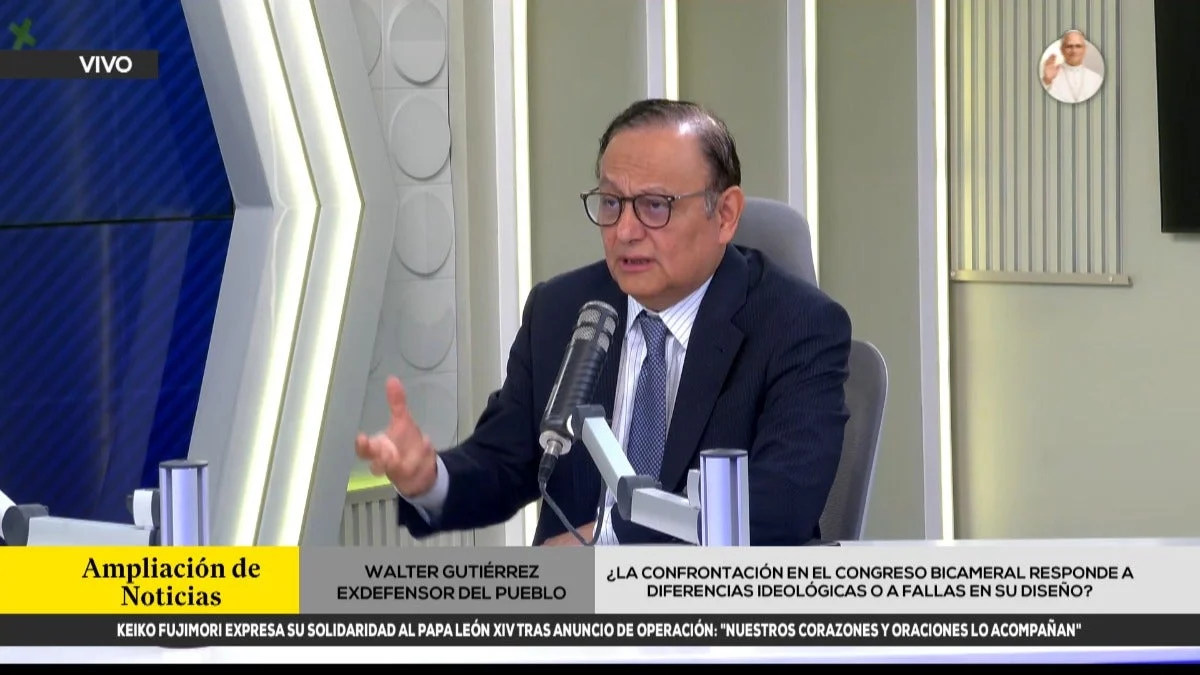
In a scathing critique of the current state of the Peruvian legislative branch, former Ombudsman Walter Gutiérrez has sounded the alarm regarding the deteriorating quality of parliamentary conduct. Addressing the recent physical and verbal altercations within the Senate’s Constitutional Commission, Gutiérrez argued that the legislative body has abandoned its institutional duties, effectively transforming itself into a "generator of conflict" that actively undermines the nation’s economic and social stability.
The incident, which involved a heated confrontation between Senators Iber Maraví (Juntos por el Perú) and Francisco Calisto Giampietri (Renovación Popular), alongside Minister of the Interior César Astudillo, has served as a catalyst for a broader national debate. For Gutiérrez, this spectacle is not merely a momentary lapse in decorum, but a symptom of a systemic collapse in how political actors view their roles within a democracy.
The Anatomy of the Conflict: A Chronology of Institutional Decay
The recent tension in the Commission of the Constitution was not an isolated event but rather the culmination of months of friction between the executive branch and the legislative chambers.
The Triggering Event
The session, intended to address critical legislative reforms, devolved into chaos when ideological grievances took precedence over parliamentary procedure. The altercation between Senators Maraví and Calisto—two figures representing diametrically opposed political spectrums—highlighted the increasing inability of the current Congress to facilitate discourse. When Minister of the Interior César Astudillo attempted to mediate or provide administrative clarification, the focus of the session shifted from the national agenda to personal grievances and political posturing.
Escalation of Hostilities
Following the outburst, the political climate within the halls of Congress remained volatile. Observers noted that the incident reflected a growing trend where inter-party cooperation is replaced by performative obstructionism. The inability of legislative leadership to contain such outbursts has led many, including the former Ombudsman, to question the competency of those currently holding the gavel.
A Taxonomy of the Contemporary Legislator: Gutiérrez’s Assessment
In an interview on the program Ampliación de Noticias, Walter Gutiérrez offered a candid, albeit grim, classification of the current parliamentary body. He proposed that the current Congress is fragmented into three distinct profiles, each contributing differently to the institution’s current state of paralysis.
1. The Anti-Systemic Infiltrators
Gutiérrez identified a significant cohort of legislators who, in his view, harbor a fundamental disdain for the democratic system. "There are congresistas who have no interest in their actual functions," he remarked. "They are present not because they believe in the system, but because they have successfully infiltrated it to dismantle it from within." This group, according to Gutiérrez, views the parliamentary process as a platform for agitation rather than a mechanism for governance.
2. The Novice Democratic Contingent
The second group described by the former Ombudsman consists of individuals who possess a genuine democratic intent but suffer from a critical lack of parliamentary experience. This demographic, often elected in waves of populism, struggles to navigate the complexities of legislative drafting, committee management, and constitutional oversight. While Gutiérrez expressed a sliver of hope that these members might eventually grow into their roles, he warned that their current learning curve is proving costly for the nation’s stability.
3. The Institutionalist Minority
Finally, Gutiérrez acknowledged a third, significantly smaller group of legislators who fully grasp the gravity of their constitutional responsibilities. These individuals are characterized by their commitment to the rule of law and the separation of powers. However, he lamented that this group is frequently sidelined, drowned out by the noise and belligerence of the aforementioned groups.
The Economic and Social Toll: Beyond the Congressional Walls
The most pressing warning issued by Gutiérrez centers on the "spillover effect" of political dysfunction. He emphasized that the consequences of legislative volatility are not contained within the legislative palace; rather, they permeate every layer of Peruvian society.
Impact on Citizen Security
The lack of a coherent, unified legislative agenda creates a power vacuum that directly influences public safety. When the Ministry of the Interior and the legislative oversight bodies are at odds, the implementation of security policies suffers. Criminal organizations, exploiting the distraction of the political class, often expand their reach when law enforcement agencies are preoccupied with political survival rather than operational success.
Employment and Economic Uncertainty
Business confidence is inextricably linked to political stability. Investors and small-to-medium enterprise owners alike look to the capital for signs of continuity. When Congress shifts its focus to constant interpellation and internal bickering, the resulting uncertainty drives away foreign investment and stifles domestic growth. Gutiérrez argues that every day spent in political conflict is a day lost for job creation and economic recovery.
The Erosion of Public Services
Perhaps most damaging is the degradation of public services. The effective functioning of the state requires a seamless interplay between the budget-allocating legislature and the service-providing executive. When this relationship breaks down, the primary casualties are the citizens who rely on public health, education, and infrastructure. The politicization of administrative appointments further compounds this, as meritocracy is frequently sacrificed for political patronage.
The Mandate of Control: A Call for Self-Regulation
Central to Gutiérrez’s critique is the concept of parliamentary oversight. "A Congress has the duty to represent, to legislate, to appoint authorities, and to control," he stated. "But it also has the duty to control itself, because it cannot effectively control others if it does not first control its own conduct."
This statement serves as a rebuke to the current leadership of the Congress, which has been criticized for its lax enforcement of the Code of Ethics. Without a robust system of internal discipline, the body risks descending into a state of permanent anarchy, where the rules of order are ignored in favor of the whims of the loudest voices.
Implications for the Future of Democracy
As the political crisis unfolds, the implications for the future of the Peruvian democratic project are profound. If the legislature continues to act as a barrier to governance rather than a facilitator, the risk of a total breakdown in public trust increases exponentially.
The Need for Institutional Reform
Gutiérrez’s observations underscore a desperate need for structural reform, including more rigorous requirements for parliamentary candidates and a stronger emphasis on political education. The current system, which allows for the rapid rise of individuals with no experience or commitment to democratic norms, is arguably failing to serve the public interest.
The Role of Civil Society
The former Ombudsman’s words act as a clarion call for civil society, the press, and the public to demand greater accountability. The narrative that political conflict is an unavoidable "cost of doing business" must be rejected. Instead, the focus should return to the fundamental purpose of the legislative branch: the creation of a stable, functional, and equitable society.
In conclusion, Walter Gutiérrez’s analysis provides a sobering reality check. The incident involving Senators Maraví and Calisto is not merely a piece of political theater; it is a manifestation of a deeper institutional malaise. If the current Parliament does not heed the warning to prioritize constitutional duty over ideological warfare, the cost will continue to be paid by the citizens in the form of diminished security, fewer jobs, and a further erosion of the public services that constitute the backbone of a functioning state. The path forward requires not just new laws, but a fundamental reassessment of the values and responsibilities inherent in holding public office.