The Regional Government of Moquegua is reaching a pivotal milestone in its efforts to modernize public education infrastructure. With the Amparo Baluarte Educational Institution (I.E.) project currently at a 75% completion rate, the region is preparing to deliver a state-of-the-art facility that promises to redefine the learning experience for hundreds of students.
Main Facts: A Landmark Educational Investment
The redevelopment of the Amparo Baluarte school represents one of the most significant investments in local educational infrastructure in recent years. With a budget exceeding S/ 22 million, the project is designed not merely as a renovation, but as a complete structural overhaul aimed at meeting modern international standards for safety, inclusivity, and technological integration.
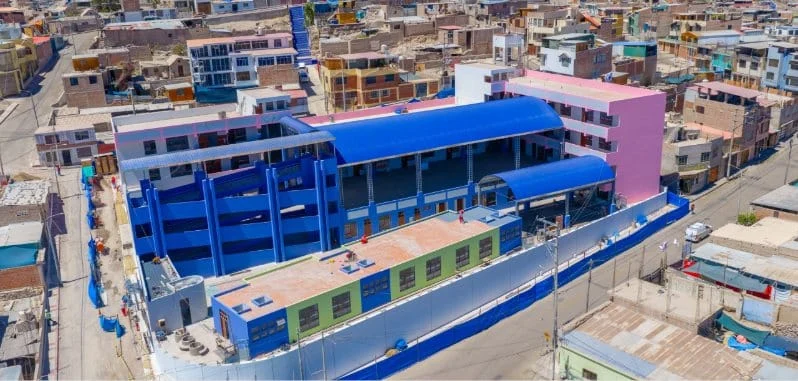
As of September 2026, the construction site is in its final phase. Engineering teams are currently focused on the meticulous details of the project’s completion: exterior paving, advanced roof waterproofing, and final interior finishing touches. This development marks a transition from heavy structural construction to the refinement of spaces that will soon house 300 students across the Initial (preschool) and Primary education levels.
The infrastructure is designed as a three-story complex, prioritizing accessibility and safety. Key features include:
- Inclusive Design: Specialized ramps, handrails, and resting platforms that ensure full mobility for students with disabilities.
- Advanced Safety: Encapsulated aerial bridges connecting various wings of the building, providing secure transit for children during class changes.
- Climate Adaptation: A sophisticated drainage system utilizing gutters and grates, paired with metallic covers and self-supporting roofs designed to mitigate the harsh local sun and high temperatures.
Chronology of Development
The path to this 75% milestone has been a journey of careful planning and execution. The project began with the identification of a significant "infrastructure gap" in the Moquegua region, where aging facilities no longer met the demands of a growing student population.

- Initial Planning and Procurement: The regional government prioritized the project based on the critical need to replace outdated, unsafe structures with a facility capable of hosting a modern curriculum.
- Mobilization and Groundbreaking: Construction commenced with the clearing of the site and the laying of deep-foundation systems, essential for a three-story build in this topography.
- Structural Framing: Throughout the previous year, the skeletal structure was erected, involving the installation of reinforced concrete columns and the complex aerial bridges that distinguish this facility from standard school designs.
- The "Contingency" Phase: During the construction period, the educational community transitioned to temporary facilities. While this presented challenges, the Regional Government ensured that the transition was seamless, allowing students to continue their academic growth without interruption.
- Current Finishing Phase: With the primary structures complete, the site has entered the final quarter of construction, where the focus shifts to aesthetic finishes, technical equipment installation, and final safety inspections.
Supporting Data: Infrastructure and Technology
The Amparo Baluarte project is more than just concrete and steel; it is an integrated technological hub. The school is being equipped with modern educational tools designed to prepare students for a digital-first future.
The FabLab Initiative
A standout feature of the new facility is the inclusion of a "FabLab" (Fabrication Laboratory). This space is dedicated to innovation, research, and hands-on technological experimentation. By providing children with access to 3D printing, prototyping tools, and digital design software, the school aims to foster a culture of inquiry and engineering from a primary level.
Digital Classroom Integration
Each classroom and administrative office will be outfitted with brand-new, high-end furniture and technology, including interactive whiteboards and modern computer terminals. This represents a significant shift from traditional teaching methods to an interactive, digital-centric pedagogy.
Recreational Infrastructure
Recognizing that physical health and play are as vital as academics, the regional government has invested heavily in the recreational zones:
- Sports & Culture: A dedicated multipurpose patio designed for both high-intensity sports and cultural performances.
- Early Childhood Play Area: A specialized zone for the 42 students in the 3, 4, and 5-year-old cohorts, featuring synthetic turf, safe-surface slides, and swings.
Official Perspectives and Educational Impact
The project is viewed by the Moquegua Regional Government as a flagship initiative. By concentrating resources on a total of 300 students, the administration is focusing on a high-quality "per capita" impact rather than spreading funds too thinly.

"Our goal is to ensure that every student, regardless of their age or physical ability, has an environment that encourages them to succeed," noted a spokesperson for the regional infrastructure department. The emphasis on "encapsulated" designs and climate-resilient roofing demonstrates a proactive approach to the environmental challenges of the region, ensuring that education is not disrupted by weather conditions or extreme heat.
The project also addresses the pedagogical needs of the 21st century. By moving away from cramped, outdated rooms to open, airy, and technologically connected spaces, the school is facilitating a more collaborative environment. The inclusion of the FabLab suggests a long-term vision where Moquegua’s youth are not just consumers of technology, but creators of it.
Implications for the Moquegua Community
The near-completion of the Amparo Baluarte school has profound implications for the local community.
1. Social Mobility through Education
Access to superior facilities is a key driver of student retention and performance. By providing a safe, comfortable, and tech-forward school, the region is directly investing in the future human capital of the Moquegua province.
2. Setting a Benchmark for Public Works
With a budget of S/ 22 million, the project sets a high bar for public accountability and construction quality. The project’s transparency and consistent progress serve as a model for other regional governments in Peru. It demonstrates that large-scale infrastructure projects can be managed effectively when paired with a clear focus on the specific needs of the end-users—the children.

3. Economic and Urban Revitalization
The construction project has generated local employment opportunities during its build phase and will continue to support the local economy through the maintenance and operation of the new facility. Furthermore, the modernized school acts as a focal point for the neighborhood, potentially increasing property values and encouraging further investment in the surrounding area.
4. A Template for Inclusion
The integration of accessibility features (ramps, platforms, and safe transit routes) is a powerful statement on inclusivity. By making the school physically accessible to all, the government is signaling that education is a right to be enjoyed without physical barriers.
Conclusion: A Bright Horizon
As the 75% mark turns into 80%, 90%, and finally 100% completion, the excitement within the Moquegua community is palpable. The transition from the current contingency classrooms to the state-of-the-art facility will be a major celebratory moment for parents, students, and teachers alike.
The Amparo Baluarte Educational Institution stands as a testament to what can be achieved when regional authorities prioritize the fundamental needs of the next generation. It is not just a building; it is a foundation upon which the future leaders, innovators, and citizens of Moquegua will be built. As the final touches are applied, the community looks forward to the day the doors open, ushering in a new era of educational excellence.