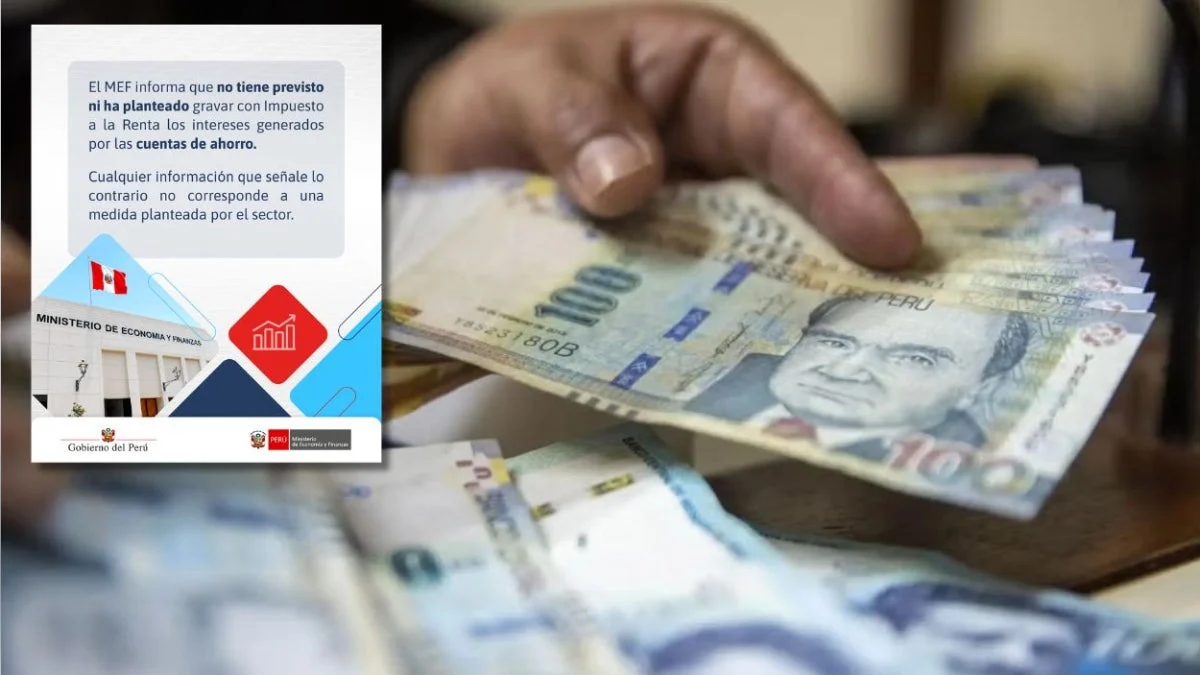
In a move to quell growing public concern regarding the security of personal savings, the Peruvian Ministry of Economy and Finance (MEF) issued a formal clarification this week, categorically denying any intention to impose an Income Tax on interest generated by personal savings accounts. The statement comes on the heels of widespread speculation triggered by the publication of the Multiannual Macroeconomic Framework (MMM) for 2027-2030, which listed the current tax exemption on savings interest as a benefit slated to expire at the end of 2026.
The Genesis of the Uncertainty: A Technical Audit vs. Policy Proposal
The confusion originated from the technical nature of the Multiannual Macroeconomic Framework (MMM) 2027-2030. As a cornerstone document for national fiscal planning, the MMM provides a comprehensive look at the government’s projections, including a transparent inventory of all existing "tax expenditures"—benefits, exemptions, and incentives that represent revenue the state chooses not to collect in exchange for promoting specific economic behaviors, such as encouraging formal savings.
Within the document, the MEF outlined several tax benefits scheduled to expire on December 31, 2026. Among these items, the exemption on Income Tax for interest earned on bank deposits and Cooperatives of Savings and Credit (COOPAC) was highlighted with an associated fiscal cost. For the general public, the listing of this exemption in a document regarding 2027 fiscal projections was misinterpreted as a signal that the government intended to let the exemption lapse, effectively triggering a new tax burden on depositors.
However, the Ministry was quick to intervene. "The MEF informs that it has neither planned nor proposed to levy an Income Tax on the interest generated by savings accounts," the institution stated in a series of social media posts. "Any information suggesting the contrary does not correspond to a measure proposed by the sector."
Chronology of the Exemption and Legislative Precedents
To understand why this issue holds such weight in the Peruvian financial system, one must look at the history of the tax exemption. The policy of keeping savings interest tax-free is designed to encourage individuals to keep their money in the formal banking system, which in turn provides liquidity to banks to facilitate loans, mortgages, and investment.
- Pre-2023: The exemption has been a recurring feature of Peru’s tax landscape, subject to periodic renewals by the Executive branch.
- April 2023: Under the administration of President Dina Boluarte and then-Minister of Economy Alex Contreras, the government issued Legislative Decree 1549. This decree officially extended the tax exemption on savings interest and interest from cooperatives until December 31, 2026.
- Present Day: As the country approaches the 2026 deadline, the "sunset clause" naturally appears in technical reports like the MMM. However, the inclusion of the figure in a report does not constitute a policy change, but rather a budgetary acknowledgement of the "fiscal cost" of maintaining the status quo.
Fiscal Impact and Economic Significance
The MEF’s report serves as a vital tool for fiscal transparency. By quantifying the "cost" of tax exemptions, the government allows analysts and the public to see exactly how much revenue is forgone to support specific social or economic outcomes.
According to the 2027-2030 projections:
- Bank Deposits: The tax exemption on interest generated by personal bank accounts carries a projected fiscal cost of approximately S/ 268 million for the year 2027. This represents roughly 0.02% of the national GDP.
- Cooperatives (COOPAC): The exemption for interest generated by deposits in savings and credit cooperatives is estimated to cost the treasury S/ 25 million annually.
- Aggregate Impact: Combined, these exemptions represent a total of S/ 293 million per year that the state does not collect.
When considering the broader list of all tax exemptions expiring in 2026, the total potential fiscal cost reaches S/ 848 million. For the MEF, the goal is to evaluate whether these exemptions continue to meet their objectives, but the Ministry maintains that penalizing individual savers is not on the table.
The Mechanics of Renewal: What Happens Next?
While the MEF has provided a verbal guarantee that they do not intend to tax savings, the reality of the Peruvian legislative framework is that a simple ministerial statement is not a permanent law. Because the current exemption is tied to a specific date—December 31, 2026—the legal framework will eventually require a new mechanism to extend this benefit beyond that point.
As it stands, the burden of ensuring this exemption continues lies in future legislative action. Whether through a new Executive decree or a bill presented to Congress, the government will need to formalize the extension before the current deadline arrives. Experts suggest that the government is likely to monitor the fiscal situation throughout 2025 and 2026 before drafting the necessary legislation to ensure the continuation of the incentive.
Implications for the Financial System
The reaction to the MMM report highlights the sensitivity of the Peruvian public to changes in fiscal policy. In a post-pandemic economic environment, where inflation and interest rate fluctuations have already impacted household budgets, the prospect of an additional tax on interest—however small—was viewed with significant apprehension.
Financial analysts note that taxing savings interest would be counterproductive to the government’s goals of "financial inclusion." If savers were taxed on their modest returns, they might move their capital toward informal savings methods, which would weaken the stability of the banking sector and reduce the availability of credit for businesses and consumers.
By clarifying the situation so promptly, the MEF has sought to prevent a potential "run" on deposits or a decline in consumer confidence. The ministry’s commitment suggests that they recognize the importance of maintaining a stable, tax-neutral environment for personal savings to encourage capital formation in the country.
Conclusion: A Balancing Act of Fiscal Transparency
The incident surrounding the 2027-2030 Multiannual Macroeconomic Framework serves as a case study in the complexities of government communication. While the MEF was fulfilling its duty to provide a transparent accounting of fiscal expenditures, the technical nature of the language used was easily misconstrued.
Moving forward, the challenge for the Peruvian government will be to balance its commitment to fiscal transparency with the need to communicate effectively with the public. As the 2026 deadline approaches, all eyes will be on the Ministry of Economy and the Congress to see how they navigate the legislative process to secure the future of these exemptions. For now, the message from the government is clear: the savings of individuals are safe from new taxation, and the current regime of tax-free interest remains a priority for the state’s economic strategy.
For the average citizen, the assurance from the MEF should provide the necessary peace of mind to continue utilizing formal banking institutions, knowing that their modest gains from interest are protected by the current legislative mandate and the explicit policy position of the current administration.