The upcoming 2026 Regional and Municipal Elections in Peru have hit a significant procedural impasse. A coalition of 14 political organizations has formally petitioned the Pleno of the National Jury of Elections (JNE) to issue a binding, definitive ruling regarding the legal status of former mayors running as first councilors. The core of the controversy centers on whether these candidates, if their respective lists are victorious, are legally permitted to be granted the credentials to assume the office of Mayor, thereby effectively bypassing constitutional prohibitions against immediate re-election.
This request, delivered with a sense of urgency, has stalled critical logistical preparations for the highly anticipated debates for the Metropolitan Municipality of Lima, scheduled for September 21 and 22. As the electoral calendar tightens, the lack of clarity from the country’s highest electoral authority is fueling concerns over political transparency, fairness, and the potential for post-election legal crises.
The Genesis of the Conflict: A "Covert Re-election"?
The controversy arises from a strategy employed by several political groups in the 2026 cycle. Following the municipal elections of 2022, which saw various individuals elected as mayors, these same figures are now appearing on ballots as candidates for the position of "First Councilor."
Critics, including a significant bloc of the competing political parties, argue that this configuration is a "covert re-election" strategy. They contend that if these candidates were to be elected as councilors and subsequently ascended to the mayoral seat—perhaps through a vacancy or a predetermined legal succession mechanism—it would undermine the spirit of the constitutional mandate prohibiting the consecutive re-election of mayors.
The JNE, led by President Roberto Burneo, previously clarified that there is no express legal prohibition against an authority elected in 2022 running for a councilor position in 2026. However, the legal ambiguity persists regarding the consequence of a victory: can an individual who served as mayor in the previous term receive the mayoral credential simply by virtue of being the first name on a winning council list? This "gray area" has become the focal point of the current electoral dispute.
Chronology of the Standoff
The tensions escalated during the initial negotiation session convened by the JNE on Monday, September 7, aimed at organizing the logistics for the Lima mayoral debates.
- September 5: JNE President Roberto Burneo acknowledges the complexity of the situation in an interview, admitting that while the eligibility of these candidates to run for councilor is settled, the outcome regarding their potential assumption of the mayoral office remains an open question for the Pleno.
- September 7: The JNE holds a mesa de negociación with 19 of the 26 competing political organizations. During this session, it is revealed that Renovación Popular has requested that Rafael López Aliaga—the party’s candidate for first councilor—represent the group in the upcoming mayoral debates.
- September 7 (Afternoon): A fierce debate breaks out among the 19 parties present. Parties such as the APRA, the PPC, and the Partido Patriótico del Perú voice strong opposition, arguing that the debate participants must be legitimate candidates for the mayoralty, not individuals whose legal ability to hold the office is in question.
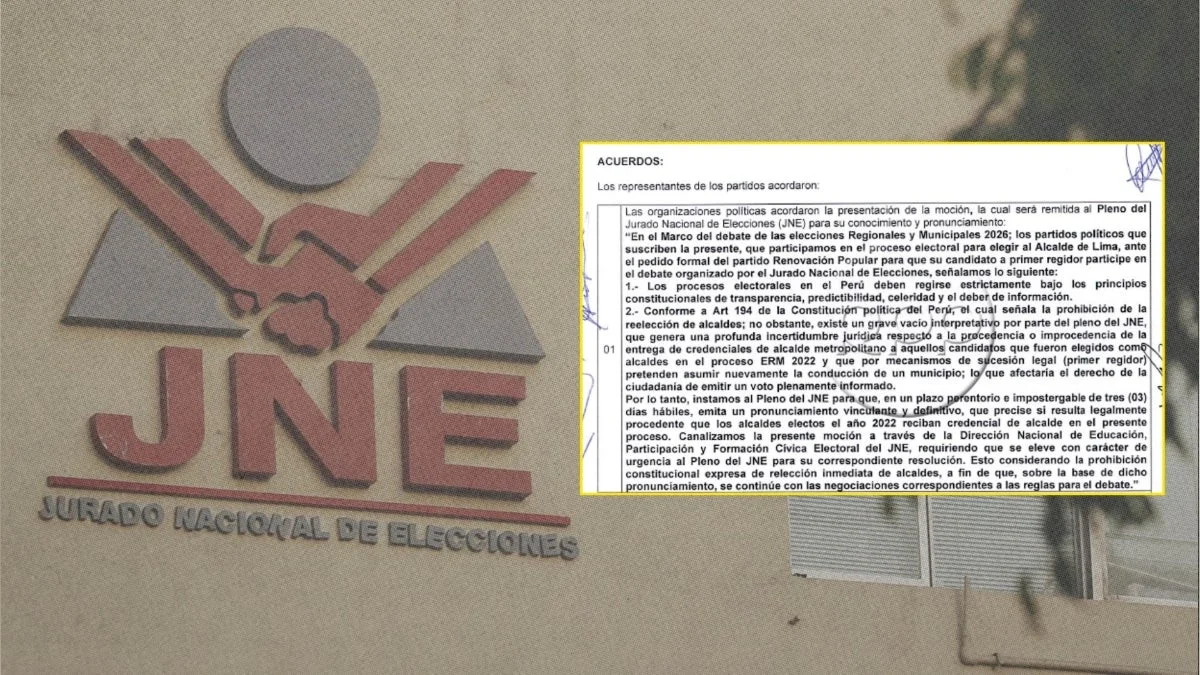
- September 7 (Evening): A formal vote is taken. 14 of the 19 organizations present sign an agreement demanding a binding ruling from the JNE within three business days.
- September 8: The political landscape remains in a state of paralysis as the JNE is officially served with the petition, with the deadline set for Thursday, September 10.
Stakeholder Positions: A Divided Political Spectrum
The rift between the political organizations reflects deep-seated anxieties about electoral ethics and the "level playing field."
The Coalition of 14
The group, which includes diverse political forces such as Podemos Perú, Somos Perú, Avanza País, and the APRA, argues that the "grave interpretive void" must be filled immediately. Their formal resolution states: "We urge the Pleno of the JNE to issue, within a peremptory and non-extendable period of three business days, a binding and definitive pronouncement that clarifies if it is legally appropriate for mayors elected in 2022 to receive the mayoral credential in this process."
Their primary concern is that the electorate is being misled. They argue that if a candidate campaigns as a councilor, but intends to exercise the office of mayor, the voters are not being presented with a transparent choice. Furthermore, they fear that proceeding with the debate before this is settled would grant an unfair platform to candidates who are testing the limits of constitutional law.
The Dissenting Voice: Renovación Popular
Renovación Popular, the only organization to vote against the resolution, has accused the other parties of attempting to "coax" or "coerce" the JNE. In a formal statement included in the meeting’s minutes, the party argued that the demand for a ruling is a tactical maneuver by its rivals to exclude their candidate from the debate. They maintain that the current legal framework is clear enough to allow their participation and that the pressure on the JNE is an infringement on the electoral body’s independence.
The Role of the JNE: A Judicial Dilemma
Carlos Vilela, the JNE’s Director of Education, Participation, and Electoral Civic Training, has acknowledged the difficulty of the situation. Vilela emphasized that the decision is "strictly jurisdictional," meaning it resides solely within the power of the Pleno of the JNE.
The JNE faces a delicate balancing act. On one hand, it must protect the constitutional prohibition against re-election and ensure that the election process is not subverted by creative interpretations of the law. On the other hand, it must ensure that it does not appear to be interfering in the political process or arbitrarily excluding candidates, which could lead to claims of bias or disenfranchisement.
The JNE’s upcoming decision will set a precedent for the remainder of the 2026 electoral cycle. If they rule against the candidates, it could result in the disqualification of entire lists or require major adjustments to the candidate lineups of several prominent parties. If they rule in favor, they may face a firestorm of criticism regarding the integrity of the mayoral office itself.
Wider Implications for the 2026 Elections
The implications of this standoff extend far beyond the upcoming debate.
- Institutional Credibility: The speed and clarity of the JNE’s response will either bolster or diminish public confidence in the institution. As Peru has faced significant political instability in recent years, the JNE’s role as a final arbiter of legitimacy is under intense scrutiny.
- The "Debate" as a Battleground: The debate has transformed from a venue for policy discussion into a tactical battlefield. If the debate proceeds without a ruling, the event itself may be overshadowed by protests or boycotts from those who feel the rules of the game are being violated.
- Future Legislation: This controversy will almost certainly serve as a catalyst for future electoral reforms. Whether the current rules are interpreted loosely or strictly, it is clear that the existing framework leaves too much room for ambiguity, leading to the kind of friction currently paralyzing the Lima mayoral race.
- Voter Education: The incident highlights the urgent need for better voter education. As the legal maneuvering continues, the average citizen may be left confused as to why the candidates for mayor are the subject of such intense judicial debate, further alienating a public already weary of political scandal.
As the deadline of September 10 approaches, the eyes of the Peruvian political establishment are fixed on the offices of the JNE. Whether the Court chooses to provide the requested clarity or maintains its previous stance, the decision will undoubtedly leave a lasting mark on the 2026 election cycle, serving as a reminder that the health of a democracy depends as much on the clarity of its rules as it does on the participation of its citizens.