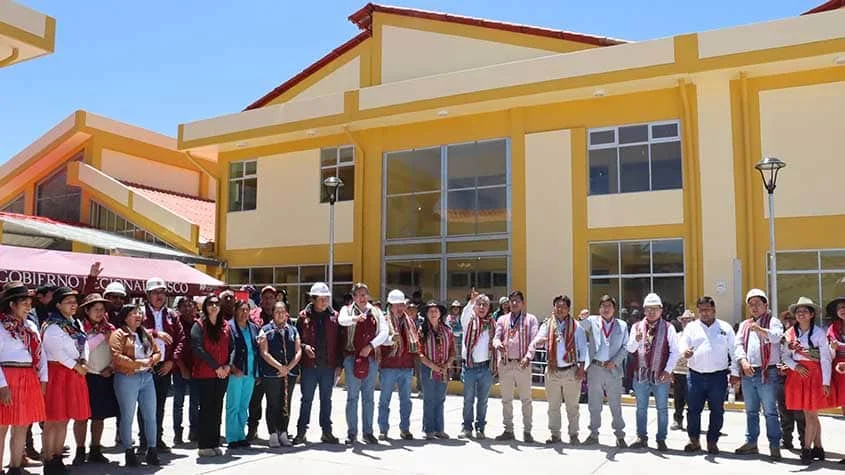
In a significant move to decentralize healthcare services and bridge the historical gap in medical accessibility, the Regional Government of Cusco has officially inaugurated a state-of-the-art medical facility in the district of Ccapi, located within the province of Paruro. The project, which represents a public investment of over S/ 19 million, stands as a testament to the regional administration’s commitment to prioritizing public health infrastructure in the sierra sur region.
The new center, classified as a Level I-4 establishment, marks a transformative shift for the local community, transitioning from basic primary care to a facility capable of providing specialized medical services. Governor Werner Salcedo Álvarez, who led the inauguration ceremony, emphasized that this milestone is the culmination of over a decade of advocacy by the residents of Paruro.
The Scope of the Project: Modernizing Rural Healthcare
The newly opened facility is far more than just a building; it is a comprehensive medical complex designed to serve the immediate needs of 3,860 inhabitants and surrounding rural sectors. By elevating the facility’s status to a Level I-4, the regional government has ensured that the residents of Ccapi no longer need to travel to the city of Cusco for essential diagnostic and clinical procedures.
The center features a wide array of specialized areas, including:
- Clinical Services: Comprehensive medicine, pediatrics, and gynecology/obstetrics.
- Diagnostics and Support: Advanced laboratory services, ultrasound imaging, and dental care.
- Emergency and Surgical Support: A dedicated birthing center and a minor surgery unit.
- Community Support: Specialized areas for mental health, a vaccination program, and dedicated programs for the comprehensive care of the elderly.
This infrastructure is supported by modern biomedical equipment and clinical furniture, ensuring that the facility functions at a high resolution capacity within the Yaurisque micro-network.

A Chronology of Progress: From Promise to Delivery
The journey to the completion of the Ccapi health center spans over ten years, characterized by periods of planning, budget allocation, and construction management.
The Planning Phase (2014–2020)
For over a decade, the residents of Ccapi voiced concerns regarding the precarious state of their local health post. The facility was severely limited in its ability to handle emergency cases, forcing expectant mothers and trauma patients to endure hours of travel to reach the nearest hospital in the provincial capital or Cusco. The project was initially proposed to address the high rates of infant mortality and the lack of maternal health monitoring in the region.
Budgeting and Institutional Approval (2021–2023)
The regional government identified the project as a priority for the "Closing Gaps" initiative. Through careful financial planning and collaboration with the Ministry of Health (MINSA), the S/ 19 million budget was secured. The focus was not only on construction but also on the long-term sustainability of the facility, including the procurement of medical-grade technology that could withstand the environmental challenges of the high-Andean terrain.
The Execution Phase (2024–2026)
Construction proceeded in stages, with strict oversight to ensure that the facility met national health infrastructure standards. Despite the logistical challenges associated with transporting high-tech equipment to the rural province of Paruro, the project reached completion in October 2026.
Supporting Data and Technical Impact
The decision to invest S/ 19 million in a rural district is grounded in data-driven health policy. According to regional health authorities, the previous infrastructure was unable to manage even 30% of the patient demand in the Yaurisque micro-network.

- Capacity Resolution: The new I-4 classification allows for 24-hour emergency care, a critical requirement for a population that lives in a geographically dispersed and rugged environment.
- Economic Impact: Beyond health outcomes, the facility reduces the "out-of-pocket" expenditure for local families. Previously, patients and their families incurred significant costs related to transportation, lodging, and lost work days while seeking treatment in distant urban centers.
- Preventative Care: The integration of mental health and geriatric care represents a modern approach to public health, recognizing that rural populations are increasingly facing chronic conditions that require long-term management rather than just emergency intervention.
Official Responses and Strategic Vision
During the inauguration, Governor Werner Salcedo Álvarez underscored the symbolic and practical importance of the project. "This is not just about concrete and steel," the Governor stated. "It is about restoring the dignity of our people in Paruro. For ten years, this community asked for a chance to be healthy, a chance for their children to be born safely, and for their elders to be cared for with respect. Today, that request is a reality."
The Regional Directorate of Health (DIRESA) Cusco has also confirmed that the facility will be staffed with a multidisciplinary team of medical professionals. The recruitment process was designed to ensure that the center is staffed by personnel with the necessary qualifications to operate the high-tech diagnostic equipment.
"The strategy is clear," a DIRESA representative noted. "We are moving away from a hospital-centric model where everything happens in the city. By strengthening the I-4 levels in the provinces, we create a robust network that can handle primary and secondary care effectively, leaving the larger hospitals to manage only the most complex tertiary cases."
Implications for the Future of Regional Health
The success of the Ccapi health center serves as a blueprint for future infrastructure projects in the Cusco region. The focus on "decentralized specialization" is a strategic move to alleviate the overcrowding of major hospitals in the city of Cusco, which have historically been overwhelmed by patients arriving from the provinces with preventable or treatable conditions.
1. Strengthening the Microrred Yaurisque
The facility acts as the anchor for the Yaurisque micro-network. Its ability to provide diagnostic imaging and lab work locally means that local health posts in even smaller, more remote villages can refer patients to Ccapi instead of bypassing the entire regional network to go straight to the city.

2. A Model for Social Equity
In the context of the Peruvian Andes, access to healthcare is often equated with social equity. By bringing high-quality medical services to a population of nearly 4,000, the government is effectively narrowing the gap between urban and rural quality of life. This investment is likely to increase the confidence of the rural population in the public health system, encouraging earlier check-ups and better management of chronic diseases.
3. Sustainability and Maintenance
The challenge now lies in the maintenance and continued staffing of the facility. The Regional Government of Cusco has pledged that the operational costs—including the maintenance of the biomedical equipment and the timely supply of medicines—will be integrated into the regional budget as a non-negotiable expense.
Conclusion
The inauguration of the S/ 19 million health center in Ccapi represents a transformative moment for the province of Paruro. By moving beyond basic care and providing a facility equipped with modern diagnostics, surgery, and specialized support, the Regional Government of Cusco has fulfilled a long-standing promise to its citizens. As the facility begins full operations, it stands as a model for how targeted, well-funded infrastructure can directly address the socio-economic disparities in rural healthcare, ultimately fostering a healthier, more resilient population in the Cusco region.