The Republic of Peru, situated squarely along the volatile "Ring of Fire," faces an existential reality: the question is not if a major seismic event will occur, but when. As the nation modernizes its public health infrastructure, the Program for National Health Infrastructure (PRONIS) has embarked on a mission to move beyond traditional construction standards. By integrating advanced seismic isolation technology into hospitals, the government is transforming vulnerable buildings into "fortresses of health" designed to remain fully operational when they are needed most.
The Mandate of Essential Infrastructure
In the aftermath of a major earthquake, a hospital must not only remain standing; it must function with 100% capacity. Traditional building codes focus on "life safety"—ensuring that a building does not collapse on its occupants. However, for medical facilities, this is insufficient. A hospital that remains standing but suffers critical structural damage to internal systems, medical gases, or electrical grids is effectively useless during a disaster.
PRONIS has redefined the standard for medical facilities, categorizing them as "essential infrastructure." This classification mandates that these buildings survive seismic forces with minimal damage, ensuring that operating theaters, intensive care units (ICUs), and emergency rooms remain functional, keeping the heart of the health system beating in the face of natural disaster.
The Mechanics of Resilience: How Seismic Isolation Works
The cornerstone of this initiative is the use of seismic base isolators. Unlike conventional structures that are rigidly fixed to their foundations, these hospitals are designed to "decouple" from the ground.
Seismic isolators act as a sophisticated buffer between the building’s foundation and the superstructure. When the earth begins to shake, the isolators absorb and dissipate the kinetic energy of the seismic waves. This effectively "floats" the building, allowing the ground to move beneath it while the structure itself remains relatively stationary. This technological leap reduces the lateral forces transmitted to the building by as much as 60% to 80%, protecting not only the structural skeleton but also the sensitive medical equipment and life-support systems housed within.

Chronology of a Seismic Shift
The transition toward seismic-resistant hospital design in Peru has been a strategic evolution over the last decade.
- 2015-2018: Initial assessments by health authorities identified that a significant percentage of legacy hospital buildings in Lima and provincial capitals would likely face total or partial collapse in an earthquake of magnitude 8.0 or higher.
- 2019-2020: PRONIS began formalizing the requirement for seismic isolation in all new hospital designs, moving beyond the minimum legal code requirements to adopt international standards for "Essential Buildings."
- 2021-2023: The integration of BIM (Building Information Modeling) allowed engineers to simulate seismic impacts on specific structures like the Sergio E. Bernales hospital in Comas, refining the placement of isolators to account for soil composition and building weight distribution.
- 2024-Present: Scaling the technology. Current projects across Apurímac, Lambayeque, and Cajamarca are now being delivered with these safety protocols embedded in their foundational design, marking a new era for regional health infrastructure.
Supporting Data: From Comas to Cajamarca
The commitment to this technology is not merely rhetorical; it is backed by significant engineering investment. The following projects represent the vanguard of this seismic-resistant initiative:
1. The Sergio E. Bernales Hospital (Lima – Comas)
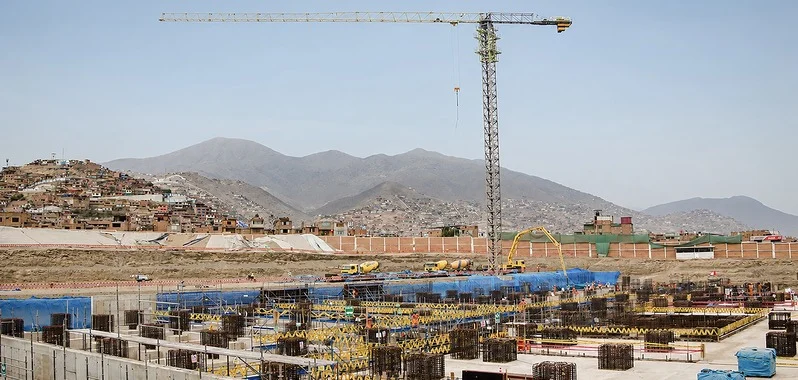
As one of the most significant medical hubs in Northern Lima, the Sergio E. Bernales is setting a national benchmark. The project incorporates nearly 500 high-performance seismic isolators. The scale of this installation ensures that this facility will act as a primary emergency response center for the entire northern metropolitan sector during a catastrophe.
2. The Enrique Montenegro Hospital (San Juan de Lurigancho)
Serving one of the most populous districts in the capital, this hospital features 82 specialized seismic devices. Its design is tailored to the specific seismic profile of the eastern Lima basin, ensuring that the facility remains a critical lifeline for millions of residents.
3. Regional Expansion
The initiative is not limited to the capital. PRONIS is actively deploying these technologies in:

- Apurímac: Projects in Chincheros and Tambobamba.
- Lambayeque: The new hospital facility in Motupe.
- Áncash: The Progreso health center.
- Cajamarca: The Bambamarca health facility.
These regional hospitals are critical because, in a major earthquake, rural and semi-urban health networks are often the first to be severed from central government support. These structures are designed to be self-sustaining islands of medical care.
Official Perspectives: The Engineering Imperative
PRONIS officials have consistently emphasized that this is a long-term investment in public safety. "We are moving away from the paradigm of ‘repairing’ after the fact," says a lead engineer associated with the PRONIS projects. "The cost of installing seismic isolation is a small percentage of the total construction budget, but it prevents the total loss of a multi-million dollar asset and, more importantly, saves thousands of lives."
The integration of BIM technology has been particularly highlighted by the Ministry of Health as a "game changer." By creating digital twins of these hospitals, engineers can test how the building will react to specific seismic wave frequencies before a single brick is laid. This level of precision allows for a more efficient distribution of isolators, reducing waste and optimizing the structural integrity of every floor.
Broader Implications for Peruvian Society
The implications of this policy shift extend far beyond engineering.
Economic Resilience
The economic impact of a destroyed hospital goes beyond the cost of the building. The disruption of medical services for months or years after a disaster forces patients into a fragile system, leading to higher mortality rates and long-term economic instability for families. By keeping hospitals operational, the state preserves the workforce and reduces the long-term healthcare costs associated with post-disaster crises.

Public Trust
Public trust in government infrastructure is often shaken by reports of poorly constructed public works. By championing high-tech, visible seismic protection, the government is signaling a commitment to quality and transparency. These "intelligent buildings" serve as a symbol of a modern, resilient Peru that anticipates threats rather than merely reacting to them.
A Template for Latin America
Peru’s aggressive adoption of seismic isolation is attracting regional attention. Other nations along the Andean corridor, facing similar seismic risks, are closely monitoring the outcomes of the PRONIS projects. If successful, Peru stands to become a regional leader in "seismic-resilient design," exporting its engineering expertise and methodologies to other countries in the Pacific region.
Conclusion: The Path Ahead
The road to a fully resilient health network is long. While new projects incorporate cutting-edge protection, the challenge of retrofitting older, legacy hospitals remains a massive hurdle. However, the current strategy employed by PRONIS represents the most comprehensive effort in the nation’s history to insulate its most vulnerable citizens from the tectonic realities of the region.
As these hospitals in Comas, San Juan de Lurigancho, and beyond reach completion, they will stand not only as centers of healing but as monuments to a new era of disaster preparedness. In the face of the inevitable, Peru is choosing to build a future that refuses to collapse.