Overview: A Nation Under Pressure
The Ecuadorian government has launched an intensive, nationwide operation to mitigate the catastrophic impact of persistent heavy rainfall and the looming threat of the El Niño phenomenon. As infrastructure across several provinces faces unprecedented strain, the Ministry of Transport and Public Works (MTOP)—previously referred to as the Ministry of Transport and Technology—has deployed specialized technical teams and heavy machinery to stabilize the Red Vial Estatal (RVE).
The primary objective of these emergency interventions is to restore critical connectivity, ensure the safety of citizens, and maintain the supply chains that underpin the nation’s economy. From the Andean highlands to the coastal lowlands and the remote islands of Galápagos, the government is engaged in a race against time to fortify roads, clear debris, and provide humanitarian relief to displaced populations.
Key Geographic Hotspots: A Province-by-Province Breakdown
The logistical challenges currently facing Ecuador are multifaceted, varying significantly based on regional topography and the specific nature of the weather-related damage.
The Andean Highlands: Azuay and Loja
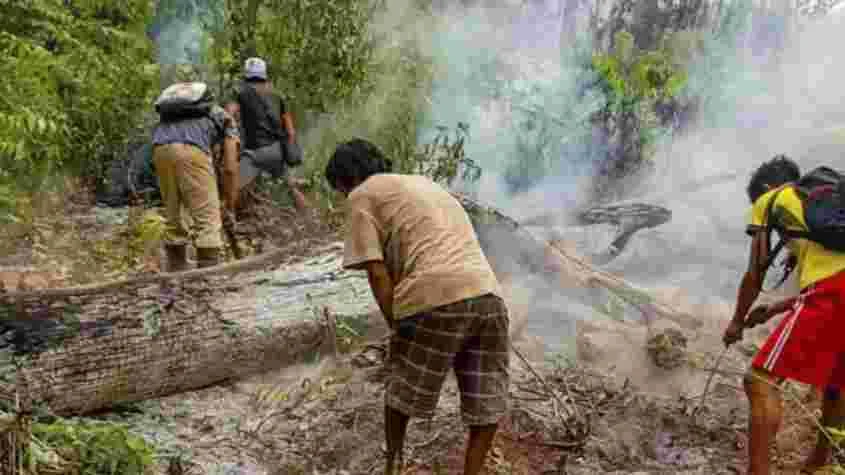
In the province of Azuay, the vital artery connecting Cuenca, Molleturo, and El Empalme has been severely compromised. At kilometer 90, a massive slope failure has dumped tons of earth and rock onto the roadway, forcing immediate closure and intensive cleanup operations. Engineers are currently working to stabilize the surrounding soil to prevent secondary slides, which remain a high risk due to soil saturation.
Meanwhile, in Loja, the focus remains on preventative maintenance. Recognizing the vulnerability of this mountainous terrain, the MTOP has ramped up its routine monitoring of arterial routes to preemptively address potential landslides before they isolate communities.
The Coastal Crisis: El Oro, Manabí, and Esmeraldas
The coastal provinces are experiencing the brunt of the flooding. In El Oro, the E25 highway (Arenillas–Puente Puyango) remains a critical bottleneck. Multiple landslides near Las Lajas have effectively severed the connection between El Oro and Loja. MTOP crews are currently operating around the clock to clear the debris, though operations are frequently interrupted by unstable ground conditions.
Further north, the E585 highway (Buenavista–Atahualpa) has seen targeted intervention. While traffic has been restored at kilometer 30, the damage at kilometer 18 proved too significant for immediate repair, necessitating the construction of a temporary road bypass to maintain local mobility.

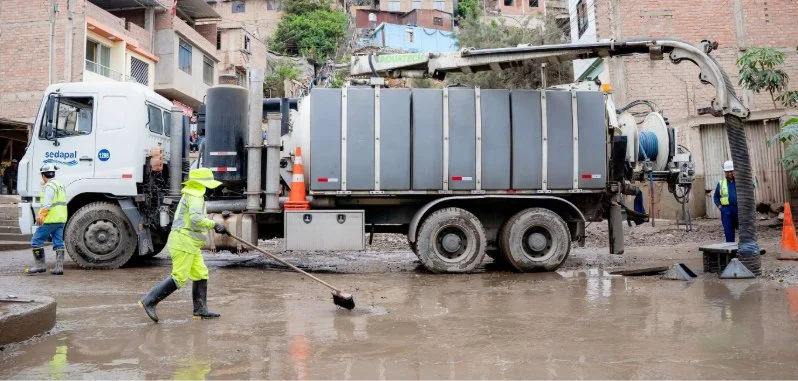
In Manabí, the intervention strategy is focused on hydraulic management. Maintenance crews are aggressively clearing drainage ditches and removing accumulated sediment along the E39A (Portoviejo lateral bypass). This is a vital preventative measure aimed at facilitating water runoff and preventing the roadway from becoming a river channel during high-intensity downpours.
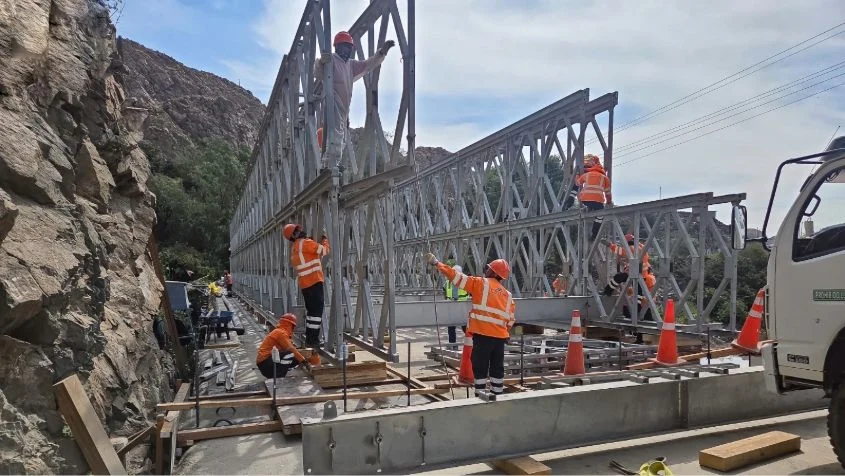
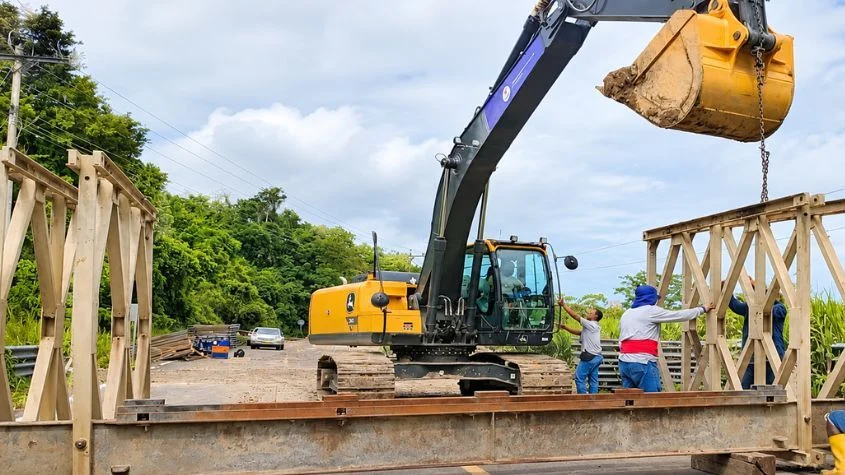
Esmeraldas presents a unique engineering challenge. The destruction of local crossing points has necessitated the installation of a Bailey bridge in Tapaila, along the E15 North corridor (Rocafuerte–Montalvo). This temporary steel bridge is essential for re-establishing contact with isolated communities in the Rioverde canton. Simultaneously, preventative maintenance continues along the E15 South (Esmeraldas–Tonsupa).
The Humanitarian Front: Bolivar and Galápagos
The situation in Bolívar shifted from infrastructure repair to a humanitarian emergency following the overflow of the Charquiyacu River in the Caluma canton. The floodwaters displaced families from 37 homes, prompting a coordinated effort between the MTOP, local parish governments, and the community to relocate residents. Engineers are currently working on riverbed channelization projects to reduce the velocity and volume of water that could threaten residential areas in the future.
In the Galápagos, the government’s response has been both logistical and humanitarian. Beyond the delivery of essential kits to affected families, authorities have deployed 40 high-capacity water pumps to clear flooded urban areas. Additionally, a maritime logistics operation is underway; a vessel has been dispatched carrying heavy machinery specifically tasked with rehabilitating damaged road infrastructure on the islands, where geography makes traditional land-based repairs impossible.
Official Response and Strategic Coordination
The government’s strategy is built upon the "Inter-institutional Coordination Model." The MTOP is not working in a vacuum; rather, it is operating as the central node in a network that includes the National Secretariat for Risk Management (SNGR), the Decentralized Autonomous Governments (GADs), and local emergency services.
Government spokespeople have emphasized that the current interventions are twofold:
- Immediate Reactive Measures: Clearing landslides, restoring power, and establishing temporary bridges to ensure that food, fuel, and medical supplies can reach isolated populations.
- Long-term Resilience Building: Strengthening slope protection, widening drainage systems, and conducting seismic-resistant upgrades to infrastructure to withstand the increased frequency of extreme weather events associated with El Niño.
Implications: The Economic and Social Cost
The ongoing weather emergency poses significant risks to Ecuador’s long-term developmental goals. The economic implications are widespread:

- Logistics and Trade: Many of the affected roads are essential for the export of agricultural products. Disruptions in El Oro and Azuay directly impact the cost and delivery times for goods moving toward the nation’s ports.
- Fiscal Burden: The constant need for emergency road repairs places a massive strain on the national budget. Funds originally earmarked for new infrastructure projects are frequently reallocated to maintenance and emergency restoration, slowing the overall modernization of the national highway network.
- Social Vulnerability: The displacement of families in provinces like Bolívar highlights the social cost of infrastructure failure. The government’s ability to provide swift relocation and long-term security is a litmus test for institutional stability.
Technical Data: The Engineering of Resilience
The use of Bailey bridges, as seen in Esmeraldas, is a hallmark of the government’s modular approach to crisis management. These bridges are prefabricated, portable truss bridges that can be assembled quickly without the need for heavy cranes or extensive foundation work.
Furthermore, the "slope stabilization" techniques being employed—which include the installation of geogrids and shotcrete on unstable hillsides—are designed to prevent the cascading failures that characterized the initial weeks of the rainy season. However, meteorologists warn that if the current El Niño intensity persists, even these modern engineering solutions will be tested to their design limits.
Chronology of Recent Emergency Actions
- Initial Phase: Mobilization of emergency response teams across the coastal and Andean corridors following the first major rainfall alerts.
- Mid-Phase: Deployment of heavy machinery to the E25 (El Oro) and the Cuenca-Molleturo highway (Azuay) as landslide frequency spiked.
- Current Phase: Transition from purely reactive debris clearing to structural engineering projects (e.g., the Bailey bridge in Esmeraldas and the bypass in Buenavista) and long-term hydraulic control in Caluma.
Conclusion: Looking Ahead
As Ecuador navigates the current environmental crisis, the importance of infrastructure as a pillar of national security has never been clearer. The Ministry of Transport and Public Works remains on high alert, with monitoring stations reporting that soil saturation levels in the highlands are still dangerously high.
The government’s commitment to restoring connectivity is a fundamental requirement for the preservation of livelihoods. However, the recurring nature of these disasters serves as a grim reminder that infrastructure in the region must evolve. Moving forward, the integration of climate-resilient engineering and advanced early-warning systems will be the defining factors in determining whether Ecuador can successfully buffer itself against the volatility of the climate in the years to come.
For now, the focus remains on the ground: the men and women operating machinery in the rain, the local leaders coordinating evacuations, and the technicians ensuring that the arteries of the nation remain open despite the fury of the elements.