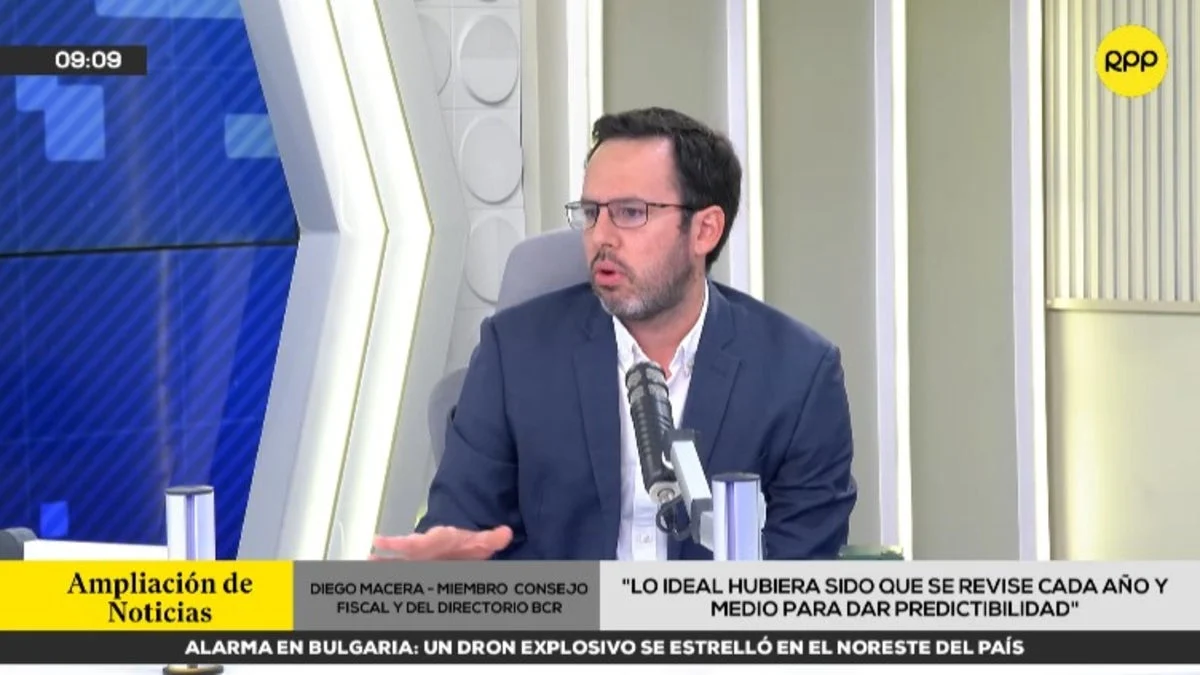
In a recent appearance on the program Ampliación de Noticias, Diego Macera, a prominent economist and member of both the Fiscal Council and the Board of Directors of the Central Reserve Bank of Peru (BCRP), delivered a sobering assessment of the nation’s current economic trajectory. His remarks centered on two critical fronts: the proposed hike in the minimum wage and the urgent need to curtail legislative initiatives that threaten fiscal stability.
Macera’s intervention comes at a time when the administration of Keiko Fujimori faces pressure to deliver tangible economic relief to the populace. However, the economist warned that short-term political gains could inflict long-term damage on the Peruvian economy, particularly by discouraging formal employment and undermining the sustainability of public finances.
Main Facts: The Minimum Wage Controversy
The core of the debate concerns the government’s proposal to raise the Remuneración Mínima Vital (RMV) from the current S/ 1,130 to S/ 1,300. While proponents argue that this increase is necessary to help families cope with inflation, Macera offered a starkly different perspective.
According to Macera, the adjustment lacks the structural foundation required for a sustainable policy. "I wish this measure had not been proposed," he stated during the interview. He clarified that while the minimum wage requires periodic review, the current approach is disconnected from the fundamental economic indicators that should govern such decisions: productivity and inflation.
By pushing the wage floor higher without a commensurate increase in labor productivity, the government risks creating a barrier to entry for small and medium-sized enterprises (SMEs). For these businesses, which often operate with thin margins, a mandatory salary hike may force them to either reduce their workforce or retreat further into the informal sector to avoid compliance costs.
Chronology of the Policy Debate
The discourse surrounding the minimum wage in Peru has evolved significantly over the past year, characterized by shifting political priorities and changing economic forecasts.
- Mid-2023: Initial discussions regarding the economic impact of the El Niño phenomenon began to emerge, with analysts like Macera warning that weather-related disruptions could cost the country between 0.5% and 1% of its GDP.
- Late 2023: The government began signaling its intention to adjust the RMV. Experts, including Elmer Cuba, proposed a phased approach—starting with a S/ 100 increase in October, followed by a subsequent S/ 70 increment after the potential impacts of the El Niño event could be fully assessed.
- Early 2024: The formal proposal to move toward S/ 1,300 gained traction, prompting strong pushback from fiscal conservatives and independent economists who view the move as a "populist gesture" rather than an evidence-based economic policy.
- Current State: The debate is currently at a stalemate, with the Ministry of Economy and Finance (MEF) attempting to balance political demands with the warnings issued by institutions like the Fiscal Council and the BCRP.
Supporting Data: Why Productivity Matters
Macera’s critique is rooted in the economic principle that wages should reflect the value generated by labor. In his view, the "political" usage of the minimum wage—treating it as a tool for popularity—destroys the mechanism’s legitimacy.
"What we want to avoid is using the minimum wage as a political tool every time someone needs a popularity boost," Macera emphasized. He advocated for a technical commission, ideally housed within the Ministry of Economy, to oversee biannual revisions. This commission would ground wage adjustments in objective metrics:
- Labor Productivity Trends: If output per worker does not rise, wage hikes inevitably lead to cost-push inflation.
- Inflationary Pressures: While wages must keep pace with the cost of living, indexation must be managed to avoid a wage-price spiral.
- Formalization Rates: Any increase that pushes the cost of labor above the reach of the average small business ultimately harms the very workers it intends to protect by excluding them from the formal social security and benefits system.
Fiscal Responsibility and Constitutional Challenges
Beyond labor policy, Macera addressed a pressing concern regarding the legislative branch’s propensity to approve spending bills without adequate funding. He expressed strong support for the Executive’s decision to take laws concerning CAS (Contrato Administrativo de Servicios) and CAFAE (Comité de Administración del Fondo de Asistencia y Estímulo) gratifications to the Constitutional Tribunal (TC).
The Battle Against Legislative Overreach
For years, the Peruvian Congress has utilized a controversial interpretation of its own powers to authorize public spending. Macera highlighted that the Fiscal Council has repeatedly warned of the catastrophic impact these measures have on the national budget.
"Since last year, we have raised our voices multiple times, warning about the costs of the regulations the Congress was passing, shielded by an interpretation that the legislature had the initiative for public spending," Macera noted. Fortunately, the Constitutional Tribunal has since rectified this position, establishing in a binding ruling that the Congress does not, in fact, have the authority to initiate public spending.
The Problem of Pension Inequity
Macera used the recent law increasing the pension of retired teachers to S/ 3,500 as a primary example of how populist fiscal policy breeds inequality.
"A nurse or a prosecutor who was under the ONP (National Pension Office) system will be earning 600 soles. The inequity is clear; you are providing five or six times the difference in remuneration without any justification," he argued. This discrepancy not only creates a fiscal black hole but also erodes public trust in the pension system, as it rewards specific interest groups while ignoring the broader population of retirees who remain in extreme poverty.
Implications: The Path Toward Stability
The implications of Macera’s warnings are clear: if Peru continues to use fiscal and wage policy as tools for short-term political maneuvering, the country risks losing its hard-won reputation for macroeconomic stability.
The Risks of Populism
- Erosion of Institutional Credibility: When the BCRP and the Fiscal Council are ignored, international investors lose confidence in the country’s ability to manage its economy effectively.
- Stagnation of Formalization: If the cost of formal labor continues to rise arbitrarily, the informal sector—which currently employs the vast majority of the Peruvian workforce—will only grow, leading to a smaller tax base and less revenue for public services.
- Budgetary Collapse: Laws passed without the approval of the MEF jeopardize the fiscal deficit targets that have kept Peru’s sovereign risk rating relatively stable.
A Call for a Technical Agenda
To move forward, Macera proposes a return to technocratic governance. This involves:
- Institutionalizing the Review Process: Shifting the minimum wage decision from the political arena to a specialized commission that reports to the National Labor Council.
- Strengthening the TC’s Role: Ensuring that the judiciary remains a firm check against legislative attempts to bypass the Ministry of Economy.
- Prioritizing Equity: Addressing the pension crisis through comprehensive reform rather than piecemeal, group-specific increases that exacerbate the gap between different categories of public servants.
In conclusion, Diego Macera’s message is one of necessary restraint. Peru stands at a crossroads where it must choose between the siren song of populist spending and the arduous but necessary path of structural, evidence-based economic management. As the nation faces external pressures and internal demands for growth, the alignment of labor and fiscal policies with the realities of productivity and budget capacity is not merely an academic exercise—it is an economic imperative. The challenge for the Fujimori administration will be to embrace this fiscal discipline while still delivering the inclusive growth that the Peruvian public rightfully demands.