By Editorial Staff, Logistics & Infrastructure Review
In a significant move to bolster Paraguay’s agricultural logistics and regional economic integration, the Ministry of Public Works and Communications (MOPC) has announced that the paving project for the access road to the historic Puerto Paredón, located in the district of Hohenau, Itapúa, has reached a critical milestone of 76% completion. This infrastructure initiative is set to transform the way one of the nation’s most vital grain-producing regions interfaces with global markets.
The project, which encompasses a 11.7-kilometer stretch of the "Ruta de los Inmigrantes," represents a long-awaited upgrade for the local community and the massive agricultural sector that relies on this corridor to move its harvest from inland fields to the river ports that serve as the gateway for international exports.
Main Facts: A Vital Link for Agricultural Prosperity
The modernization of the access route to Puerto Paredón is not merely a paving project; it is a strategic logistical intervention. Puerto Paredón holds a unique status in the history and economy of Itapúa. As the oldest port in Hohenau and the second-largest in terms of bulk grain cargo movement in the department, it serves as the backbone for the local economy.
Each year, this facility handles over 350,000 tons of grain—a massive volume that requires consistent, reliable, and all-weather access to ensure that the supply chain remains uninterrupted. Previously, the unpaved nature of the road created significant logistical bottlenecks, particularly during periods of heavy rainfall, which frequently rendered the road impassable for heavy-duty trucks. The current project aims to eliminate these vulnerabilities by installing durable, high-capacity asphalt concrete surfaces.

The project is being executed by the construction firm Benito Roggio e Hijos S.A., following their successful bid in the National Public Tender ID No. 449.373. The total investment for this transformation stands at G. 49,501,248,902, reflecting the Paraguayan government’s commitment to decentralizing development and ensuring that rural production hubs have the same logistical advantages as urban industrial centers.
Chronology of Development
The path to this 76% milestone has been marked by rigorous engineering efforts and systematic planning. The project began with extensive earthworks and the rehabilitation of the sub-base, ensuring that the road could withstand the heavy load-bearing requirements of agricultural logistics.
- Initial Planning and Tender (2024): The project was formalized under the MOPC’s Call No. 37/2024, aimed at improving connectivity between rural production sites and the national grid. The bidding process concluded with the selection of Benito Roggio e Hijos S.A., a company with a proven track record in Paraguayan infrastructure.
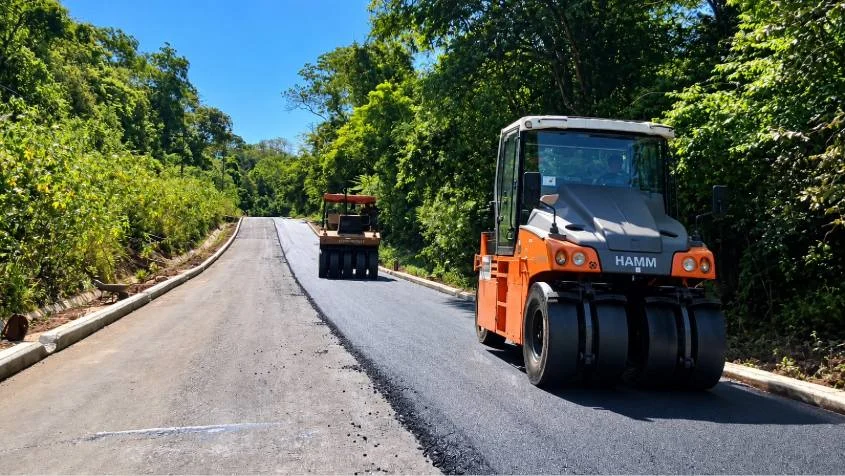
- Mobilization and Rural Paving: Construction teams initially focused on the rural segments of the 11.7-kilometer route. By early 2026, the foundational works were completed, allowing for the transition into the asphalt-laying phase.
- Current Progress (October 2026): As of October 2026, the rural section has been fully paved. The project has now entered its next critical phase: the urban transition. Teams are currently shifting focus toward the integration of the road into the urban fabric of Hohenau.
- Upcoming Phases: The final stages of the project will involve the construction of concrete access points for residents and businesses bordering the road, as well as the implementation of road safety measures, signage, and drainage systems necessary for long-term maintenance.
Supporting Data: Logistical Impact and Economic Weight
To understand the scale of this project, one must look at the specific logistical challenges facing Itapúa. The department is a powerhouse of grain production in Paraguay, with soybean, corn, and wheat crops forming the foundation of the regional GDP.
The 11.7-kilometer stretch serves as the "last mile" connection to the PY06 highway, which is one of the most important arterial roads in the country. By sealing this connection, the MOPC is effectively reducing transportation costs for thousands of farmers. Data suggests that the improved road surface will decrease vehicle maintenance costs for transporters by approximately 30% and reduce transit times, which is critical during the narrow windows of the harvest season.
Furthermore, the integration of the road into the urban sector of Hohenau means that the local economy will also see a boost. Improved road quality is correlated with higher property values and increased investment in commercial services along the corridor. The project is designed not just for trucks, but for the community, providing a safer, more efficient commute for students and workers who traverse the "Ruta de los Inmigrantes" on a daily basis.

Official Responses and Strategic Vision
The MOPC has underscored that the Puerto Paredón project is part of a broader vision for the modernization of the "Paraguay Profundo" (Deep Paraguay). By prioritizing access roads, the Ministry is attempting to bridge the gap between rural production and international markets.
"Our goal is to ensure that no ton of grain is left behind due to poor infrastructure," a spokesperson for the Ministry noted. "The progress in Hohenau is a testament to the fact that when we invest in strategic nodes—like these historic ports—we are investing in the stability of our national economy."
The technical requirements of the contract are stringent. The use of high-quality asphalt concrete ensures that the road can endure heavy traffic cycles. Additionally, the inclusion of concrete access paths for local frentistas (fringe dwellers) demonstrates a conscious effort to balance industrial needs with community integration, ensuring that heavy logistical traffic does not compromise the quality of life for the residents of Hohenau.
Implications for the Future of Regional Logistics
The completion of this project will likely serve as a blueprint for future infrastructure developments in the Itapúa region. As global demand for Paraguayan agricultural products continues to rise, the ability to move goods from the field to the river port efficiently becomes a matter of national competitiveness.
Safety and Social Connectivity
Beyond the economic metrics, the project has significant social implications. The "Ruta de los Inmigrantes" is a vital conduit for education and daily social interaction. With the new paving, the hazards associated with loose gravel, dust, and mud-filled potholes are being eliminated. This is particularly important for the local school zones, where safety is a primary concern for parents and municipal authorities.

Economic Sustainability
The investment of nearly 50 billion guaraníes is significant, but when amortized over the projected lifespan of the road, the cost-benefit analysis favors the project heavily. The reduction in greenhouse gas emissions from idling trucks stuck in mud, combined with the faster movement of goods, aligns with the national government’s broader goals of sustainable development and environmental stewardship.
Future Expansion
While the current project focuses on the 11.7-kilometer stretch, officials have hinted that the success of this model could lead to further expansions of the secondary road network connecting to Puerto Paredón. By creating a hub-and-spoke system where local roads feed seamlessly into the primary highway network, the region of Itapúa is positioning itself to be a leader in agro-industrial logistics for the next decade.
In conclusion, as the project nears its final 24% of construction, the focus remains on the seamless transition between the rural highway and the urban center. For the residents of Hohenau and the thousands of producers who rely on Puerto Paredón, the completion of this road is more than just a public work—it is the paving of a more prosperous, connected, and secure future.