The initial euphoria that characterized the Peruvian business landscape following the inauguration of President Keiko Fujimori has begun to give way to a more measured, cautious outlook. According to the latest survey data released by the Central Reserve Bank of Peru (BCRP), business confidence, which had soared to impressive heights in mid-2026, has experienced a consecutive decline, signaling a shift in the private sector’s appetite for investment and expansion.
While the majority of economic indicators remain above the critical 50-point threshold—the divide between optimism and pessimism—the downward trend over the past two months has raised concerns among policymakers and market analysts alike. The honeymoon period, which saw economic expectations breach the 70-point mark in July, is now contending with the realities of structural challenges and a wait-and-see approach from the corporate sector.
Chronology of a Shifting Sentiment
The trajectory of business confidence in 2026 has been marked by distinct phases of volatility and recalibration.
The July Peak: Following the transition of power in July 2026, the business community expressed a rare, high-octane sense of optimism. This was fueled by the expectation of institutional stability and a business-friendly policy agenda. During this period, the BCRP’s index of economic expectations broke through the 70-point barrier, a significant milestone that suggested a robust recovery for the second half of the year.
The August Moderation: By August, the initial fervor began to cool. While major corporations maintained a favorable perception of their current operational status and the broader economic environment, the conversation shifted toward the medium term. Decision-makers began to adopt a more conservative stance, factoring in external risks and the uncertain pace of government policy implementation.
The September Pullback: The most recent data from September confirms that this "cautious wait" has solidified into a trend. The decline in key indicators—ranging from planned capital expenditure to hiring intentions—suggests that the private sector is no longer acting on the initial momentum of the new administration, but is instead adjusting its sails to meet a more challenging fiscal and social environment.
Supporting Data: Dissecting the Decline
The BCRP’s survey provides a granular look at where the cooling is most acute. When analyzing the data, several critical areas of business activity show a clear loss of steam:
1. Investment Expectations
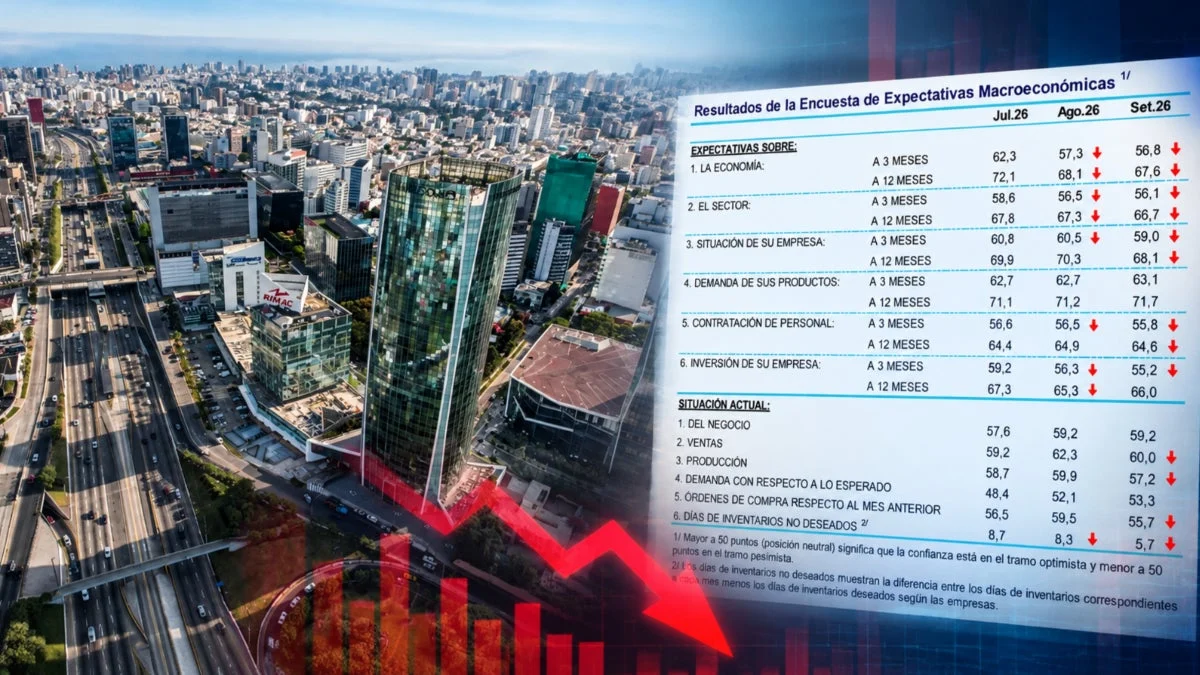
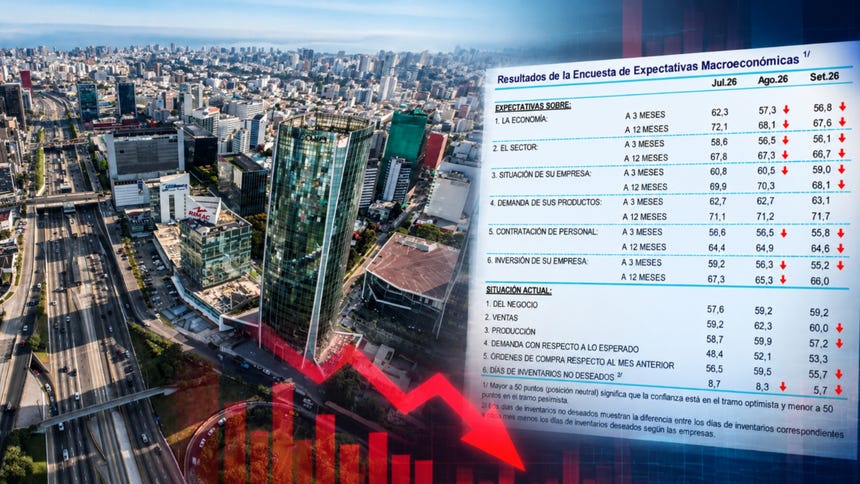
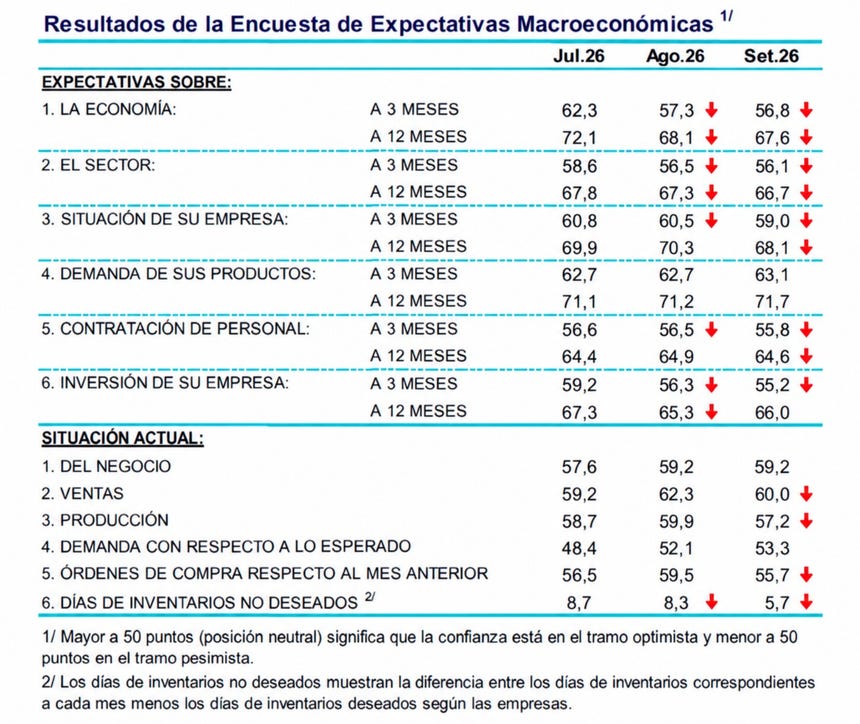
The most glaring metric is the expectation for business investment over the next three months. This index has fallen from 59.2 points in July to 55.2 points in September, a cumulative drop of 4 points in just two months. This suggests that while companies are still planning to invest, they are scaling back the size or the urgency of those projects, preferring to preserve liquidity in the face of uncertainty.
2. Orders and Sales
Perhaps the most direct indicator of market health is the volume of purchase orders. This index plummeted from 59.5 points in August to 55.7 in September, effectively erasing the growth seen in the previous month. Similarly, the sales index dropped from 62.3 to 60.0, while production levels dipped from 59.9 to 57.2. These figures indicate that demand-side pressure is softening, reflecting a potential slowdown in domestic consumption or export throughput.
3. Economic Outlook (3 and 12 Months)
The loss of confidence extends beyond the immediate future. Expectations for the Peruvian economy at the three-month horizon fell from 62.3 in July to 56.8 in September. Even more telling is the outlook for the 12-month horizon, which dropped from 72.1 to 67.6 during the same period. This suggests that the pessimism is not merely a reaction to short-term noise, but a broader recalibration of growth forecasts for the coming year.
4. Hiring Trends
The labor market, while more resilient, has not been immune to this trend. Expectations for personnel recruitment at the three-month horizon saw a slight, yet consistent, downward drift from 56.6 to 55.8. The fact that this decline has persisted for three consecutive months suggests that employers are becoming increasingly selective about expanding their payrolls.
The Factors Driving Corporate Cautiousness
Why the sudden shift? Economic specialists and analysts point to a confluence of factors that are tempering the initial enthusiasm surrounding the current administration.
- Insecurity and Social Climate: Persistent concerns regarding public safety remain a primary drag on business operations. The cost of security and the impact of crime on supply chains continue to weigh heavily on corporate balance sheets.
- The "El Niño" Phenomenon: Despite seasonal variations, the looming threat of the El Niño weather pattern continues to cast a shadow over agricultural and textile sectors. Businesses are preemptively adjusting their inventories and investment plans to mitigate potential climate-related shocks.
- Public Investment and Policy Execution: The pace at which the government translates its political platform into actionable public infrastructure projects is a critical driver of private sector confidence. Any perceived delay in public spending creates a vacuum that private capital is hesitant to fill.
- Macroeconomic Costs: Volatility in input costs and price fluctuations remains a source of anxiety. As inflation pressures persist, companies are finding it difficult to project long-term margins, leading to a defensive posture in financial planning.
Official Responses and Stakeholder Perspectives
When the new government assumed office in July, the private sector was eager to signal its support. Jorge Zapata, president of the Confederation of National Business Institutions (Confiep), was one of the most vocal proponents of the new "era" of investment.
"The Peru of today is in one of the best moments in its history," Zapata stated during the July inauguration events. "The opportunities are exceptional, but the government must provide clear signals to the investment community to sustain this momentum."
However, as the months progressed, the silence or the ambiguity surrounding certain structural reforms has led to the current "wait-and-see" approach. The government, for its part, maintains that the economy is fundamentally sound and that the current dip is a natural correction following an overheated period of optimism.
Despite the decline, the administration emphasizes that the country remains in "optimistic territory" according to the 50-point BCRP threshold. They argue that as structural reforms take hold and the macroeconomic environment stabilizes, confidence will naturally rebound.
Implications for the Peruvian Economy
The decline in business confidence carries significant implications for the nation’s growth trajectory for the remainder of 2026 and into 2027.
A Potential Slowdown in Growth
If investment remains suppressed, the ripple effects will be felt across the labor market and consumer demand. Reduced corporate spending often leads to a tightening of credit and a reduction in the velocity of money within the economy. If the "cautious" phase extends into the final quarter of the year, the government may struggle to meet its ambitious GDP growth targets.

The Need for Proactive Policy
The data suggests that the business community is looking for more than just rhetoric; they are looking for "clear signals," as emphasized by the leadership at Confiep. This could mean accelerating public-private partnerships, providing clarity on tax policy, or delivering a more aggressive strategy to tackle the insecurity that plagues business operations.
Resilience in the Face of Uncertainty
It is important to note that the economy is not in a recession. The fact that indicators remain above the 50-point mark signifies that, while companies are curbing their expansion, they are not actively contracting their operations. There is still a base level of confidence in the market, and some sub-indicators—such as demand relative to expectations—actually showed a slight improvement in the latest report, rising from 52.1 to 53.3 points.
Conclusion: A Critical Juncture
The Peruvian economy is currently navigating a delicate transition. The initial excitement that followed the July inauguration provided a necessary boost, but that momentum is now being tested by the structural realities of the Peruvian landscape.
The decline in business confidence is not a sign of failure, but rather a sign of maturity in the market. Investors are demanding that the government move beyond the symbolic transition and begin delivering tangible results in infrastructure, security, and economic policy. As the year draws to a close, the administration’s ability to reverse these downward trends will be the true test of its tenure. Whether this period of "cooling" leads to a stagnant 2027 or serves as a foundation for more sustainable, calculated growth remains to be seen. The coming months will be pivotal in determining whether the "best moment in history" for Peru becomes a missed opportunity or a genuine turning point.