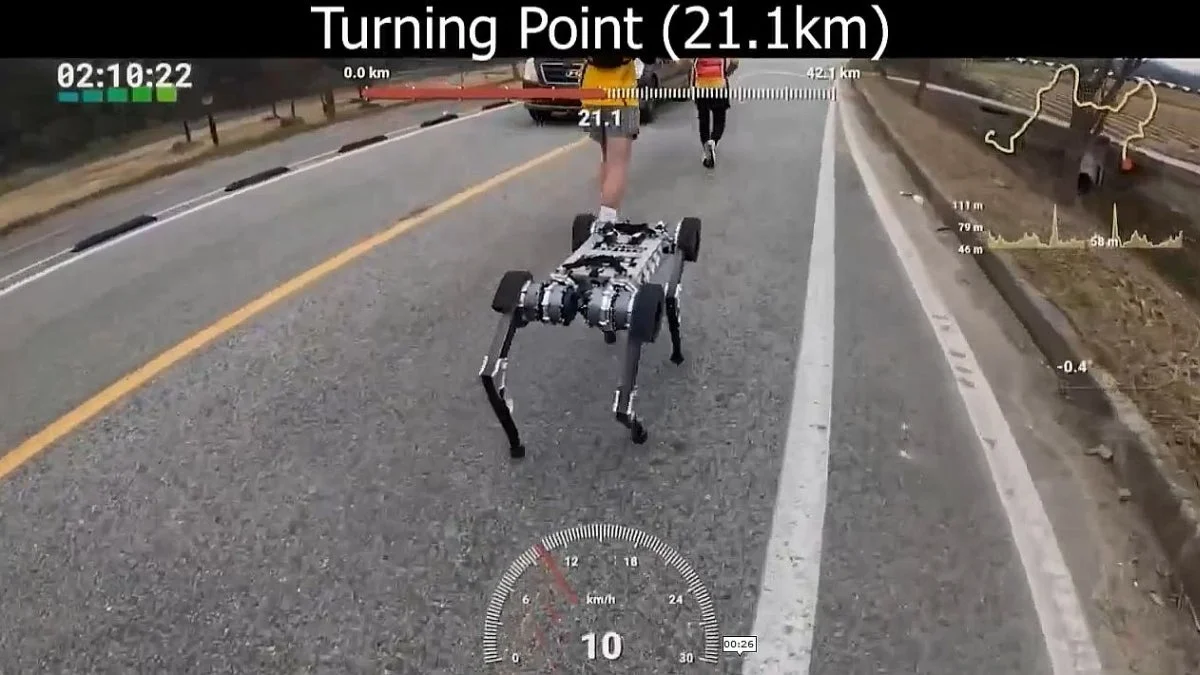
In a landmark achievement for mechanical engineering and robotics, the South Korean-developed quadruped robot RAIBO2 has successfully completed a full marathon, crossing the finish line in 4 hours, 19 minutes, and 52 seconds. While the completion of a 42.195-kilometer course is a feat in itself, the true significance of the event lies in the machine’s unprecedented energy efficiency. Developed by researchers at the Korea Advanced Institute of Science and Technology (KAIST), RAIBO2 has shattered existing limitations for legged robots, proving that autonomous systems can operate with a level of endurance that challenges the biological efficiency of humans.
The Engineering Breakthrough: Solving the Energy Paradox
For years, the development of quadruped robots—machines that mimic the movement of animals—has been hindered by a fundamental physical limitation: the "energy-cost barrier." Unlike wheeled robots, which can utilize momentum and mechanical rolling to conserve power, legged robots must constantly expend energy to maintain balance, support their body weight against gravity, and mitigate the kinetic energy losses that occur during the impact of every "step."
Most contemporary four-legged robots suffer from a restrictive operational radius, typically struggling to move beyond 20 kilometers on a single charge. This limitation has largely relegated them to controlled environments, laboratories, or short-duration tasks, preventing their widespread adoption in critical fields such as disaster response, search-and-rescue operations in mountainous terrain, or large-scale infrastructure inspection.
RAIBO2 was conceived specifically to dismantle these constraints. The KAIST team, led by visionary robotics engineers, approached the problem through a holistic redesign, optimizing both the hardware architecture and the sophisticated software governing the robot’s movement. By reducing the mass of the limbs, optimizing motor control circuits, and refining motion strategies through deep reinforcement learning, the team created a machine that treats energy conservation as a primary design imperative rather than an afterthought.
Chronology of the Sangju Marathon Run
The performance of RAIBO2 took place during the 22nd edition of the Sangju Marathon in South Korea. The event served as the ultimate proving ground for the robot, placing it in a real-world, high-stakes environment alongside human runners.
- Pre-Race Calibration: Prior to the start, the research team conducted rigorous testing on the robot’s gait optimization and thermal management systems to ensure it could withstand the sustained load of the full distance.
- The Starting Gun: RAIBO2 began the race alongside human competitors, immediately establishing a steady, reliable cadence.
- The Midway Point: Throughout the first half of the marathon, telemetry data showed that the robot’s energy expenditure was significantly lower than predicted, confirming that the new motion-control algorithms were effectively minimizing mechanical loss.
- The Terrain Challenge: The Sangju course is notoriously difficult, featuring a cumulative elevation gain of 286 meters and sections of unpredictable, slippery terrain. RAIBO2’s adaptive stability control proved crucial here, allowing it to maintain an average speed of 2.64 meters per second without stumbling or requiring manual intervention.
- The Finish Line: After 4 hours, 19 minutes, and 52 seconds of continuous movement, RAIBO2 concluded its journey. Upon arrival, the data revealed that the robot had consumed 1,280 watt-hours of energy, leaving a significant reserve still available in its battery packs.
Supporting Data: By the Numbers
The metrics recorded during the marathon provide a compelling case for the advancement of robotic efficiency. The most critical indicator of this success is the "Cost of Transport" (CoT), a dimensionless unit that measures the energy efficiency of a vehicle or animal relative to its weight and speed.
A lower CoT indicates higher efficiency. Historically, human runners maintain a CoT of approximately 0.37. RAIBO2 achieved a record-breaking CoT of 0.25—a figure that is not only industry-leading for quadrupeds but is officially more efficient than the human standard.
Key technical specifications include:
- Total Distance: 42.195 km (Full Marathon).
- Average Speed: 2.64 m/s.
- Energy Consumption: 1,280 Wh.
- Efficiency Metric: A CoT of 0.25, surpassing existing quadruped standards by a factor of three.
- Remaining Potential: Based on the residual battery capacity, researchers estimate the robot could have continued for an additional 25 kilometers, effectively extending its operational range to nearly 70 kilometers on a single charge.
Implications for the Future of Robotics
The success of RAIBO2, recently detailed in the scientific journal Nature, marks a paradigm shift in how we perceive the utility of autonomous machines. The implications for industries that rely on remote or dangerous operations are profound.
1. Disaster Response and Search-and-Rescue
In the wake of earthquakes, floods, or structural collapses, human first responders are often unable to access deep-seated zones due to instability or toxic conditions. A robot capable of covering vast distances with high endurance can navigate debris fields that would exhaust a human responder, providing critical situational awareness and carrying essential medical supplies without the need for constant recharging.
2. Environmental and Infrastructure Monitoring
Large-scale infrastructure, such as pipelines, power grids, and border territories, often traverse rugged, inaccessible regions. The efficiency demonstrated by RAIBO2 suggests a future where autonomous squads of robots could patrol these assets for days, identifying leaks or structural damage before they result in catastrophic failures.
3. The "Human-Robot Synergy" Era
By achieving a CoT lower than that of humans, RAIBO2 validates the possibility of robots working alongside humans in outdoor, high-mobility roles. This opens the door for robots to act as "pack mules" or assistants in remote scientific expeditions, military logistics, and agricultural management, where power grids are nonexistent and autonomy is non-negotiable.
Official Perspectives and Academic Reception
The research team at KAIST emphasizes that while the marathon win is a headline-grabbing achievement, the core value lies in the data gathered. "The goal was never just to win a race," the researchers noted in their report. "The goal was to prove that we could bridge the gap between biological efficiency and mechanical reliability."
The scientific community has lauded the study for its transparency and the robustness of its testing methodology. By publishing in Nature, the KAIST team has invited global scrutiny and collaboration, which is essential for the next phase of development: miniaturization and increased payload capacity.
Experts in the field of robotics have pointed out that while RAIBO2 is optimized for flat or moderately uneven terrain, the next challenge will be adapting this high-efficiency gait for vertical climbing or extreme, chaotic environments. However, the foundational technology—the integration of learned motor-control policies with energy-efficient hardware—is considered a "solved" pillar that will accelerate all future quadrupedal projects.
Conclusion: The Path Ahead
The RAIBO2 marathon experiment is more than a technical milestone; it is a glimpse into a future where the mechanical limitations of our creations no longer tether them to our side. As researchers continue to refine the interplay between software-driven movement and hardware endurance, the prospect of long-range, autonomous, legged machines moving through our world becomes an inevitability rather than a dream.
By proving that a robot can move as efficiently—and indeed, more efficiently—than a human athlete, KAIST has provided a blueprint for the next generation of industrial and humanitarian tools. The road ahead for RAIBO2 and its successors is long, but if the Sangju Marathon is any indication, they have the energy to reach the finish line, wherever it may be.