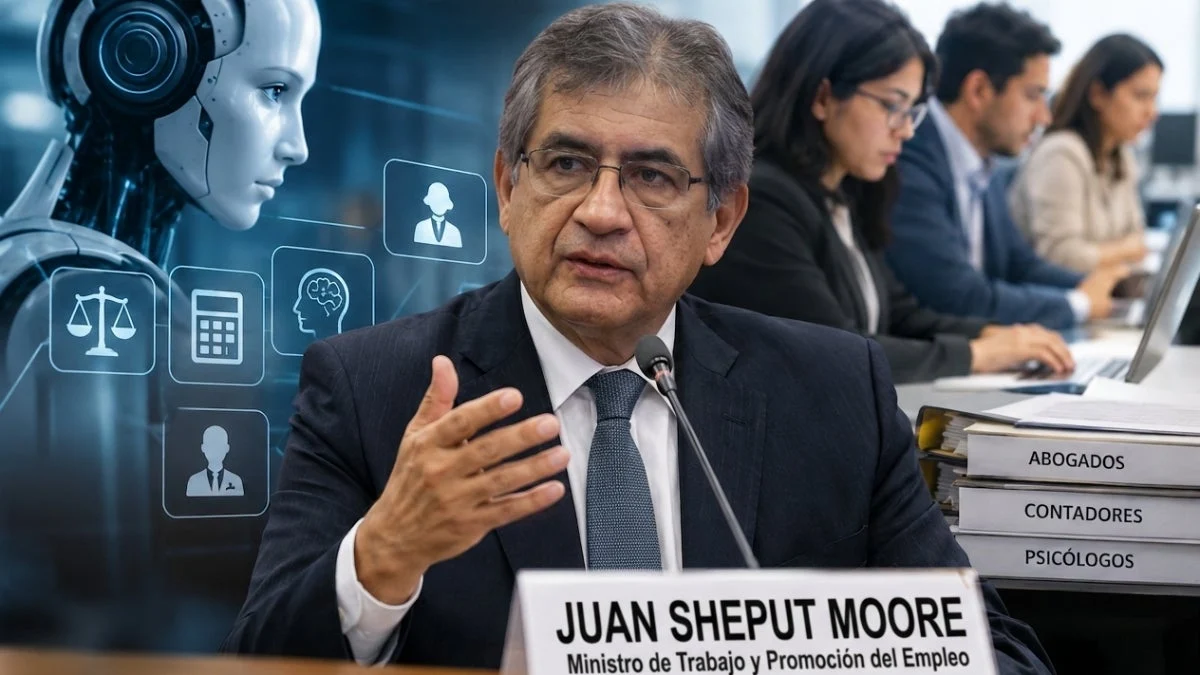
The landscape of the Peruvian labor market is undergoing a structural transformation of unprecedented scale. As artificial intelligence (AI), advanced automation, and robotics transition from experimental technologies to core operational pillars, the nation’s workforce finds itself at a critical crossroads. Juan Sheput, the Minister of Labor and Employment Promotion, recently issued a stark warning: the traditional "white-collar" professional ecosystem is no longer immune to the efficiency mandates of the digital age.
During a testimony before the Congressional Labor Committee, Minister Sheput emphasized that the integration of AI is not merely a future threat but a present reality that is actively displacing human labor in sectors long considered bastions of stability, such as law, accounting, administration, and psychology. This shift, coupled with a growing chasm in digital literacy among the youth, has prompted the government to initiate a formal inquiry into the long-term viability of current employment models.
The Anatomy of Displacement: Which Professions are at Risk?
The traditional career path in Peru is facing a "shake-up." According to the Ministry of Labor, the integration of AI tools—ranging from generative language models to automated data processing suites—has allowed companies to bypass the need for entry-level and mid-level professionals.
The Impact on Professional Services
For decades, a university degree in law or administration was seen as a gateway to lifelong job security. Today, those same fields are witnessing a reduction in headcount. AI systems are now capable of drafting legal contracts, managing complex accounting ledgers, and performing administrative tasks with a speed and precision that human workers cannot match.
Minister Sheput noted that this is not a localized trend; it is a systematic replacement process. "Many companies are adopting technologies that incorporate AI into their core processes, and as a result, they are opting to forgo the services of professionals who were previously essential," he stated. The displacement is not limited to mundane tasks; it is reaching into the cognitive labor sector, where decision-making and analytical synthesis—once the exclusive domain of human professionals—are now being offloaded to algorithms.
Chronology: From Innovation to Institutional Response
The progression toward an AI-integrated economy in Peru has accelerated over the past three years.
- Early 2023: The rapid global adoption of Large Language Models (LLMs) triggers a pilot phase in the Peruvian private sector. Large firms begin testing AI for customer service and internal data analysis.
- Late 2024: Market data indicates a noticeable decline in the hiring of junior-level administrative and legal support staff in Lima-based corporations.
- Early 2025: The Ministry of Labor identifies a growing disparity between employer demand for "digital-ready" talent and the actual skill sets of the graduating workforce.
- Mid-2026 (Present): The Ministry of Labor and Employment Promotion (MTPE) formalizes its response via Ministerial Resolution 280-2026-TR, creating a specialized commission to study the impact of AI on employment and labor relations.
This commission represents the first major institutional effort to quantify the displacement of labor and propose a policy framework to mitigate the socio-economic fallout.
The "Digital Illusion": Addressing the Skills Gap
Perhaps the most alarming data point shared by Minister Sheput concerns the youth demographic. While many young Peruvians are "digital natives" in terms of social media usage and mobile device fluency, they lack the "professional digital competencies" required by the modern enterprise.
The Smartphone Paradox
Sheput dismantled the common misconception that owning a smartphone equates to digital literacy. "The dramatic reality is that most young people do not possess actual digital skills," he cautioned. "Having a smartphone is not the same as understanding how to leverage technology for productivity. For instance, the ability to formulate a precise, effective prompt for an AI to perform a task is a skill that is largely absent."
This gap creates a dangerous paradox: while companies are hungry for talent that can manage and collaborate with AI, the education system continues to churn out graduates who possess theoretical knowledge but lack the practical "AI-literacy" needed to remain relevant in a tech-driven economy.
Official Responses and Policy Proposals
The Peruvian government is moving toward a strategy of "aggressive adaptation." The creation of the commission under Ministerial Resolution 280-2026-TR serves as the vehicle for this strategy. The group, comprising government officials, labor union representatives, and private sector leaders, has a six-month mandate to:
- Map the Displacement: Identify specific occupations and industries most at risk of immediate automation.
- Redefine Education: Propose reforms to the higher education curriculum to ensure that universities focus on high-value, human-centric skills that AI cannot yet replicate.
- Legislative Safeguards: Develop labor regulations that protect workers while fostering an environment conducive to technological investment.
The "Cusco Model" as a Roadmap
Minister Sheput pointed to the tourism sector in Cusco as a successful blueprint for the rest of the country. In that region, educational institutions adjusted their curricula to mirror the immediate needs of the local tourism market. By aligning academic output with sectoral requirements, the region has seen an increase in youth employability. The government aims to replicate this granular, regionalized approach across other sectors, including technology, manufacturing, and agriculture.
Implications: The Need for Labor Reconversion
The implications of this technological wave are profound. We are moving toward an economy where "lifelong learning" is no longer a buzzword, but a survival requirement.
Economic and Social Impact
The displacement of professionals in administrative and legal fields could lead to a significant increase in underemployment or informal labor if the workforce is not rapidly retrained. The Ministry of Labor is prioritizing "labor reconversion"—a process of retraining workers whose skills have been rendered obsolete by automation, shifting them toward roles in the digital economy that are currently facing a labor shortage.
The Human Element
Despite the focus on technology, the government maintains that the goal is not to eliminate human contribution, but to evolve it. The challenge lies in creating a transition period where the "human-in-the-loop" model becomes the standard. This means training workers not just to use software, but to supervise, curate, and ethically guide the AI tools that are performing the heavy lifting.
Conclusion: A Call for Unified Action
The transformation of the Peruvian labor market is a double-edged sword. While AI offers the potential for unprecedented productivity gains and the creation of new, high-paying jobs in the tech sector, it also threatens to leave behind a significant portion of the population that is not equipped for the transition.
Minister Sheput’s address serves as a wake-up call for the entire nation. The synergy between the Ministry of Labor, the education sector, and private enterprises is the only viable path forward. By fostering a culture of continuous learning and aligning the academic curriculum with the realities of an AI-driven market, Peru has the opportunity to navigate this disruption. However, the window of opportunity is closing. The future of the Peruvian workforce will not be defined by the machines themselves, but by the agility with which the country adapts its human capital to work alongside them.
The upcoming report from the newly formed commission will be a definitive document for the future of labor in Peru, setting the tone for how the country will balance the inevitable march of progress with the fundamental need to ensure that its people remain at the center of the economy.