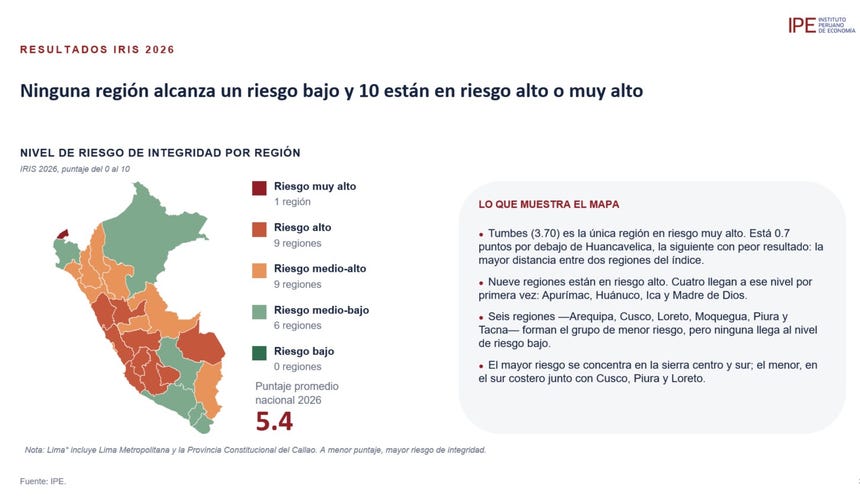
As Peru approaches critical regional and municipal elections, a sobering report from the Peruvian Institute of Economics (IPE) has cast a long shadow over the country’s administrative landscape. The inaugural Subnational Integrity Risk Index (IRIS) 2026 provides a granular look at the systemic failures plaguing local governments, revealing that 19 out of 25 regions currently face heightened risks of corruption and administrative inefficiency.
The findings are not merely statistical anomalies; they represent a fundamental breakdown in public service delivery. With 62% of all regional and municipal infrastructure projects currently paralyzed or abandoned, the index paints a portrait of a nation where the state’s ability to convert public funds into citizen well-being has reached a near-standstill.
Main Facts: A System Under Stress
The IRIS 2026 report serves as a diagnostic tool, evaluating regions based on two primary pillars: Public Management and Administrative Efficiency, and Institutional Performance and Anti-Corruption Controls. The results are damning: not a single region in Peru currently possesses the robust conditions required to fully mitigate corruption or ensure the optimal use of public resources.
Martín Valencia, Manager of Economic Studies at the IPE, emphasizes that the index was designed to identify the "enablers" of corruption. "The IRIS evaluates the practices that facilitate or hinder the misuse of public funds," Valencia notes. "We look at the characteristics of state procurement. Are contracts excessively fragmented? Are they awarded in the final quarter of the year, a common precursor to overpricing? Are projects being abandoned? These are the footprints of a compromised system."
The data reveals a stark divide. While no region is immune, the intensity of the risk varies significantly. At the epicenter of this crisis is Tumbes, which exhibits the highest risk levels in the country. In Tumbes, 72% of public works are paralyzed, and an astonishing 43% of procurement contracts are awarded via direct adjudication, bypassing the competitive bidding processes meant to ensure value for money and transparency.
Chronology of Deterioration: A Five-Year Decline
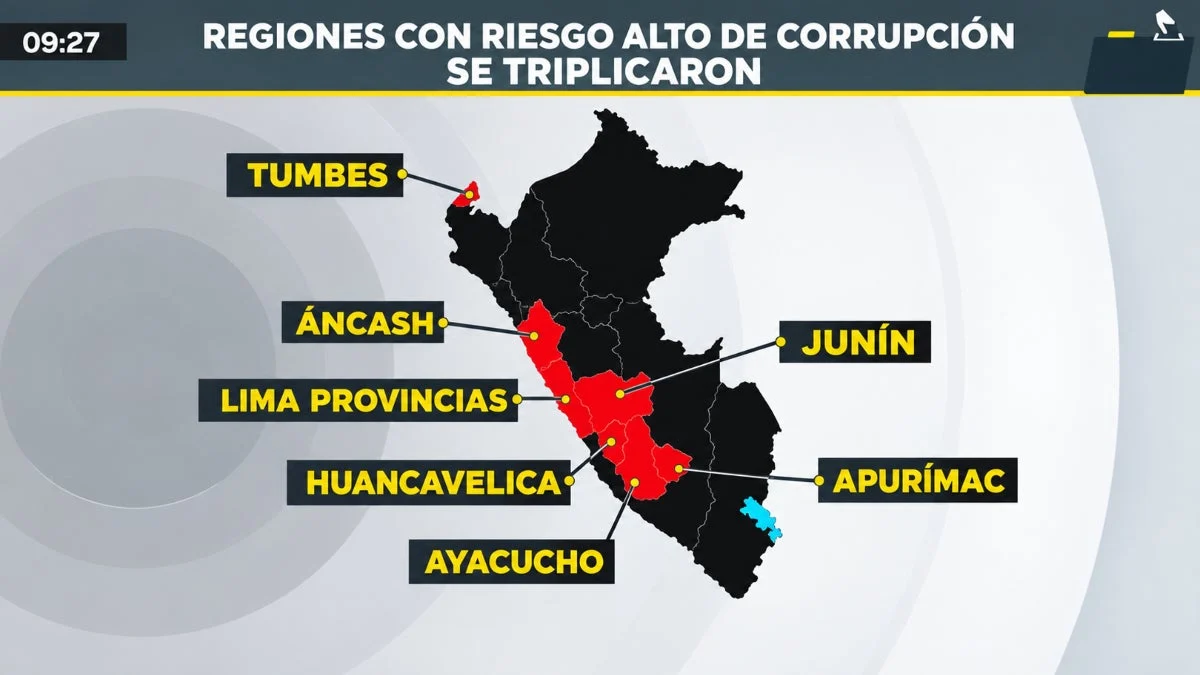
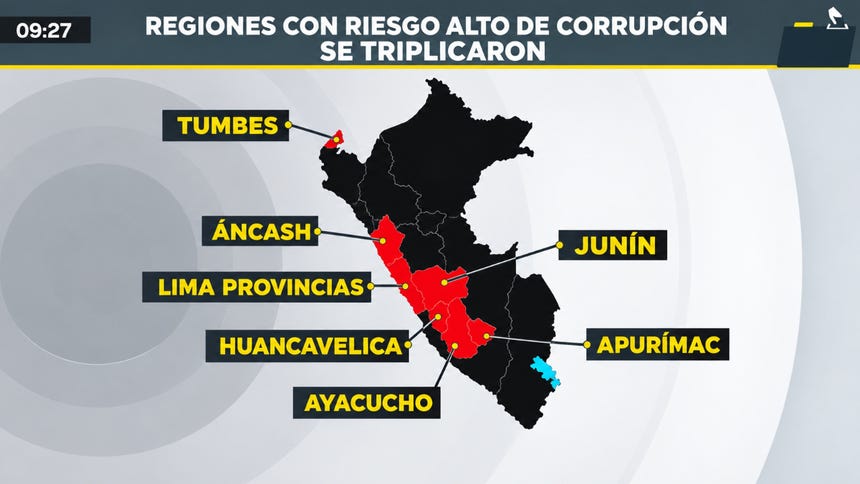
The current state of regional governance is not a sudden development but the culmination of a five-year regression. In 2019, only three regions were classified as having "high corruption risks." Today, that number has ballooned to 10, including Áncash, Apurímac, Ayacucho, Huancavelica, Junín, Lima Provinces, and Tumbes.
The Trajectory of Failure
- 2019: Pre-pandemic administrative structures showed moderate signs of stability, with only three regions in the high-risk category.
- 2020–2022: The COVID-19 emergency and subsequent natural disasters (such as Cyclone Yaku) triggered widespread "emergency declarations." While necessary for rapid response, these declarations became loopholes for bypassing standard oversight, allowing for direct contracting without public competition.
- 2023–2025: A sharp decline in public trust. Citizen perception of regional and local authorities plummeted, correlating with a spike in formal corruption complaints filed with oversight bodies.
- 2026: The launch of IRIS 2026 confirms that the institutional "defenses" against corruption have been hollowed out, leaving the public sector vulnerable to capture.
Supporting Data: Infrastructure and Procurement
The most visible casualty of this governance crisis is the country’s infrastructure. The fact that 62% of regional projects are stalled is not just a statistic—it is an economic tragedy.
Key Indicators of Institutional Decay:
- Procurement Fragmentation: The report identifies a recurring pattern of "micro-contracting," where large projects are broken into smaller, non-competitive contracts to evade public scrutiny and oversight thresholds.
- The "Emergency" Loophole: In regions like Tumbes, persistent states of emergency (due to climate events and rising insecurity) have been used as a pretext to bypass standard bidding. This has led to a culture of discretionary spending that lacks accountability.
- Citizen Disillusionment: The IRIS index incorporates qualitative data from the public. The sharp drop in approval ratings across the board reflects a growing societal awareness that the "social contract" is being broken by those elected to uphold it.
Official Responses and Expert Analysis
The implications of these findings have sparked intense debate among economists and former policymakers. Paola Lazarte, former Minister of Transport and Communications, argues that the cost of this corruption is far greater than the value of the stolen funds.
"When a project is paralyzed due to corruption or mismanagement, it is not just the immediate capital that is lost," Lazarte explains. "It is the lost opportunity cost. We lose the social and economic return on that infrastructure. We incur massive overcosts, dilatated chronograms, and, ultimately, a decline in the quality of public services that drags down national productivity."
According to the IPE, while the national outlook is grim, there are pockets of resilience. Regions like Arequipa, Cusco, Piura, Moquegua, and Tacna have managed to maintain higher standards of efficiency.
- Moquegua stands out for its success in fostering public-private coordination, creating a transparent and favorable environment for investment.
- Tacna shows better performance due to a focus on structural competitiveness, linking public investment to measurable improvements in health, education, and labor market participation.
Implications: A Crossroads for Local Democracy
The findings of the IRIS 2026 index present a complex, yet necessary, challenge for the incoming generation of governors and mayors. With the elections only weeks away, the report serves as a diagnostic roadmap for reform.
The Path Forward
- Digitization of Procurement: To combat the prevalence of "direct" contracts, regional governments must adopt fully transparent, blockchain-enabled, or highly digitized procurement platforms that eliminate human discretion in vendor selection.
- Infrastructure Audits: The incoming administration must prioritize an "audit of the abandoned." Before initiating new projects, local governments must account for the 62% of currently paralyzed works, determining which should be completed, which should be liquidated, and where legal responsibility lies.
- Restoring Citizen Trust: Trust cannot be bought; it must be earned through transparency. The IRIS index suggests that publishing clear, accessible data on project progress and budget execution is the first step in reversing the negative perception held by the public.
- Strengthening Oversight: The decline in institutional performance suggests that the current oversight bodies are either under-resourced or ignored. There is a need for a decentralized but strictly monitored audit system that provides real-time feedback on local government spending.
Conclusion: The Cost of Inaction
The 2026 IRIS report is more than a list of failing regions; it is an indictment of a governance model that has failed to adapt to the demands of a modern economy. As Martín Valencia of the IPE summarized, the goal of the index is not merely to "name and shame," but to provide the incoming authorities with the data they need to pivot toward efficiency.
For the citizens of Peru, the message is clear: the upcoming elections are not just a choice of personality, but a choice of systemic direction. Without a fundamental change in how regional resources are managed, the cycle of paralysis and corruption will continue to stifle the country’s potential, leaving millions of citizens without the essential infrastructure and services required for a dignified life. The "IRIS 2026" is a warning light—whether the next generation of leaders heeds that warning will determine the economic and social trajectory of the nation for the next decade.