In a landmark development for the Huancavelica region, the local government has officially set in motion one of the most significant educational infrastructure projects in the country’s history. The renovation of the emblematic "La Victoria de Ayacucho" educational institution is moving forward with a total investment exceeding S/ 134 million. This initiative, executed through the innovative "Obras por Impuestos" (Works for Taxes) mechanism, promises to redefine the academic landscape of the region, ensuring that this historic school arrives at its bicentennial milestone as a beacon of modern, high-quality education.
The Scope of the Project: A Mega-Infrastructure Masterpiece
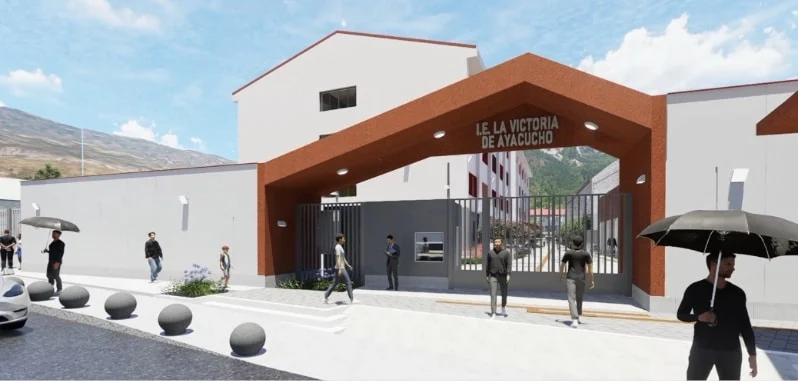
The project is far more than a simple renovation; it is a comprehensive overhaul designed to align the school with 21st-century pedagogical requirements. The scope of the work, being executed by the construction firm RIPCONCIV under the direction of the Banco de Crédito del Perú (BCP), encompasses a sprawling complex tailored for holistic student development.
The master plan includes the construction of multiple state-of-the-art pavilions designed to house administrative offices, a dedicated secretariat, and high-tech classrooms. Beyond standard academic spaces, the school will feature specialized laboratories for scientific research, workshops for vocational and artistic training, and a sophisticated library. Recognizing the importance of physical health and recreation, the facility will include modern sports fields and a full-scale stadium. Furthermore, the inclusion of greenhouses and green areas emphasizes a commitment to environmental education and sustainable campus management.
Perhaps most notably, the school will feature dedicated "Pedagogical Innovation Classrooms," equipped with advanced technology designed to facilitate digital literacy and collaborative learning. Every corner of the new complex will be fully signaled and designed for accessibility, ensuring that students of all physical capabilities can navigate the campus safely.
The "Obras por Impuestos" Model: A Catalyst for Regional Development
The financing and execution of this project are made possible by the "Obras por Impuestos" (OxI) mechanism, established by Law N° 29230. This public-private partnership model allows private companies to invest in public infrastructure projects, effectively pre-financing them against their future income tax obligations.

In this instance, the BCP has assumed the role of the lead partner, bringing its extensive experience in managing large-scale educational infrastructure to the Huancavelica project. This model has proven to be a vital instrument in the Peruvian government’s strategy to bridge the infrastructure gap in rural and regional areas, bypassing traditional bureaucratic bottlenecks that often delay public works. By leveraging the logistical efficiency and financial management capabilities of a major banking institution, the government of Huancavelica has successfully secured the funding and expertise necessary to launch a project of this magnitude, which might otherwise have faced years of administrative stagnation.
Chronology and Implementation Strategy
The project began with the signing of Convenio N° 051-2024, an agreement between the Regional Government of Huancavelica, the BCP, and ProInversión. Following the formalization of this agreement, the project entered the planning and design phase, which prioritized the needs of the student body during the transition period.
A critical component of the project’s timeline is the "Plan de Contingencia." Recognizing that the construction of a campus of this size would necessitate the demolition of the existing, outdated structures, authorities have already transitioned the student body to temporary facilities. These modules are not the typical makeshift sheds; they are sophisticated, two-story structures built with high-performance materials. These units include specialized insulation systems designed to withstand the harsh Andean climate—protecting students from extreme winter cold while maintaining a comfortable thermal environment during warmer months. These temporary facilities are equipped with ramps and pasarelas (walkways) to ensure safe circulation, allowing academic activities to continue uninterrupted while the primary site undergoes its radical transformation.
The upcoming phase involves the systematic demolition of the old school structures, clearing the path for the new foundations. The project management team has indicated that the demolition will be carried out with the highest safety standards to protect both the surrounding neighborhood and the nearby operational contingency modules.
Official Responses and Strategic Vision
Leoncio Huayllani, the head of the Regional Government of Huancavelica, has been a vocal proponent of the project, framing it as a necessary tribute to the school’s historical legacy. "From these halls have emerged great personalities who have shaped our region," Huayllani stated. "As the school approaches its bicentennial anniversary, it deserves an infrastructure that is modern, imposing, and worthy of its history. As a regional government, we have made every effort to concretize this mega-project. We are ensuring that our emblematic institution reaches its bicentennial not just as a symbol of the past, but as a modern hub for the future."

The regional government views this project as a flagship initiative that demonstrates the potential for regional growth when private sector efficiency meets public sector planning. The sentiment shared by regional leaders is that the new "La Victoria de Ayacucho" will serve as a symbol of regional progress and a catalyst for a broader educational transformation across the Huancavelica department.
Implications for the Educational Sector
The implications of this investment extend far beyond the construction of walls and classrooms. By investing over S/ 134 million into a single institution, the regional government is setting a new benchmark for what a public school in the Andean highlands can provide.
1. Narrowing the Digital Divide
The inclusion of "Pedagogical Innovation Classrooms" is a direct response to the global shift toward digital-first education. In a region where access to advanced technology has historically been inconsistent, this facility will provide students with the tools to compete in an increasingly globalized workforce.
2. Economic and Social Impact
The sheer scale of the investment will have a multiplier effect on the local economy. The construction phase alone will generate hundreds of jobs, and the long-term presence of a modern, large-scale educational institution will stimulate local commerce and demand for services in the surrounding area. Furthermore, the improved infrastructure is expected to increase student retention and academic performance, potentially raising the standard of living for the community in the long run.
3. Resilience to Climate Challenges
The design of the contingency modules—and by extension, the new school—reflects a sophisticated understanding of regional climate risks. By implementing thermal insulation and weather-resistant design, the project serves as a case study for future infrastructure projects in high-altitude environments where extreme temperatures often lead to school closures or poor learning conditions.

4. A Blueprint for Future Partnerships
The success of this project will likely serve as a model for other regional governments in Peru. By successfully utilizing the OxI mechanism for a project of this complexity, Huancavelica is demonstrating that private-public partnerships can be scaled to meet the needs of large, long-term infrastructure goals, provided there is strong political will and transparent cooperation.
Looking Toward the Future
As the demolition phase commences, the anticipation in Huancavelica is palpable. The "La Victoria de Ayacucho" project is a testament to the idea that heritage and modernity are not mutually exclusive. Instead, the school is being positioned as a bridge between its 200-year history and the future of Peruvian education.
When the project reaches completion, the new facility will not merely be a place of instruction; it will be a center of community life. With its modern stadium, library, and arts workshops, the school is designed to be an inclusive space that fosters creativity, athleticism, and intellectual rigor. For the parents, students, and educators of Huancavelica, the S/ 134 million investment represents more than just construction materials; it represents a tangible commitment to the belief that every student, regardless of their location, deserves access to world-class facilities and the opportunity to reach their full potential.
The transformation of the "La Victoria de Ayacucho" school is, in many ways, the story of the modern Peruvian interior: ambitious, forward-looking, and increasingly capable of leveraging sophisticated financial tools to secure a brighter future for the next generation. As the new pavilions rise, they will stand as a permanent reminder of the power of collaboration and the enduring value of education in the development of a nation.