AYACUCHO, PERU – In a significant effort to fortify the educational sector against the persistent challenges posed by climate-related disasters, the Peruvian government, through the National Program for Educational Infrastructure (PRONIED) and in close coordination with the Regional Government of Ayacucho, has launched a major initiative to install 41 emergency "dome" classrooms across 11 schools in the region.
This multi-million-sol investment, totaling over S/ 4,078,150, serves as a critical stopgap measure designed to ensure that the academic year remains uninterrupted while permanent school infrastructure—damaged by severe seasonal rains—undergoes necessary reconstruction and repair.
Main Facts: A Resilient Response to Environmental Challenges
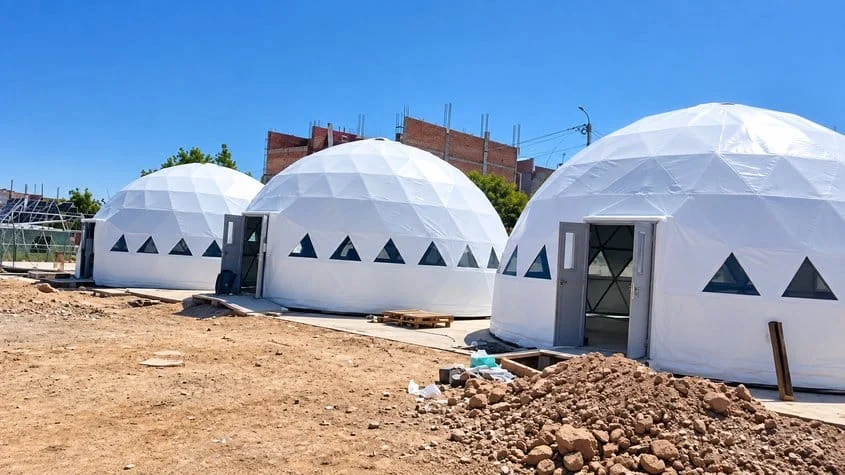
The initiative centers on the deployment of high-performance, modular dome-style classrooms. These structures were selected for their structural integrity, ease of assembly, and ability to provide a safe, climate-controlled environment for students who would otherwise be displaced by the destruction of their school buildings.
The project encompasses a total of 11 distinct educational institutions spanning various provinces in Ayacucho. By investing over four million soles, the Ministry of Education (MINEDU) is addressing the immediate shortage of safe learning spaces. Each of these 41 units is not merely a tent or a makeshift room; they are fully equipped, functional classrooms designed to meet the pedagogical needs of both students and teachers.
According to official specifications, each dome is outfitted with high-quality furniture, including:

- Desks and chairs for 30 students per unit.
- Ergonomic desk and chair sets for instructors.
- High-visibility acrylic whiteboards.
This logistical feat is expected to accommodate a total of 2,460 students, effectively mitigating the risk of academic dropout and educational regression among vulnerable populations in the affected provinces.
Chronology: From Crisis to Implementation
The timeline of this project highlights the urgency with which the Peruvian authorities approached the infrastructure crisis in the Ayacucho region.
- Early 2026 (Initial Impact): Heavy seasonal rains and subsequent flooding caused widespread structural damage to school facilities across the Ayacucho region, rendering several classrooms unsafe for occupation.
- May–June 2026 (Assessment Phase): PRONIED, alongside regional educational authorities, conducted an intensive assessment of the damage. Data confirmed that traditional repair methods would take too long to ensure students returned to classrooms in a timely manner.
- July 2026 (Procurement and Handover): The Ministry of Education finalized the procurement of the 41 dome units. In a formal ceremony, the units were handed over to the Regional Government of Ayacucho. This handover marked the transition from federal procurement to regional responsibility, with the local government committing to the logistical challenge of transporting and installing the units in often remote areas.
- August 2026 (Execution): Systematic installation began. Priority was given to schools with the highest degree of damage, such as the Juan Mendoza Quispe and José Abelardo Quiñones schools in Huamanga, and the Quiturara school in Huanta.
Supporting Data: Distribution and Capacity
The deployment of these 41 classrooms is geographically strategic, ensuring that resources are distributed where they are most needed. The following table illustrates the distribution of the dome classrooms across the beneficiary institutions:
| Educational Institution | Province | Number of Domes |
|---|---|---|
| IE Juan Mendoza Quispe | Huamanga | 4 |
| IE 38984-3 José Abelardo Quiñones | Huamanga | 6 |
| IE Quiturara | Huanta | 4 |
| IE 38238 | Huanta | 4 |
| IE Inmaculada Concepción | Vilcashuamán | 3 |
| IE 24296 Todas las Sangres del Perú | [Regional] | 6 |
| IE Relave | [Regional] | 2 |
| IE 25513 | Parinacochas | 2 |
| IE Juan Velasco Alvarado | Huamanga | 4 |
| IE 28954-22 | Huamanga | 1 |
| IE 38724 | La Mar | 2 |
The total investment of S/ 4,078,150 averages out to approximately S/ 99,467 per unit, a cost-effective figure when considering the long-term benefit of preventing learning loss for nearly 2,500 children.
Official Responses: Strengthening Public-Private Coordination
Minister of Education, José Antonio Chang Escobedo, emphasized that the project is a testament to the efficacy of the "Decentralized Educational Management" model. In his statement, Chang Escobedo highlighted that the success of the program relies heavily on the synergy between national oversight and regional execution.

"The Ministry of Education, through PRONIED, has provided the physical assets, but the commitment of the Regional Government of Ayacucho to manage the site preparation and installation has been the true engine of this progress," said Minister Chang Escobedo. He further noted that these domes serve as a bridge, not a permanent solution, and that the long-term goal remains the structural rehabilitation of the affected permanent school buildings.
The regional authorities in Ayacucho have also expressed their gratitude, noting that the domes are specifically designed to withstand the region’s unique climatic conditions, which are often characterized by significant temperature fluctuations and high-altitude weather patterns.
Implications: The Future of Emergency Education in Peru
The implementation of dome-style classrooms in Ayacucho has far-reaching implications for the future of emergency education in Peru. As climate change continues to increase the frequency and intensity of weather events, the ability of the state to react quickly is paramount.
1. Pedagogical Continuity
The primary implication is the preservation of the academic calendar. When schools are damaged, students often face weeks, or even months, of suspended classes. By utilizing modular, rapid-deployable units, the educational system can pivot to a "functional status" within days of a disaster, ensuring that the right to education is protected as stipulated by the Constitution.
2. Standardization of Infrastructure
The move toward modular design allows PRONIED to maintain a standardized stock of emergency materials. Instead of negotiating for bespoke repairs, which are time-consuming, the government can maintain a "kit-based" approach, significantly reducing response times.

3. Economic Stability for Families
When schools close, the economic ripple effects are felt throughout the community. Parents may be forced to leave their employment to care for children at home, or children may be pressed into labor. By keeping schools open through these temporary measures, the state supports the overall economic stability of the Ayacucho region.
4. Psychological Impact on Students
Environment plays a critical role in childhood development. Studying in a safe, professional, and well-equipped environment—even if temporary—is psychologically preferable to studying in unsafe, damaged buildings or not studying at all. The dome classrooms provide a sense of normalcy and security that is essential for student well-being during periods of regional upheaval.
5. Future-Proofing the Region
While these domes are currently serving as emergency relief, their modular nature means they can be repurposed in the future. Once permanent infrastructure is restored, these units can be relocated to other provinces experiencing growth or temporary overcrowding, turning a one-time emergency expense into a long-term capital asset for the Ministry of Education.
Conclusion
The deployment of 41 dome classrooms in Ayacucho is a landmark example of proactive governance. By bridging the gap between disaster and reconstruction with a solution that prioritizes both safety and learning quality, the Ministry of Education and the Regional Government of Ayacucho have demonstrated a commitment to the region’s youth.
As the installation process nears completion, the focus will now shift to the long-term recovery phase: rebuilding the traditional infrastructure of these 11 schools. However, until that work is finalized, the dome classrooms will serve as a beacon of resilience, ensuring that the children of Ayacucho continue to pursue their education, unhindered by the challenges of their environment.