In the heart of the 21st century, access to clean, running water remains one of the most profound markers of inequality in Peru. Despite decades of economic growth and national development plans, the fundamental right to water has become an increasingly elusive goal for millions of citizens. A recent analysis by the Peruvian Institute of Economics (IPE), based on data from the National Institute of Statistics and Informatics (INEI), paints a stark portrait of a nation falling behind: national coverage of water via public networks has plummeted to 83%, leaving the country significantly detached from its long-held goal of 97% coverage.
This decline is not merely a statistical anomaly; it is a human crisis. Over 5 million Peruvians currently lack access to a public water connection—a figure that has grown more concerning as the country struggles to keep pace with rapid urbanization and informal housing expansion.
The Core Facts: A Growing Gap in Essential Services
The current state of water infrastructure in Peru is characterized by a "triple threat": lack of coverage, inconsistent service, and poor water quality. The national goal, originally established by the National Sanitation Policy for 2021 and subsequently pushed to 2026, appears increasingly unattainable. With the country currently sitting 14 percentage points below the 97% target, the structural failings of the system are undeniable.
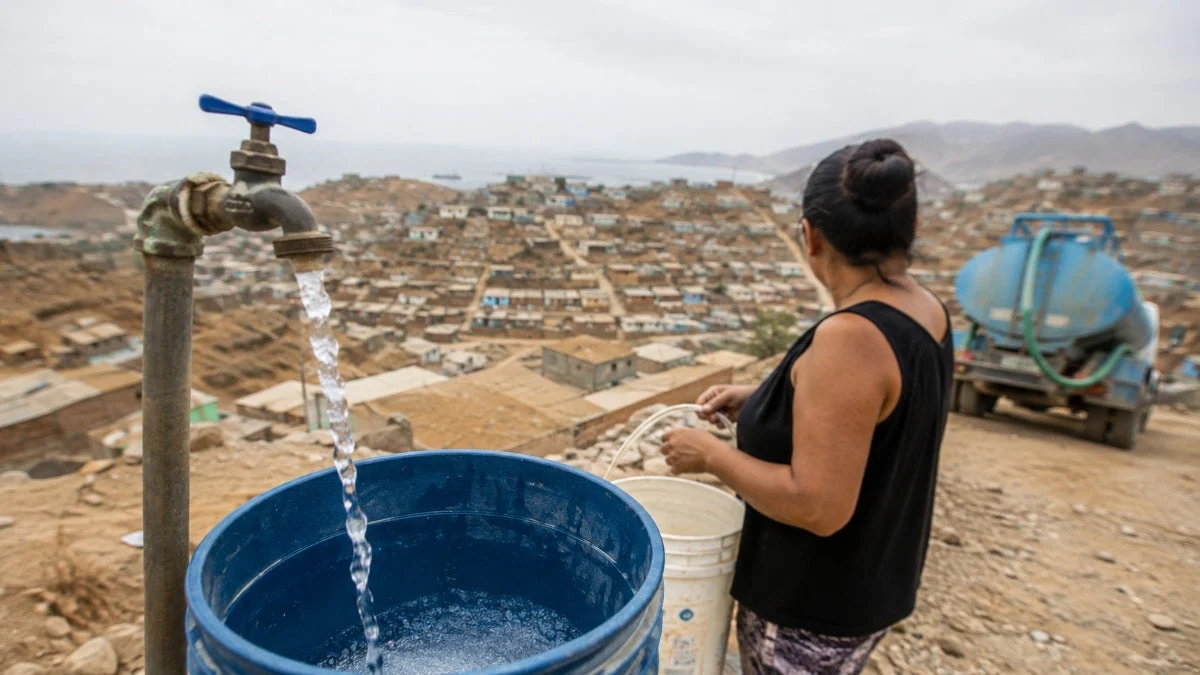
According to Stephanie Maita, an economist at the IPE, the primary driver of this regression is the disconnect between infrastructure development and population growth. While the absolute number of connections has increased since 2017, the expansion has been outpaced by the uncontrolled growth of informal urban settlements. These communities, often established on the peripheries of major cities, lack the basic planning required for the installation of piped water, leaving their residents to rely on expensive, unreliable, and often unsafe alternatives.
A Chronology of Stagnation: From 2021 to 2026
The trajectory of Peru’s water crisis can be viewed as a timeline of missed milestones and shifting benchmarks:
- Pre-2017: Initial attempts at expansion showed promise, but regional disparities were already hardening.
- 2021: The original deadline for universal (97%) coverage established by the National Sanitation Policy. The goal was missed due to bureaucratic delays, budgetary constraints, and the onset of the global pandemic.
- 2022–2024: Faced with the failure to meet the 2021 target, the government extended the deadline to 2026. During this period, the focus shifted toward "closing gaps," yet the pace of urban informality accelerated, effectively cancelling out the new connections being installed.
- 2025 (Present Day): Analysis confirms that 14 out of 26 regions have actually regressed in their coverage percentages. The gap between the target and reality is wider than it was at the start of the decade, signaling a systemic crisis that transcends mere construction delays.
Regional Disparities: The Geography of Exclusion
The water crisis is not felt equally across the Peruvian territory. The IPE’s data reveals a country fractured by geography. While urban hubs like Lima Metropolitana, Callao, Apurímac, and Moquegua report coverage levels above 90%, the situation in the Amazon and the highlands is dire.
In Loreto, the most critical case in the country, less than half of the population has access to public water. Puno and Ucayali follow closely behind, with only six out of every ten people served. These regions are the same areas that faced the highest barriers ten years ago, illustrating a cycle of institutional neglect where the most vulnerable populations remain at the bottom of the priority list.
Furthermore, the divide between urban and rural settings remains stark. While urban areas enjoy an 89% coverage rate, rural areas—where infrastructure is harder to deploy—suffer from a meager 61% accessibility rate. This disparity perpetuates the cycle of poverty, as rural communities are forced to spend disproportionate amounts of time and income simply to secure water for daily survival.
Beyond Access: The Hidden Costs of Quality and Continuity
Having a pipe in the wall is only half the battle. The quality and reliability of the water provided are equally critical. Even in areas with high coverage, "access" does not equate to a 24-hour supply. In five regions, the population receiving water for less than 12 hours a day has actually increased, with Tumbes, Junín, and Lambayeque showing significant deterioration.
![Más de 5 millones de peruanos no tienen acceso al agua y la cobertura retrocedió en 14 regiones [INFORME]](https://f.rpp-noticias.io/2026/08/17/305130_1897122.jpg?width=860&quality=80)
Water quality is another grave concern. Nationally, only 42% of the population has access to "safe" water. In 13 regions, this drops to just one in five people, exposing communities to waterborne diseases and long-term health risks.
The "Poverty Tax" on Water
Perhaps the most egregious aspect of this crisis is the economic burden placed on those without access. Hania Pérez de Cuéllar, former Minister of Housing, Construction, and Sanitation, has repeatedly highlighted that families in peri-urban areas who rely on water trucks (cisterns) pay up to seven times more per liter than a resident in a wealthy neighborhood like La Molina or San Isidro. This is a "poverty tax"—the poorest families, who are the least capable of absorbing extra costs, are paying the highest price for the most basic human necessity.
Institutional Fragility: The Crisis of the EPS
At the heart of the operational failure are the 50 Entidades Prestadoras de Servicios de Saneamiento (EPS), the state-run or municipal entities responsible for water distribution. With the exception of Sedapal (which serves the capital), most of these companies are managed by local municipalities, which often lack the technical and financial capacity to manage complex water systems.
The financial health of these companies is, by all accounts, catastrophic. According to the IPE and the former Minister of Housing, 38 of these companies fail to bill for at least 30% of the water they produce. In some cases, the "non-revenue water" (lost to leaks or illegal connections) reaches 70%. This creates a death spiral:
- Inefficiency: Poor maintenance leads to massive leaks.
- Revenue Loss: The company cannot collect fees for water that never reaches a meter.
- Insolvency: Without revenue, the company cannot invest in infrastructure or repairs.
- Deterioration: The service quality drops further, leading to more illegal connections and further losses.
The Organismo Técnico de la Administración de los Servicios de Saneamiento (OTASS) was created to intervene in these failing companies, but its success has been sporadic. While some interventions have stabilized certain EPS, the majority remain in a state of chronic operational paralysis.
Implications and the Path Forward
The implications of this ongoing crisis are profound. Economically, the lack of water prevents development and productivity, particularly for women and children, who often bear the brunt of water collection duties. Socially, it fuels resentment and distrust in state institutions. Public health remains the most immediate casualty, as the lack of potable water is a direct contributor to chronic malnutrition and infectious diseases.
For the Peruvian government, the path forward requires more than just building pipes. It necessitates:
- Reform of the EPS: Depoliticizing the management of water entities and ensuring they operate under strict technical and financial criteria.
- Targeted Urban Planning: Addressing the roots of informal housing, which makes the extension of water networks technically impossible and financially ruinous.
- Technological Investment: Focusing on leak detection and smart metering to stop the massive wastage of water that is currently being produced but never sold.
- Public-Private Synergy: Leveraging the lessons learned from the few successful EPS to scale up better management practices nationwide.
The "thirst" of the Peruvian population is not a lack of resources, but a failure of governance. As the 2026 deadline approaches, the nation stands at a crossroads: it can continue to patch a crumbling system, or it can fundamentally restructure how water is managed, valued, and delivered to every citizen, regardless of their postal code or economic status. Anything less is a betrayal of the basic rights that a modern state is obligated to protect.