Executive Summary: A Response to Weather-Induced Mobility Challenges
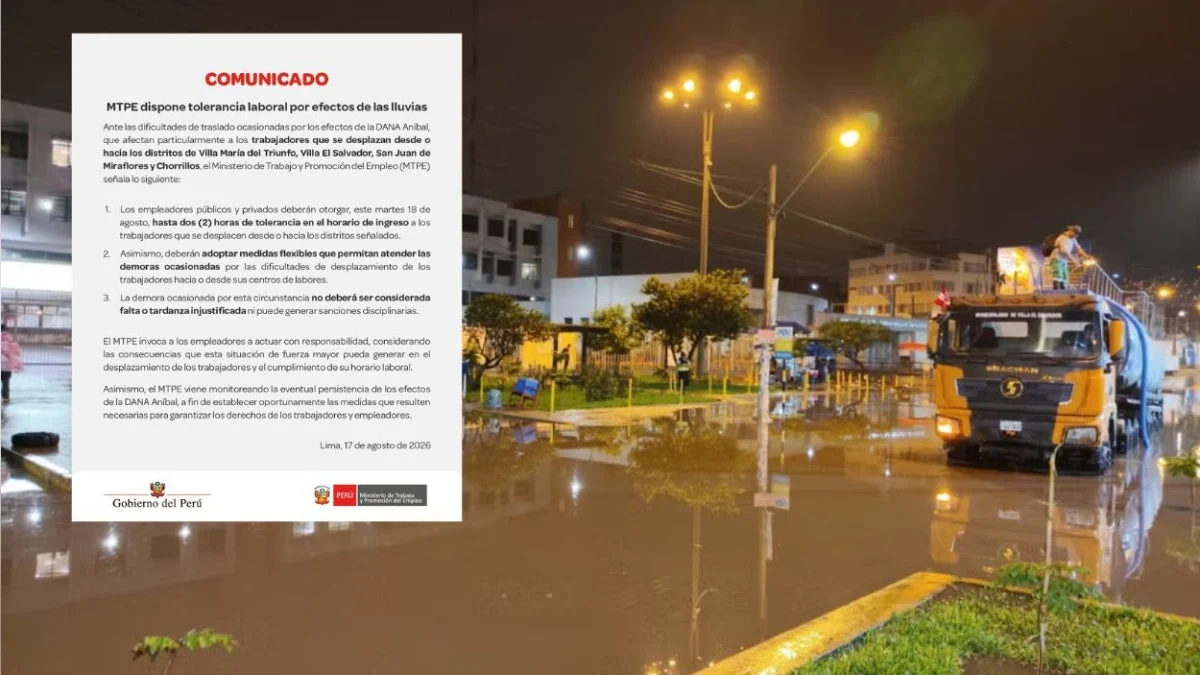
In a significant administrative move to mitigate the impact of severe meteorological conditions on the local workforce, the Peruvian Ministry of Labor and Employment Promotion (MTPE) has officially mandated a two-hour grace period for employee arrivals. This measure, effective Tuesday, August 18, is specifically designed to support individuals commuting to or from the southern districts of Lima, which have been hit hardest by the atmospheric instability known as "DANA Aníbal."
The decree, issued late Monday evening, acknowledges the precarious state of public transportation and the logistical gridlock caused by intense rainfall and resulting infrastructure damage. By granting this temporary flexibility, the government aims to safeguard the professional standing of thousands of citizens who find themselves unable to navigate the chaotic transit environment through no fault of their own.
Chronology: The Escalation of DANA Aníbal
The events leading to this ministerial intervention began over the weekend as the meteorological phenomenon designated as DANA Aníbal—an acronym for "Depresión Aislada en Niveles Altos"—began its trajectory over the coastal regions of Lima.
- Saturday, August 15: Preliminary meteorological reports identified a high-pressure system interacting with cold air masses, resulting in uncharacteristic precipitation patterns. Local authorities issued initial warnings regarding potential flooding and surface runoff in the southern outskirts of the capital.
- Sunday, August 16: As rainfall intensified throughout the night, the urban infrastructure in Villa María del Triunfo and San Juan de Miraflores began to show signs of strain. Significant pooling of water on major transit arteries, such as the Panamericana Sur, forced municipal transit authorities to implement emergency detours.
- Monday, August 17: The morning commute saw unprecedented delays as public transport fleets struggled to navigate waterlogged roadways and blocked intersections. By midday, social media reports and transport union bulletins indicated that travel times from Villa El Salvador to the city center had more than tripled.
- Monday Evening: Following a rapid assessment of the logistical crisis, the MTPE held an emergency session. Recognizing that the disruption was not a localized incident but a widespread barrier to workforce participation, the Ministry drafted the official resolution providing for the two-hour grace period.
Supporting Data: Impact on Mobility and Logistics
The districts of Villa María del Triunfo (VMT), Villa El Salvador (VES), San Juan de Miraflores (SJM), and Chorrillos represent a critical industrial and residential corridor. Combined, these zones house hundreds of thousands of workers who rely on the daily stability of the transit network to sustain the economic output of the capital.
Transit Gridlock and Infrastructure Strain
According to regional traffic management data, the influx of water into low-lying areas in Chorrillos and SJM resulted in the temporary closure of at least four major intersections. These closures acted as a bottleneck, causing a cascading effect that paralyzed traffic flow for over 15 kilometers in every direction.
Public transportation—the primary mode of transit for roughly 75% of the workforce in these districts—experienced a breakdown in service continuity. Bus operators reported mechanical failures due to water intake, while informal transit routes were rendered impassable by mud and debris. The MTPE’s decision to intervene was supported by reports indicating that the average transit time for a typical morning commute had increased by approximately 150% during the peak hours of Monday morning.
Official Responses: The Ministry’s Mandate
The Ministry of Labor and Employment Promotion has framed this directive as an exercise of "force majeure," a legal term indicating that the situation was beyond the control of the affected parties.
Legal Protections for Employees
The core of the MTPE’s directive lies in the protection of labor rights. Under the new mandate:
- Non-punitive Policy: Any employee arriving within two hours of their scheduled start time due to weather-related transit issues shall not be penalized.
- Prohibition of Disciplinary Action: Employers are explicitly barred from categorizing these late arrivals as "unjustified tardiness." Any attempt to dock pay, issue formal reprimands, or trigger disciplinary proceedings based on these specific arrivals will be considered a violation of the labor code.
- Mandatory Compliance: The regulation applies equally to the public and private sectors. No organization, regardless of its size or nature, is exempt from the requirement to adopt flexible attendance policies.
"The goal is to ensure that the worker does not face the double burden of navigating a hazardous commute and fearing for their job security," stated a ministry spokesperson during a press briefing. The Ministry emphasized that the "responsible" approach for any organization is to prioritize the physical safety of their staff over rigid adherence to time-clocks during extreme environmental events.
Implications: The Long-Term View of Urban Resilience
The disruption caused by DANA Aníbal serves as a stark reminder of the vulnerability of Lima’s urban infrastructure to climate-induced events. The MTPE’s response, while necessary in the short term, has sparked a wider conversation about the future of work in a city increasingly prone to atmospheric volatility.
Adapting to a Changing Climate
The decision to grant a two-hour grace period is not just a logistical fix; it represents a shift in labor relations. Traditionally, attendance policies in Lima have been rigid, often failing to account for the city’s complex topography and unpredictable weather. By codifying flexibility, the MTPE is setting a precedent that may influence how companies manage their workforce in the future.
The Role of Remote Work
Industry analysts are already suggesting that this incident provides a strong argument for the formal adoption of telecommuting or hybrid models. If a portion of the workforce in VMT, VES, SJM, and Chorrillos had the capability to work from home, the strain on public infrastructure during such events would be significantly reduced. The MTPE has hinted that, should these weather patterns persist, it will continue to evaluate policies that favor remote work as a tool for "continuity of operations."
Monitoring and Future Measures
The Ministry has committed to a continuous monitoring process. Meteorologists from the national weather service have indicated that while the immediate intensity of DANA Aníbal is expected to subside by Wednesday, the saturated soil and damaged road surfaces will continue to cause localized delays for the remainder of the week.
Consequently, the MTPE has kept the door open for the extension of these measures. Should the transit gridlock continue, the Ministry reserves the right to issue further directives, potentially extending the grace period or recommending that businesses move to "remote-first" operations until the infrastructure is deemed fully safe for mass transit.
Conclusion: A Collaborative Approach to Crisis
The current situation demands a high level of cooperation between the government, employers, and the workforce. The MTPE’s mandate is a firm baseline—a standard that must be met—but the Ministry has also encouraged employers to go above and beyond, suggesting that companies should proactively communicate with their staff to determine individual circumstances.
As Lima navigates the aftermath of this meteorological event, the focus remains on resilience. The ability of the labor market to absorb these shocks, supported by sensible government regulation and empathetic corporate management, will be the determining factor in how quickly the city returns to normalcy. For now, the message from the authorities is clear: during periods of crisis, the primary objective is the safe and secure transit of the people who power the nation’s economy.
The MTPE remains vigilant, ready to adapt its strategy to ensure that the rights of the worker are protected, and that the economic engine of Lima remains stable, even in the face of the unpredictable forces of nature.