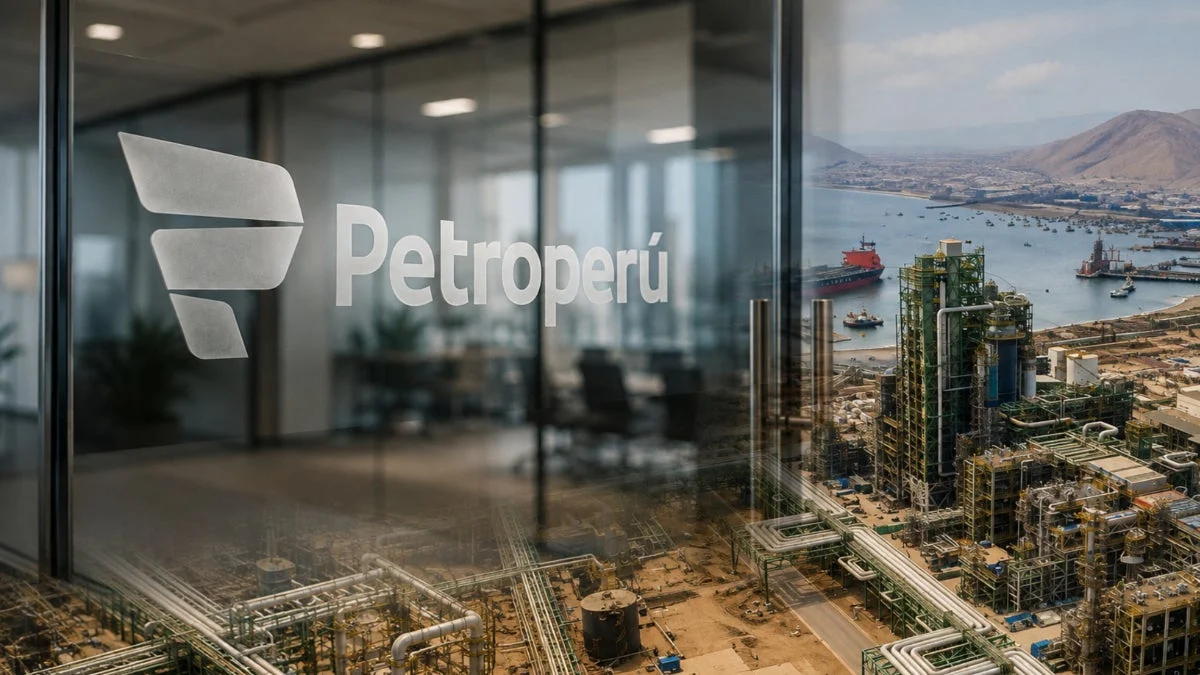
In a strategic maneuver to navigate one of the most precarious financial periods in its history, the state-owned oil company Petroperú has officially incorporated a new subsidiary: Petroperú Invest. This entity has been designed as a Special Purpose Vehicle (SPV) to serve as a financial firewall, intended to secure and manage up to US$2 billion in private financing. The immediate objective is to obtain a "bridge loan" of US$500 million, a lifeline essential for purchasing crude oil and restoring the operational capacity of the Talara Refinery.
The creation of this subsidiary, approved by the Board of Directors and formalized through filings with the Superintendency of the Market of Securities (SMV), represents a significant shift in how Petroperú intends to handle capital injections. With Carlos Enriquez Cuéllar appointed as its first General Manager, the company is positioning itself to regain the trust of international creditors who have remained skeptical of the state oil firm’s internal management.
The Genesis of Petroperú Invest: A Structural Firewall
The fundamental purpose of Petroperú Invest is to act as a financial intermediary—or, as industry experts describe it, a "treasurer." By isolating the incoming funds from the main company’s corporate accounts, Petroperú aims to mitigate the risk perception that has hampered its ability to attract private investment.
Aurelio Ochoa, a former director of Petroperú, explained that the creation of this subsidiary is a direct response to the lack of confidence in the parent company’s current financial governance. "Because there is distrust, this company emerges to take on a role as a custodian," Ochoa noted.
Technically, Petroperú Invest functions as a Special Purpose Vehicle (SPV). According to former Deputy Minister of Hydrocarbons, Erick García, this structure is common in large-scale financial operations where specific revenue streams—such as those generated by the refining process—are ring-fenced to guarantee the repayment of loans. "It serves as a shield or a protection for the money," García explained. "If you are going to have specific cash flows from a specific activity, you can form this company to protect those resources from the volatility of the main entity."
A Chronology of Stagnation: The Long Road to US$2 Billion
The path to securing this funding has been fraught with delays, political instability, and administrative friction.
- Initial Promises (May 2026): The government, under the administration of the time, announced an ambitious plan to secure up to US$2 billion from the international banking sector to stabilize Petroperú.
- The Bridge Loan Failure: A primary component of this plan was a "bridge loan" of US$500 million, intended to provide immediate liquidity while the larger, long-term financing package was negotiated. Three months have passed, and this initial tranche has yet to materialize.
- Administrative Friction: Analysts point to a period of "short-circuiting" between the previous Board of Directors and Proinversión—the state agency responsible for promoting private investment. This lack of synergy effectively paralyzed the negotiation process.
- Current State: Today, the situation is critical. The lack of liquid assets has left the Talara Refinery operating at a fraction of its capacity. Crude-laden tankers are reportedly idling off the coast, unable to unload their cargo because the company lacks the immediate cash flow to pay for the shipments.
Supporting Data and Financial Context
The crisis at Petroperú is not merely a liquidity issue; it is a systemic challenge that has prompted warnings from global credit rating agencies like Moody’s. The agency has repeatedly highlighted that without a clear, executable roadmap and concrete state support, the company’s long-term viability remains in question.
The legal framework for this operation is grounded in Emergency Decree 003-2026, which mandates that funds be channeled through one or more trusts (fideicomisos) under the supervision of Proinversión. To oversee the technical administration of these funds, Petroperú has appointed TMF Fiduperú, a move intended to provide transparency and reassure international lenders that the funds will be used strictly for their intended purpose: the acquisition of crude and the maintenance of operational continuity.
Official Responses and Stakeholder Perspectives
The creation of Petroperú Invest has drawn mixed reactions from industry experts, government officials, and, crucially, the workforce.
The Expert View
Pedro Gamio, former Deputy Minister of Energy, views this development as a "trial by fire" for the current management team led by Oliver Stark. Gamio emphasizes that the synergy between Petroperú’s board and Proinversión is no longer a matter of preference but an absolute necessity for survival. "The company is losing market share daily. The refinery is semi-paralyzed because it lacks the essential raw material: crude oil. We are witnessing a situation where the infrastructure is ready, but the engine is starved of fuel," Gamio remarked.
The Labor Perspective
The Federation of Petroleum Workers (Fenpetrol) has expressed significant apprehension regarding the new subsidiary. In a public statement, the union raised questions about the true long-term intentions behind Petroperú Invest.
"We consider it necessary to clarify what the true role of this Special Purpose Vehicle will be," the union stated. "We are concerned that it may be used to absorb personnel in a way that bypasses current collective bargaining agreements or allows for the erosion of labor benefits. There is a fear that this could be a mechanism to eventually restructure the company at the expense of the workers’ rights."
Erick García acknowledged these concerns, stating that for the sake of transparency, Proinversión must provide a comprehensive, step-by-step breakdown of how the subsidiary will interact with the existing workforce and the parent company’s operational structure.
Future Implications: Can the Strategy Work?
The survival of Petroperú as a major player in the regional energy market depends on the success of this financial architecture. The strategy is clear: by creating a "clean" vehicle that is legally and operationally distinct from the legacy debt and management issues of the parent company, the state hopes to entice private banks to open their credit lines.
However, the clock is ticking. The delay in receiving the initial US$500 million is not just a bookkeeping issue; it is a daily drain on the company’s balance sheet. Every day that the refinery remains under-utilized while ships sit idle at sea represents lost revenue and increasing operational costs.
As the government moves forward with this SPV model, the focus will shift to two critical areas:
- Transparency: How effectively will TMF Fiduperú and Proinversión manage the trust? Any hint of mismanagement will likely close the door on the remaining US$1.5 billion of the proposed funding.
- Labor Stability: The government must address the concerns of Fenpetrol. A labor dispute during this delicate financial restructuring could prove disastrous for the company’s image and operations.
Petroperú Invest is, in effect, a last-ditch effort to separate the company’s operational future from its recent past. Whether it succeeds in "oxygenating" the firm or merely adds another layer of bureaucracy remains to be seen. For now, the eyes of the market, the government, and the workforce are fixed on the arrival of the first bridge loan—the litmus test for whether this new subsidiary can actually deliver on its promise of stability.