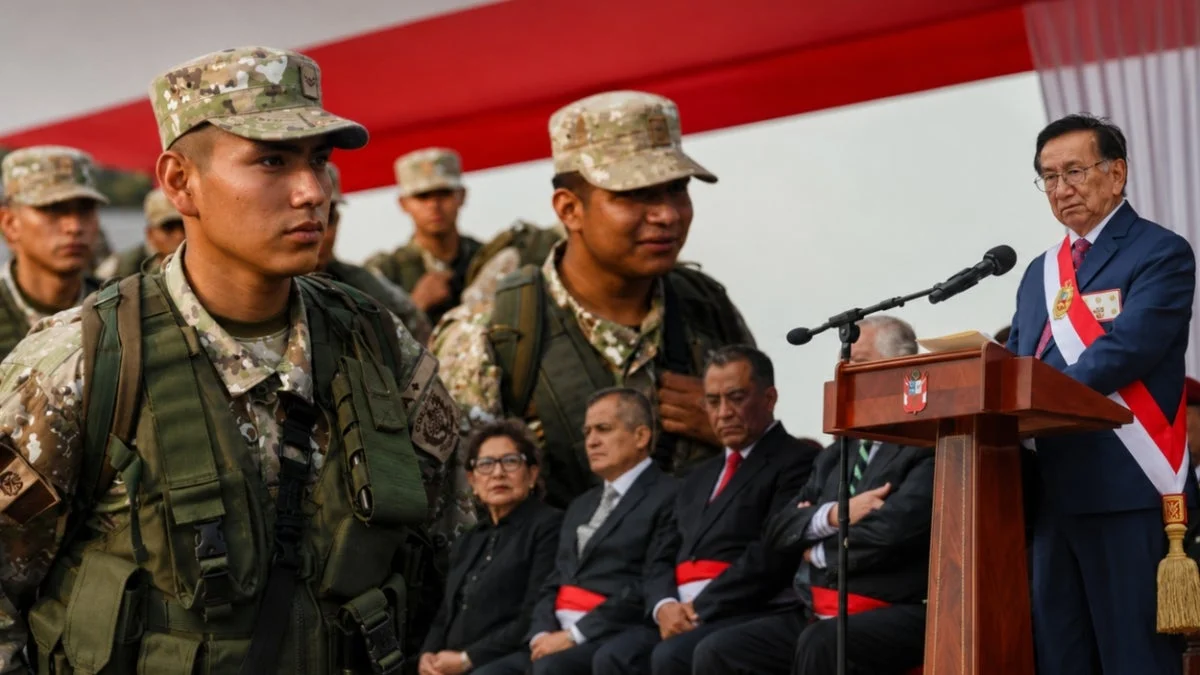
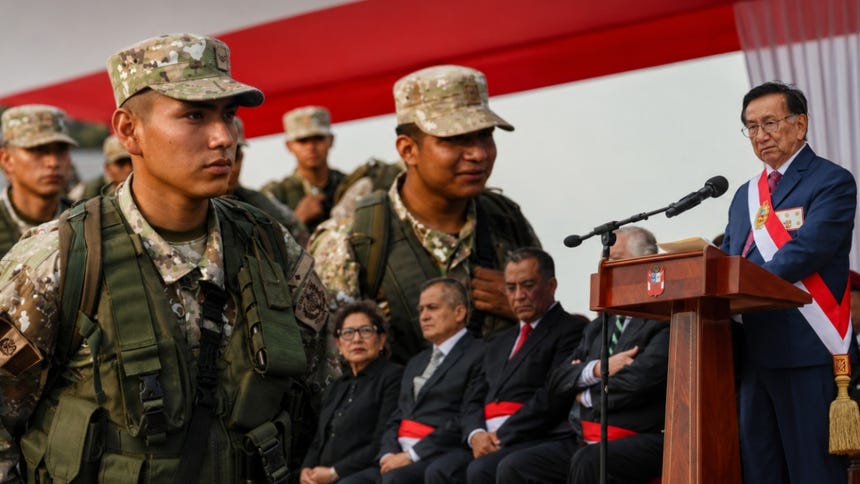
In a landmark decision aimed at strengthening the country’s national defense and providing a sustainable economic safety net for young citizens, President José María Balcázar announced a significant policy shift this Friday. During the solemn ceremonies commemorating the 146th anniversary of the Battle of Arica and the renewal of the Oath of Fidelity to the Flag, the head of state revealed that his administration will implement a permanent monthly bonus of S/300 for all youth participating in the Voluntary Military Service.
The policy, which covers personnel across the Peruvian Army, the Navy, and the Air Force, represents a strategic investment in human capital. Beyond the immediate financial relief for recruits, the President also signaled an expansion in military capabilities, confirming that the Executive branch will seek a supplementary credit to bolster the operational readiness and infrastructure of the Armed Forces.
Main Facts: The New Financial Commitment
The announcement, made in the presence of high-ranking military officials and government dignitaries, serves as a direct recognition of the sacrifices made by young men and women who commit themselves to national security. President Balcázar emphasized that the S/300 monthly bonus is designed to be a permanent feature of the national budget, ensuring that soldiers are not left in a state of financial vulnerability upon completing their two-year commitment.
"From my government, I want to announce that we are going to start from the top down and from the bottom up; this means recognizing in the budget of the Republic a permanent bonus of 300 soles for our soldiers who serve in the Army, the Navy, and the Air Force," the President stated. By framing the bonus as a form of "compensation for services," the administration seeks to address the gap between the end of military service and the start of a civilian career, a period often fraught with unemployment and economic instability.
Chronology of Events and the Commemorative Context
The announcement was strategically timed to coincide with one of the most important dates in the Peruvian military calendar.
- 146th Anniversary of the Battle of Arica: The ceremony honored the memory of Colonel Francisco Bolognesi and his troops, who, despite overwhelming odds, chose to fight to the last bullet. This historical context served as the backdrop for the President’s call to respect and value those currently in uniform.
- The Renewal of the Oath: The event included the traditional renewal of the Oath of Fidelity to the Flag, a moment of profound national pride that underscores the bond between the citizen and the State.
- The Announcement: Following the military honors, President Balcázar took to the podium to bridge the gap between historical duty and contemporary social policy, unveiling the financial aid package.
- The Future Roadmap: The President indicated that this is merely the first phase of a broader plan to revitalize the Armed Forces, with the upcoming management of a supplementary credit serving as the next milestone in his administration’s agenda.
Supporting Data: Understanding the Voluntary Military Service
The Voluntary Military Service in Peru is not merely a recruitment tool; it is a comprehensive program governed by Law N.º 29248. It is designed to offer young people, aged 18 to 30, a structured environment for professional growth.
Benefits of the Service
The current framework provides several pillars of support:
- Direct Subsistence: Volunteers receive daily food, a full uniform kit, and monthly stipends, which will now be supplemented by the new S/300 permanent bonus.
- Healthcare Access: Recruits are provided with full medical coverage within the health establishments of their respective military branches.
- Educational Integration: The service provides technical and productive training. Furthermore, after the first year of service, participants gain access to significant educational benefits, including pathways to "Beca 18," a prestigious state-sponsored scholarship program.
- Social Inclusion: Beyond the base, soldiers receive discounts of up to 50% on museums, cultural activities, and sporting events, encouraging the integration of military youth into the broader cultural life of the country.
To enlist, applicants must hold a National Identity Document (DNI), have completed at least primary education, and pass a rigorous psychometric and physical fitness assessment.
Official Responses and Strategic Implications
The decision to allocate a supplementary credit to the Armed Forces has generated significant discourse within political and military circles. Supporters of the measure argue that the aging infrastructure and evolving security landscape require a modern, well-equipped military force.
The President’s commitment to "strengthen the operational capabilities" of the forces implies a potential upgrade in equipment, technology, and logistics. For many, this is a long-overdue response to the challenges faced by military institutions in maintaining national security in the 21st century.
However, the policy is not without its critics, who raise questions regarding the fiscal sustainability of such a permanent increase in public spending. The Ministry of Economy and Finance will likely be tasked with outlining how the budget will be adjusted to accommodate these expenses without compromising other social programs.
Long-term Societal Implications
The move to provide a financial cushion for soldiers post-service is a significant step toward solving the "re-entry problem." Historically, many veterans have struggled to translate their military skills—such as discipline, leadership, and technical proficiency—into the civilian job market. By framing the S/300 bonus as a bridge, the administration hopes to provide these young people with the liquidity needed to pursue further education or vocational training immediately upon discharge.
Moreover, by making the military a more attractive and stable career path, the government hopes to increase the quality and retention rates of its voluntary force. This, in turn, creates a more professionalized military capable of responding to both internal and external threats, as well as providing critical support during national emergencies such as natural disasters.
A Tribute to Sacrifice
In his closing remarks, President Balcázar drew a direct line between the heroes of the past and the soldiers of the present. "That is how we must begin, by paying homage to our Francisco Bolognesi and his soldiers who lost their lives in a battle, and by valuing those who serve today," he remarked.
The administration’s focus on the "human element" of the military, combined with the planned injection of capital into operational resources, signals a shift in the government’s security doctrine. This approach views the strength of the nation not just in terms of weaponry, but in the welfare and development of the individuals who swear to protect the flag.
Conclusion: The Path Forward
As the government prepares to formalize the supplementary credit and implement the new bonus structure, the focus will now turn to the legislative and bureaucratic steps required to codify these promises. The public, the military, and the youth of Peru will be watching closely to see how effectively these reforms are rolled out.
If successful, this initiative could redefine the relationship between the Peruvian state and its Armed Forces, ensuring that those who offer their youth in service to the country are not only honored with medals and ceremonies but also supported with the economic dignity they deserve. The upcoming months will be critical in determining whether this, as the President promised, is the start of a sustained investment in the nation’s future protectors.