As Peru heads to the polls this Sunday, the nation faces the culmination of a five-year project of institutional erosion. A powerful, trans-ideological coalition in Congress—spanning the spectrum from the far-right to the far-left—has acted in lockstep to dismantle the system of checks and balances. Through a systematic "capture" of state institutions, this bloc has passed a series of legislative reforms designed to guarantee impunity for its members, sideline independent oversight, and neutralize the judiciary.
This report examines the mechanics of this legislative strategy, detailing how political adversaries became partners in a common goal: the consolidation of absolute power, free from the constraints of the rule of law.

The Anatomy of Institutional Capture
The coalition’s strategy has been marked by a consistent pattern: the strategic replacement of personnel in key oversight bodies followed by the passage of laws that weaken the state’s capacity to investigate corruption and organized crime.
The Tribunal Constitucional: A Strategic Foothold
On May 10, 2022, the Congressional coalition flexed its muscle by electing six new magistrates to the Tribunal Constitucional (TC). The election was a masterpiece of political orchestration, with each candidate securing over 90 votes. The support came from a diverse array of benches, including Fuerza Popular, Perú Libre, Renovación Popular, Alianza para el Progreso, Acción Popular, Avanza País, Somos Perú, Podemos Perú, and Cambio Democrático-Juntos por el Perú.

Since their installation, the court’s rulings have frequently aligned with the interests of the coalition, effectively acting as a judicial shield for legislators and their allies.
The Ombudsman and the "Scorpion" Plot
One week after the TC appointments, the Congress selected Josué Gutiérrez as the nation’s Ombudsman. Gutiérrez, a former parliamentary advisor to the ruling party and legal counsel to Vladimir Cerrón, was chosen with 88 votes.

The implications of this appointment were later laid bare by the "Valquiria" investigation and the book La Política del Escorpión by journalist Américo Zambrano. WhatsApp exchanges between Jaime Villanueva (then-advisor to former Attorney General Patricia Benavides) and "Roberto"—the operational pseudonym for Fujimorist congresswoman Martha Moyano—revealed that the appointment was part of a calculated move to control the committee responsible for selecting the National Justice Board (JNJ).
As Villanueva noted in a leaked message: "Having a titular [Ombudsman] is essential… because the Ombudsman presides over the commission that will choose the new JNJ. If the current lady remains, the new board would be taken over by ‘caviares’ [a derogatory term for progressives]. That is the danger." The strategy succeeded: the JNJ was subsequently overhauled, and in June 2024, it nullified the disciplinary process against Patricia Benavides, reinstating her as Attorney General.

Chronology of Coordinated Inhabilitations
The coalition has effectively weaponized the constitutional power of "inhabilitation"—stripping officials of the right to hold public office—to purge those perceived as threats to their agenda.
- June 2023: Prosecutor Zoraida Ávalos was banned from office for five years. The pretext was her decision to open an investigation into then-President Pedro Castillo. Reports suggest that this move was a "quid pro quo" involving Patricia Benavides, who sought to neutralize Ávalos in exchange for immunity for her congressional allies.
- March 2024: The Congress moved to ban Inés Tello and Aldo Vásquez, members of the JNJ. Both had been instrumental in purging magistrates linked to the "Cuellos Blancos" corruption ring. While the Judiciary initially annulled these sanctions, the TC intervened to uphold the Congressional ban.
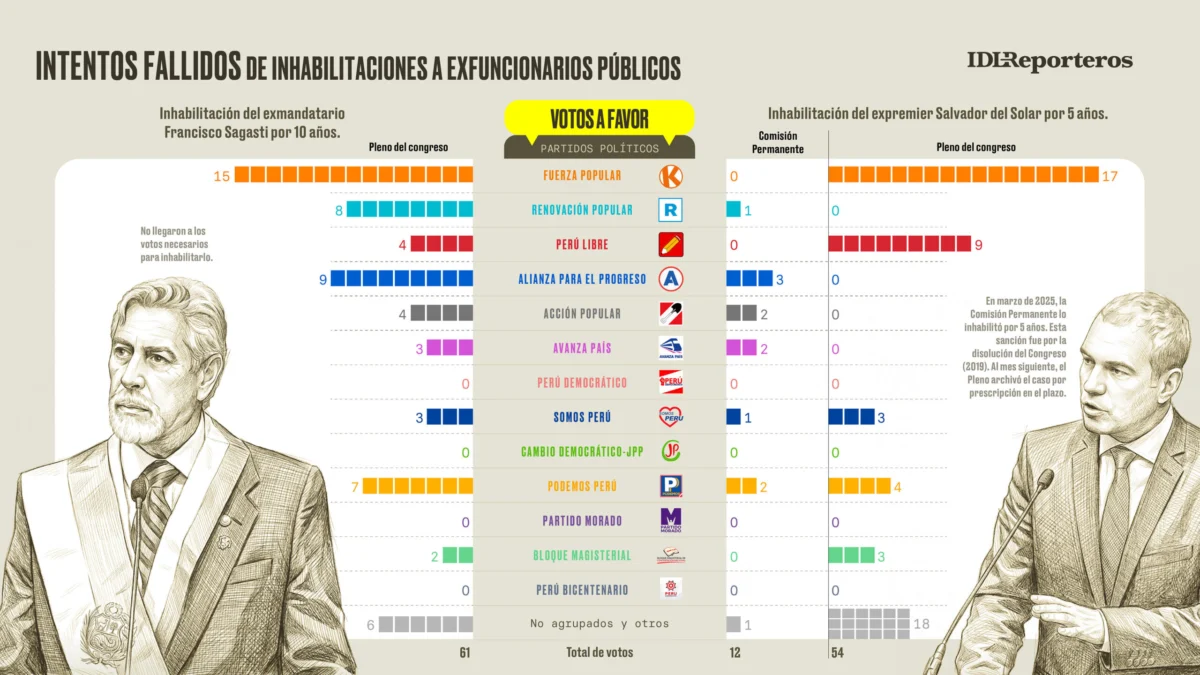
- 2025 – Targeting Potential Rivals: The coalition also attempted to neutralize potential presidential candidates. In March 2025, the Permanent Commission banned former Prime Minister Salvador del Solar, though the move was later archived due to legal deadlines. Similarly, former President Francisco Sagasti faced an attempted ban for his police reforms, though the coalition failed to muster the necessary votes.
The "Pro-Crime" Legislative Package
Perhaps the most significant legacy of this coalition is the series of laws passed between 2023 and 2024 that have crippled the criminal justice system.

The "Soto Law" (Law 31751)
This law reduced the suspension period for the statute of limitations to just one year. It has effectively granted impunity to high-ranking officials by stalling judicial processes until they expire. Beneficiaries include Alejandro Soto, Vladimir Cerrón, and former President Martín Vizcarra.
The Collaboration Reform (Law 31990)
By limiting the time authorities have to corroborate testimony from "effective collaborators" (plea bargainers) to eight months, the law has severely hampered major corruption investigations, including the Lava Jato and Cuellos Blancos cases.

The "Impunity Law" (Law 32107)
This legislation declares the prescription of crimes against humanity and war crimes committed prior to 2002. This has triggered a wave of requests for release from military and political figures accused of extrajudicial killings and forced disappearances. Notably, it led to the release of former presidential candidate Daniel Urresti, who had been convicted for the murder of journalist Hugo Bustíos.
Implications for the State and Society
The coalition’s actions have effectively created a "parallel legality" where the law is used as a tool for self-preservation rather than justice.

- Systemic Impunity: The shielding of former President Dina Boluarte (in cases ranging from the "Rolex" scandal to protest-related deaths) and the protection of former Attorney General Benavides have eroded public trust in the state.
- Economic Illegality: The extension of the Reinfo (mining formalization registry) until 2026 has provided a legal cover for illegal mining operations, often linked to the regions where these political parties hold influence.
- Criminalization of Dissent: The recent reform of the Agency for International Cooperation (APCI) represents a direct threat to civil society. By preventing NGOs that receive foreign funding from participating in legal defenses for human rights victims, the law effectively creates a "gag order" on independent watchdogs and human rights defenders.
Official Responses and Stance
Throughout these processes, members of the coalition have maintained that their actions are purely legislative and aimed at correcting what they term "judicial overreach." They argue that the judiciary and the JNJ had been captured by ideological factions, and that their reforms are necessary to restore constitutional balance. However, international observers, the Peruvian Bar Association, and the Public Ministry have repeatedly challenged these laws as unconstitutional, citing the "control of conventionality" as a necessary safeguard against the legislative assault on democratic norms.
Conclusion
As voters head to the ballot boxes, the evidence presented in this report suggests that the "capture" of the Peruvian state is not merely a collection of isolated incidents, but a cohesive, long-term political project. By controlling the Congress, the Tribunal Constitucional, and the Ombudsman’s office, and by passing a series of laws that dismantle the investigative capacity of the prosecution, this coalition has constructed a fortress of immunity. The future of Peruvian democracy now rests on whether the next administration—and the citizens themselves—can dismantle this structure or if the precedent of "governing through impunity" will become the new standard for the nation’s political life.