By Economic Analysis Desk
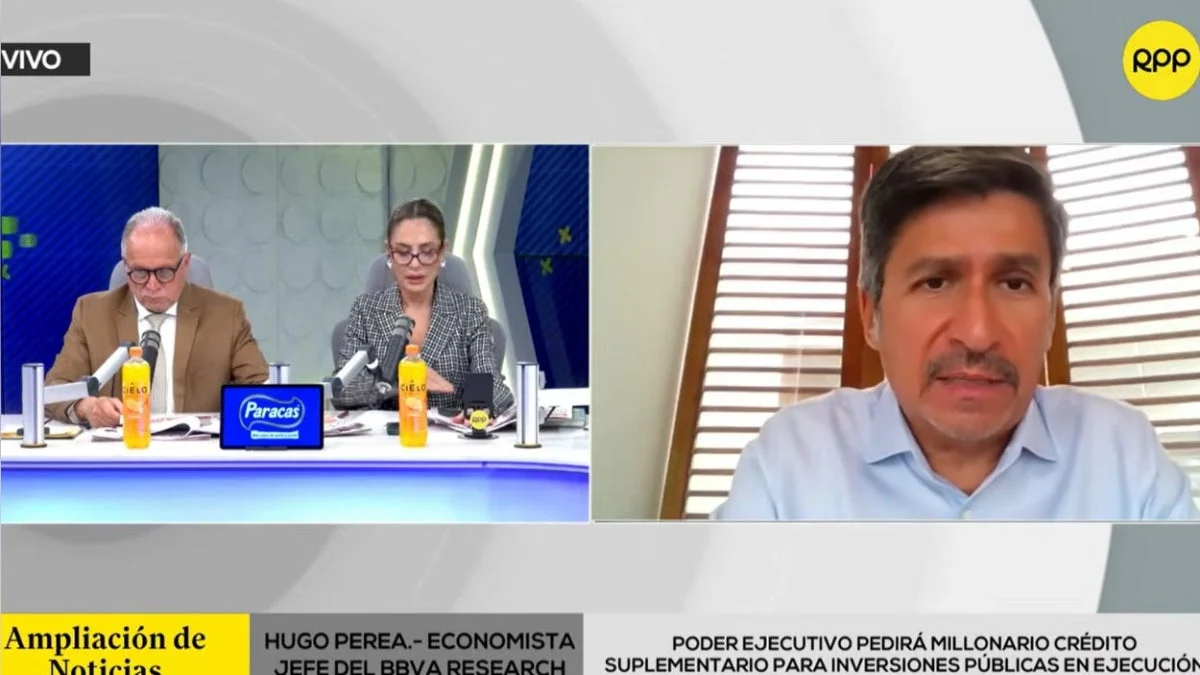
The Peruvian economic landscape is currently navigating a period of profound fragility. As the government signals intentions to expand public spending through a supplemental credit, leading voices in the financial sector are raising alarms. Hugo Perea, Chief Economist at BBVA Research, has emerged as a vocal critic of this fiscal trajectory, arguing that the administration is risking long-term stability in exchange for short-term political gains.
The core of the issue lies in a fundamental contradiction: while the Ministry of Economy and Finance (MEF) acknowledges a "complex" fiscal environment, it simultaneously proposes an increase in the 2026 public budget. This move, experts warn, could jeopardize the country’s hard-won macroeconomic stability and threaten its coveted investment-grade status.
Main Facts: The Anatomy of a Fiscal Collision
At the heart of the controversy is the government’s plan to implement a supplemental credit—a legislative mechanism that effectively expands the public budget beyond the levels originally approved by Congress.
In simple economic terms, a supplemental credit is an injection of expenditure. While the government may frame this as necessary for regional development and infrastructure projects, economists view it as a direct threat to the fiscal deficit. Currently, Peru’s fiscal deficit hovers at 2.2% of its Gross Domestic Product (GDP). The government’s official target, as outlined in its medium-term fiscal framework, is to consolidate this deficit to 1.8% by the end of the year.
Hugo Perea argues that these two goals—increasing spending via a supplemental credit and reducing the deficit—are mutually exclusive. "In this environment, it sounds contradictory to request a supplemental credit," Perea stated in a recent interview. "One would expect to see the government seeking areas to trim expenditures. If containment measures are not implemented, the only remaining path to reduce the deficit is through tax hikes, which is clearly undesirable."
Chronology: A Trajectory of Fiscal Erosion
To understand the current tension, one must look at the recent sequence of policy decisions and economic indicators:
- Early 2024: The MEF releases its updated macroeconomic projections, publicly admitting that the fiscal situation is "complex" and that the incoming administration in 2026 will inherit a "really challenging" economic landscape.
- Mid-2024: Despite the cautionary rhetoric, the executive branch begins drafting plans for a supplemental credit, ostensibly to boost regional and municipal investment.
- Recent Weeks: Independent bodies, including the Fiscal Council led by Alonso Segura, issue warnings regarding the rising trend of public debt and the impact of populist legislative measures.
- Present Day: The debate intensifies as market analysts and rating agencies monitor whether Peru’s fiscal discipline will hold or if the country will succumb to pre-electoral spending pressures.
Supporting Data: The Weight of Debt and Inefficiency
The fiscal pressure is not merely a product of the current budget proposal; it is exacerbated by structural inefficiencies, most notably the situation surrounding Petroperú.
The Petroperú Burden
Petroperú, the state-owned oil company, continues to function as a significant drain on public resources. According to data provided by analysts, the company has accumulated a staggering $7 billion in debt. This figure comprises international bond issuances, loans from foreign banks, obligations to the Banco de la Nación, and direct commitments to the national Treasury.
Perea describes this as a "draining of public resources" that could have been far more effectively utilized in high-impact sectors such as public health, education, or national security. He emphasizes that the company is in dire need of an "absolute financial reengineering" to prevent it from further eroding the country’s sovereign fiscal position.
Legislative Impact
The executive branch is not alone in its spending tendencies. The Peruvian Congress has recently approved a series of measures that, according to economic estimates, could represent over 11 billion soles in additional state expenditure. This represents approximately 1% of the national GDP. If this trend continues unabated, long-term projections suggest that Peru’s public debt could climb from its current level of approximately 30% of GDP to 47% within the next decade—a trajectory that would significantly reduce the state’s capacity to respond to future external shocks.
Official Responses and Political Pressures
The government’s rationale for the supplemental credit is often rooted in the need to stimulate regional economies. However, this has triggered concerns regarding political timing. With the general election cycle approaching, there is a widespread perception that these funds are being channeled toward municipal and regional projects to bolster political capital rather than to generate genuine economic value.
When questioned about the potential for political motivation, Perea noted that while concrete evidence of malpractice is difficult to isolate, the contradiction between the MEF’s rhetoric of "fiscal austerity" and its actions is fueling public and market suspicion. Furthermore, the government’s recent announcement regarding the implementation of "supervision mechanisms" for these new works has been met with skepticism, given that the current administration will conclude its mandate on July 28.
Critics argue that by the time these oversight mechanisms are operational, the current leadership will have departed, leaving the incoming government with the responsibility of managing both the projects and the associated fiscal fallout.
Implications: The High Cost of Losing Investment Grade
The most significant danger of the current fiscal trajectory is the potential loss of Peru’s investment-grade status. This is not merely an abstract metric used by credit rating agencies; it is a vital pillar of the Peruvian economy that directly impacts the cost of living for everyday citizens.
The "Cost of Capital" Ripple Effect
Maintaining an investment-grade rating allows the Peruvian state to borrow money at lower interest rates. If the country’s credit rating is downgraded due to persistent deficits and rising debt, the cost of financing for the government increases. Because the government’s interest rate serves as the benchmark for the entire financial system, this impact is immediately felt across the economy:
- Mortgages: Higher base interest rates make it more expensive for families to secure housing loans.
- Consumer Credit: Personal loans and credit card rates tend to rise, restricting household consumption.
- Corporate Investment: Companies face higher costs to borrow for expansion, which stifles job creation and suppresses private investment.
- Entrepreneurship: Small and medium-sized enterprises (SMEs), the backbone of the Peruvian economy, find it increasingly difficult to obtain the capital necessary to innovate or survive in a competitive market.
"We are not talking about a technicality that only concerns economists," Perea emphasized. "We are talking about the financial health of every family and every entrepreneur in the country. If the state loses its fiscal discipline, the cost of money for everyone increases. It is a direct penalty on the real economy."
Conclusion: A Call for Fiscal Responsibility
The path forward for Peru, according to experts, requires a pivot toward fiscal prudence and structural reform. The current strategy of relying on supplemental credits to plug gaps or satisfy political demand is viewed as a high-risk gamble.
Instead, the consensus among independent economists is that the government must prioritize:
- Expenditure Rationalization: Conducting a rigorous review of the current budget to eliminate non-essential or inefficient spending.
- Petroperú Reform: Implementing a transparent and definitive financial restructuring of the state oil company to halt the hemorrhaging of public funds.
- Predictability: Aligning political actions with fiscal targets to restore investor confidence.
As the country moves closer to the next election cycle, the pressure on the Ministry of Economy and Finance will only intensify. Whether the government chooses to heed these warnings or continues on its current course will determine not only the stability of the 2026 fiscal year but the long-term economic prosperity of the nation. The message from the private sector is clear: fiscal sustainability is not a constraint on progress—it is the very foundation upon which any sustainable progress must be built.