By Dr. Ing. Raúl Delgado Sayán
UNI 1966, CIP 9927. President of the Board, CESEL S.A. Emeritus Director, External Advisory Board, Civil and Environmental Engineering, Georgia Institute of Technology.
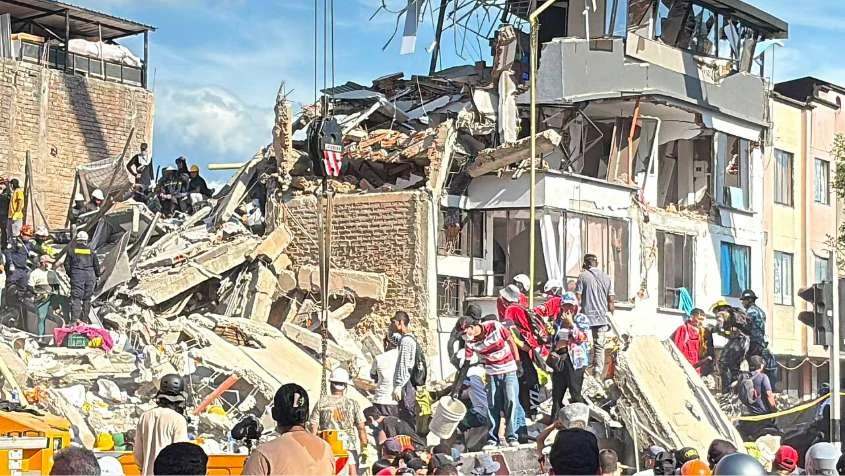
The recent seismic disasters across South America have sent a shockwave through public consciousness, shattering the comfortable myth that modern, formal construction is synonymous with safety. As images of pulverized apartment complexes—structures that appeared robust and contemporary—circulate globally, a chilling question emerges: Are we truly safe within our own homes?
This concern is not merely speculative; it is a mathematical certainty. Recent seismic events in Venezuela and Colombia have exposed a fatal vulnerability in our urban planning and construction standards. For Lima, a city perched on the edge of a predicted 8.8 Mw megathrust earthquake, these regional tragedies serve as a final warning.
The Brutal Reality of Recent Seismic Activity
The seismic instability currently plaguing our region has provided a grim preview of what happens when engineering standards are compromised by cost-cutting and regulatory oversight failures.
The Venezuelan Catastrophe
A catastrophic double seismic event, registering 7.2 Mw and 7.5 Mw, recently struck Venezuela. The humanitarian and economic toll is staggering. The World Bank has estimated physical damages exceeding $19.6 billion. The human cost is far worse: 6,301 confirmed fatalities and over 58,000 buildings either completely destroyed or rendered uninhabitable.

The Colombian Crisis
Simultaneously, Colombia faced a 7.4 Mw earthquake in the Cali region. While the magnitude was lower than the Venezuelan event, the destruction was widespread: 273 lives lost, 12,584 homes razed to the ground, and 74,873 dwellings suffering structural damage. Crucially, the collapse of 172 buildings and the failure of 2,198 educational centers highlight a systemic failure in public infrastructure resilience.
The Mathematical Imminence of the Lima Megasismo
The seismic scale is logarithmic. When we compare these regional disasters to the scenario predicted by the Geophysical Institute of Peru (IGP) for Lima, the disparity is not just linear—it is exponential.
The IGP has warned of a potential 8.8 Mw megathrust earthquake for the Peruvian capital. Because of the nature of the Richter and moment magnitude scales, an 8.8 Mw event releases energy approximately 126 times greater than the 7.4 Mw event in Colombia, and 252 times greater than the 7.2 Mw event in Venezuela. If buildings that were ostensibly "modern" crumbled under the significantly lower energy loads of our neighbors’ earthquakes, the structural integrity of Lima’s housing stock faces an existential threat that is, frankly, difficult to overstate.
The Illusion of Formal Construction
There exists a dangerous, pervasive belief that risk is exclusive to informal, self-built housing. However, the evidence from recent years—culminating in the tragic 2023 Turkey-Syria earthquakes—proves otherwise.
In Turkey, where over 50,000 lives were lost and 5,700 buildings collapsed, forensic engineering investigations revealed that the culprits were not just old structures, but new, ostensibly compliant buildings. The failures were attributed to three primary factors:

- Material Deficiencies: The use of substandard concrete, often characterized by excessive sand content and poor cohesion.
- Regulatory Permissiveness: The granting of "construction amnesties" (imar affı), which allowed thousands of illegal or non-compliant buildings to be "legalized" without any seismic retrofitting or professional verification.
- Institutional Negligence: A lack of rigorous enforcement during the permitting and construction phases.
This phenomenon of "legalizing risk" is a global scourge. In many parts of Latin America, while the codes on paper (like the Colombian NSR-10) are rigorous, the transition from paper to concrete is where the system breaks down.
The "Canned Project" Syndrome: A Corporate Crime
A particularly insidious trend in modern construction is the reliance on "canned projects" (proyectos enlatados). In an attempt to optimize costs, developers often copy and paste structural designs from one city or country to another without conducting site-specific geotechnical studies.
Engineering is not a universal template. A building designed for the stable soil of one region cannot simply be transplanted to the liquefiable soils of the Peruvian coast without catastrophic consequences. When a developer ignores the specific soil mechanics and the local seismic norms (such as Peru’s E.030 standard), they are not "optimizing costs"—they are engaging in a criminal act of negligence that turns luxury apartments into death traps.
The Lost Link: The Erasure of the Calculation Memorandum
Perhaps the most critical failure in current municipal licensing processes is the systematic omission of the "Calculation Memorandum" (Memoria de Cálculo).
Historically, this document was the cornerstone of any technical building file. It provided the specific mathematical roadmap—the parameters, geometric assumptions, material properties, and seismic criteria—used by the engineer to ensure the building would stand during an event. It allowed municipal reviewers to verify the structural logic behind the project.

With the advent of complex engineering software, a dangerous myth took hold: that these calculations were "intellectual property" or "trade secrets." Consequently, many municipalities stopped requiring them, essentially signing building permits "blindfolded."
To be clear: the use of software does not absolve the engineer of the responsibility to present their input parameters and structural models. Without the mandatory submission and peer review of these calculations, the permitting process is merely a superficial bureaucratic formality.
Policy Implications and The Path Forward
If we are to prevent Lima from becoming the site of the next humanitarian catastrophe, we must fundamentally alter our approach to construction oversight.
1. Reinstating Technical Rigor
Municipalities must return to the mandatory submission of the full Calculation Memorandum as a prerequisite for any building permit. This document must be open for review by independent, qualified structural engineers.
2. Abolishing "Legalized Risk"
We must reject any form of construction amnesty. Building codes are not suggestions; they are the minimum thresholds required to preserve human life. Retroactive "legalization" of buildings that do not meet these standards is a direct threat to the citizens who inhabit them.

3. Site-Specific Geotechnical Enforcement
Geotechnical studies must be treated as the foundational document of any project. The practice of using "canned" designs must be strictly prohibited and penalized by the professional associations (Colegio de Ingenieros del Perú).
4. Accountability for Developers and Authorities
The responsibility for a building’s safety must remain with the developer, but the state must exercise its duty to audit. When a building collapses due to structural negligence, the legal consequences must extend beyond the contractors to the licensing authorities who failed to perform their due diligence.
Conclusion: Engineering for Life
The science of seismic resistance is well-understood. We have the technology, the talent, and the codes to build structures that can withstand the most violent forces of nature. The failure, when it happens, is never a failure of physics—it is a failure of ethics and governance.
We are currently living on borrowed time. The energy accumulating along the subduction zone off the coast of Lima is a physical reality that ignores political rhetoric and economic shortcuts. We must choose, today, whether we will continue to prioritize the short-term profits of "cost optimization" or the long-term survival of our population. The choice is ours, but the clock is ticking, and it does not allow for revisions.
Selected Bibliography
- Alexander, D. (2023). Reflections on the Turkish-Syrian Earthquakes of 6th February 2023. UCL IRDR Blog.
- Delgado, R. (2023). La Ciencia dice que lo ya ocurrido volverá a ocurrir. Lampadia.
- Delgado, R. (2019). Ingeniería para No Ingenieros (VI): El Inevitable Mega Terremoto de Lima. Lampadia.
- Infobae (2026). Colombia reports 273 deaths and ongoing aid controversies after seismic events.
- Infobae (2026). Venezuela casualty toll reaches 6,301 following double earthquake.
- Oswald, D., & Moore, T. (2023). Collapse and Catastrophe: The Need to Protect Inhabitants. Buildings and Cities.
- TIME Magazine (2023). In Turkey’s Earthquake, Building Negligence Led to Devastation.