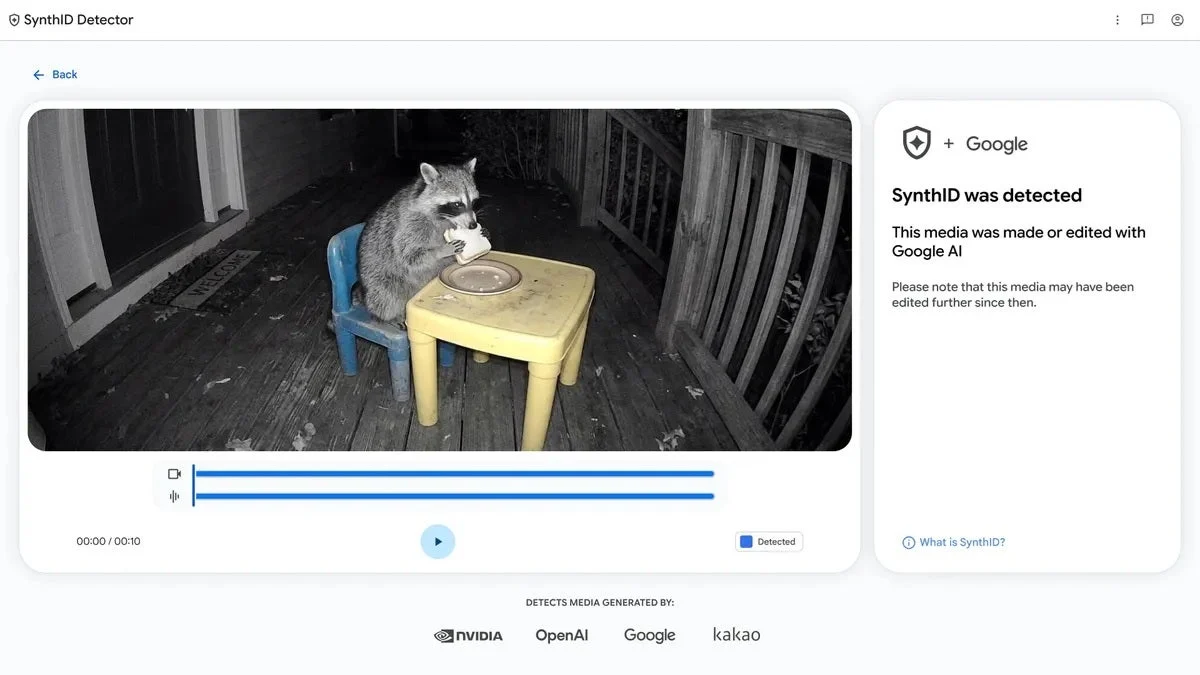
In an era where synthetic media is becoming indistinguishable from reality, the line between authentic documentation and algorithmic fabrication has blurred to a point of concern for governments, journalists, and the general public. Addressing this challenge, Google has officially expanded global access to its SynthID Detector, a sophisticated technological framework designed to identify imperceptible digital watermarks embedded within AI-generated media.
As of October 7, this tool—previously reserved for a select group of media professionals and beta testers—is now available to the public. While the interface currently operates primarily in English, its release marks a pivotal moment in the ongoing battle for digital provenance and information integrity. By allowing users to verify images, videos, and audio files, Google is attempting to create a standardized "immune system" for the internet, capable of flagging content generated by its own AI models and those of strategic industry partners.
The Core Mechanism: How SynthID Operates
At its heart, SynthID is not a traditional watermark. Unlike a visible logo or a textual disclaimer that can be cropped or edited out, SynthID functions as a robust, invisible cryptographic signature embedded directly into the pixel data of an image, the frames of a video, or the waveform of an audio file.
Resistance to Manipulation
The engineering brilliance of SynthID lies in its resilience. Google DeepMind, the research division behind the technology, has designed these watermarks to survive common adversarial attacks. If a user takes an AI-generated image and subjects it to standard post-production techniques—such as applying heavy filters, cropping, resizing, or adjusting color grading—the underlying watermark remains intact and detectable.
In the realm of audio, the signal is designed to be entirely inaudible to the human ear while remaining robust enough to withstand lossy compression formats like MP3 or alterations in playback speed. This durability is essential, as bad actors often rely on simple media manipulation to bypass automated detection systems.
Textual Integration
Beyond multimedia, the technology has also been integrated into the textual output of Gemini, Google’s flagship AI model. Rather than injecting a literal string of code into a paragraph, SynthID for text works by subtly adjusting the probability scores of the tokens (words or word parts) that the model chooses. This creates a statistical fingerprint within the generated prose that is invisible to the reader but easily identifiable by Google’s verification algorithms.
A Chronology of Trust: From Research to Public Utility
The journey of SynthID reflects the accelerated pace of the AI industry. The timeline of its development highlights a shift from internal security to a broader societal responsibility.
- Mid-2023: Google DeepMind officially unveils the SynthID technology, initially focusing on images generated by its Imagen model. At this stage, it was a closed-system experiment intended to prevent "deepfake" proliferation.
- Early 2024: Recognizing the threat of audio-based misinformation, Google expands the technology to include audio generation. Simultaneously, they begin testing the tool with select newsrooms and fact-checking organizations.
- August 2024: Google announces a landmark collaboration, inviting other tech giants to integrate the SynthID standard, signaling a move toward industry-wide adoption.
- October 7, 2024: The public launch of the SynthID Detector web portal. This milestone marks the first time that ordinary users—not just authorized partners—can verify the origin of content they encounter online.
Supporting Data: The Scale of the Invisible Web
The sheer volume of content processed by Google’s verification infrastructure is staggering. Since its initial deployment in 2023, the scope of the project has expanded exponentially. According to official data provided by Google:
- 180 Billion Assets: More than 180 billion images and videos now carry the SynthID signature.
- Centuries of Audio: The audio-watermarking system has been applied to a volume of audio equivalent to approximately 240,000 years of content.
- Million-Request Threshold: The automated verification systems integrated into Google Search, Gemini, and the Chrome browser currently process over one million requests per day.
These metrics underscore the ubiquity of synthetic content. The "AI-generated" label is no longer a niche phenomenon; it is becoming a foundational characteristic of the modern digital landscape.
Industry Collaboration and Future Outlook
Google’s strategy with SynthID is rooted in the belief that no single company can police the entire internet. To make the tool effective, it must be interoperable. Consequently, the detector is not limited to Google’s own outputs; it is designed to recognize content generated by major industry players, including OpenAI, NVIDIA, and the South Korean tech firm Kakao.
This collaborative approach is critical for establishing a "Coalition for Content Provenance." Google has confirmed that compatibility with Apple’s generative AI suite is currently in development. By bringing Apple into the fold, Google significantly expands the reach of the detector, as these four companies combined represent the vast majority of consumer-facing AI-generated content globally.
Implications: The Limits of Detection
Despite the technical sophistication of SynthID, Google is careful to manage expectations. The company emphasizes that the detector is not a "truth machine."
The False Negative Problem
The most important caveat for users is the interpretation of a "negative" result. If a user uploads an image to the SynthID Detector and receives a message stating that no watermark was found, this does not prove the content is authentic. It merely means that the file does not contain a SynthID-compatible watermark.
The content could have been generated by an older AI model that lacks watermarking capabilities, a model from a developer outside of the current coalition, or an open-source model that has had its safety and tracking features stripped away by the user. Therefore, the absence of a watermark is essentially an inconclusive result.
The Nuance of Misinformation
There is a fundamental difference between identifying a file’s origin and determining its truthfulness. A piece of content could be "authentically" generated by AI but still contain factual errors or malicious propaganda. Conversely, a real photograph of a news event could be misinterpreted by a user as AI-generated if the software fails to detect a watermark.
Google stresses that SynthID is a technical tool, not a judicial one. It provides metadata-based evidence of provenance, but the final determination of whether a piece of content is "misleading" remains the responsibility of the viewer, the journalist, or the fact-checker.
Conclusion: A Step Toward Digital Literacy
The expansion of the SynthID Detector is a necessary, albeit incomplete, response to the volatility of the digital information ecosystem. By providing the public with the tools to check for synthetic origins, Google is fostering a more skeptical and informed user base.
However, the technology highlights the "cat-and-mouse" nature of the modern internet. As companies like Google, OpenAI, and Apple build better detection tools, developers of illicit AI models will inevitably work to circumvent them. The future of digital integrity will likely depend less on a single "silver bullet" technology and more on a combination of robust watermarking, cryptographic signing standards like C2PA, and a heightened level of digital literacy among the global public.
As the industry moves forward, the success of SynthID will be measured not just by how many files it can scan, but by whether it succeeds in restoring a baseline of trust to our shared digital reality. For now, the tool serves as a vital signal in the noise—a digital lighthouse helping users navigate the increasingly complex waters of the synthetic age.