The future of the Peruvian economy rests, in many ways, on the continuity of its most stable institution. This week, the Senate’s Special Procedures Commission officially initiated the ratification process for Julio Velarde Flores, who has been designated by the administration of President Keiko Fujimori to serve another five-year term as President of the Board of Directors of the Central Reserve Bank of Peru (BCRP).
If confirmed, this mandate will extend Velarde’s tenure to a quarter of a century at the helm of the country’s monetary authority—a period that has seen Peru navigate global financial crises, commodity price fluctuations, and significant domestic political upheaval. With the Senate clock ticking, the commission, chaired by Senator Hugo Ccahuana Aymachoque, is under a strict deadline to deliver its recommendation by September 9.
The Legislative Roadmap: A Race Against the Clock
The legislative machinery surrounding Velarde’s reappointment is moving with deliberate speed. Following the formalization of his designation via Supreme Resolution No. 258-2026-PCM, published in the official gazette El Peruano on August 21, the Senate has assumed the constitutional responsibility of vetting the candidate.
The current schedule is precise:
- September 3: The process enters its formal phase.
- September 9: Deadline for the Special Procedures Commission to vote on the final report recommending ratification or rejection.
- Post-Commission: Once approved, the report moves to the Junta de Portavoces (Board of Spokespersons), which will determine its placement on the Senate floor agenda for a final debate and vote.
To secure his position, Velarde must obtain the support of more than half of the legal number of senators—a threshold of 31 votes. Given the current political landscape, this vote is viewed not merely as a bureaucratic formality, but as a critical litmus test for the Senate’s commitment to institutional stability and the independence of the BCRP.
A Technical Defense: Velarde’s Testimony Before the Commission
During his appearance before the commission, Velarde provided a comprehensive defense of his management, addressing concerns ranging from the volatility of the dollar to the strategic use of international reserves. His testimony was characterized by his signature technical pragmatism, distancing himself from political populism.
On the Dollar and Monetary Policy
Addressing concerns regarding the exchange rate, Velarde reaffirmed the BCRP’s core philosophy: the bank does not target a specific price for the dollar. Instead, its mandate is to mitigate "excessive volatility" that could destabilize businesses and households. "We are not looking for a particular level," Velarde clarified, emphasizing that the market, driven by fundamentals, remains the primary determinant of the currency’s value.
Reserves and Fiscal Discipline
A significant portion of the debate centered on the nature of Peru’s international reserves. Some political factions have previously suggested using these reserves to fund infrastructure or social projects. Velarde was categorical in his rebuttal: these resources are not "free-disposition funds" for the government. They are critical safeguards that include liabilities such as bank reserve requirements. To treat them as a piggy bank, he argued, would be to jeopardize the sovereign credit rating and the financial architecture of the nation.
Interest Rate Caps and Financial Inclusion
Velarde also weighed in on the legislative debate regarding interest rate ceilings. Critics of the current financial system have proposed strict limits to lower borrowing costs. However, Velarde warned that such policies are often counterproductive. By artificially capping rates, lenders—faced with higher risks—simply stop providing credit to the most vulnerable segments of the population. In his view, "cheaper credit" is a mirage if it results in "no credit" for those who need it most.
The Cult of Personality vs. Institutional Strength
One of the most poignant moments of the session occurred when Velarde was questioned about the extent to which Peru’s economic credibility is pinned to his personal reputation. For years, financial markets have viewed Velarde as a "guarantor" of stability.
His response was a firm rejection of this narrative: "It is the institution, not me."
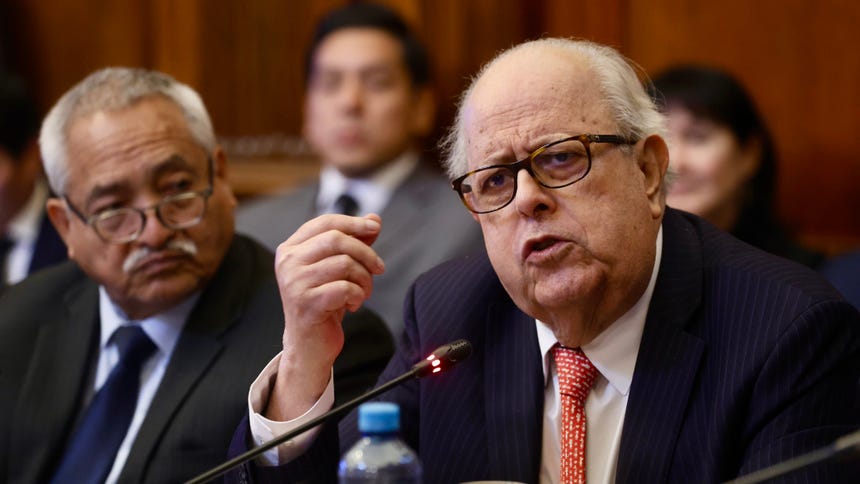
By emphasizing the BCRP’s meritocratic culture and its long-standing tradition of technical independence, Velarde sought to decouple his personal legacy from the bank’s operational health. He argued that the BCRP is designed to function as an autonomous entity, insulated from the cyclical whims of political administrations. This "institutionalist" perspective is, perhaps, his most enduring contribution to the Peruvian state.
Broadening the Horizon: The Search for New Directors
The Senate’s work extends beyond the presidency of the BCRP. In the same session, the Special Procedures Commission unanimously approved the initiation of the selection process for three additional members of the BCRP board. This process is designed to ensure that the bank remains balanced and professionally diverse.
The timeline for these appointments is rigorous:
- September 4–8: Submission of candidate proposals.
- September 22–24: Personal interviews with candidates.
- October 7: Presentation of the final report.
The commission has established strict vetting criteria, requiring that candidates possess high academic and professional standing, and be free of disqualifying factors such as criminal convictions or prohibitions from holding public office. This process is essential for maintaining the board’s technical integrity, as the board members are responsible for setting the benchmark interest rate and managing the bank’s monetary policy decisions.
Macroeconomic Implications: Why the Ratification Matters
The decision to ratify Velarde occurs against a backdrop of complex economic challenges. Recent data from the BCRP indicates that while inflation remains a concern—exacerbated by rising electricity costs and volatile food prices—the bank has managed to keep the economy from overheating.
The ratification of the BCRP president is not merely an internal administrative matter; it is a signal to international investors, rating agencies, and multilateral organizations. In a region often characterized by fiscal volatility and institutional fragility, the continuity of leadership at the Central Bank has served as an anchor for Peru.
Investors value predictability above all else. A swift and successful ratification would signal that, despite the inevitable tensions between the legislative and executive branches, the Peruvian political establishment recognizes the value of a non-partisan, expert-led monetary policy. Conversely, any delay or political obstruction would likely trigger market uncertainty, impacting the exchange rate and increasing the country’s risk premium.
Conclusion: A Moment of Institutional Maturity
As the September 9 deadline approaches, the Senate finds itself in a position to reaffirm one of the few remaining pillars of consensus in Peruvian public life. The process is a testament to the constitutional mandate of Article 86, which safeguards the autonomy of the BCRP.
Julio Velarde’s testimony underscored a fundamental truth: the stability of a nation is not built on the shoulders of one individual, but on the strength of the institutions that survive long after the individuals have moved on. However, in the current context, the Senate’s decision to confirm or reject his tenure will be viewed as a definitive statement on whether Peru chooses to continue its path of institutional rigor or flirt with the risks of political interventionism.
For now, the country watches as the commission begins its work, hoping that the final decision will reflect the same commitment to stability that has defined the BCRP for decades. The path forward is clear, but the legislative outcome remains the final, necessary step in ensuring that the engine of the Peruvian economy continues to run with precision and independence.