In the sprawling, high-tech landscape of Wuhan, China, a quiet revolution is taking place that promises to shift the boundaries between science fiction and domestic reality. Located in the heart of the East Lake High-Tech Development Zone—an area colloquially known as the "Optics Valley of China"—the Hubei Humanoid Robot Innovation Center has launched the nation’s first "7S" humanoid robot store. Since its inauguration in November, this facility has transformed from a mere showroom into a comprehensive ecosystem, signaling a pivotal shift in how society interacts with, acquires, and integrates artificial intelligence into the fabric of daily life.
The Genesis of the 7S Model
To understand the significance of this establishment, one must first look at the retail philosophy underpinning its operations. The term "7S" is a deliberate, bold evolution of the "4S" model that has defined the automotive industry for decades. Traditionally, a 4S dealership covers Sales, Spare parts, Service, and Surveys (feedback). By expanding this framework, the Wuhan center has created a new blueprint for the robotics industry.
The additional three "S" components are: Solutions, Showcasing, and Skill-training.
Liu Haifeng, the executive manager of the 7S center, explains that this holistic approach is necessary because a robot is not merely a product; it is a sophisticated, evolving tool. "The model allows us to move beyond simple transactions," Liu states. "By incorporating customized solutions for specific industrial or personal needs, constant product showcasing, and professional skill-training for the robots themselves, we are creating a lifecycle management system for automation."
Chronology of a Robotic Revolution
The journey toward this flagship store began years prior, fueled by China’s aggressive pursuit of robotics as a core strategic sector. By 2025, robotics was officially cemented as a cornerstone of the national economy.
- 2023-2024: Intense R&D efforts focused on humanoid mobility, dexterity, and natural language processing. Hubei’s Innovation Center emerged as a primary hub for this research, bridging the gap between university laboratories and industrial applications.
- November 2024: The Hubei Humanoid Robot Innovation Center opens its doors in Wuhan, marking the debut of the 7S commercial model.
- Late 2024 – Early 2025: The store becomes a focal point for both domestic consumers and international observers, hosting diplomatic delegations and technology enthusiasts eager to witness the integration of humanoid units into public spaces.
- Present Day: The store functions as a living laboratory, where daily interactions refine the AI’s responsiveness and adaptability, preparing the technology for mass-market adoption.
The Experience: A Showcase of Humanoid Capabilities
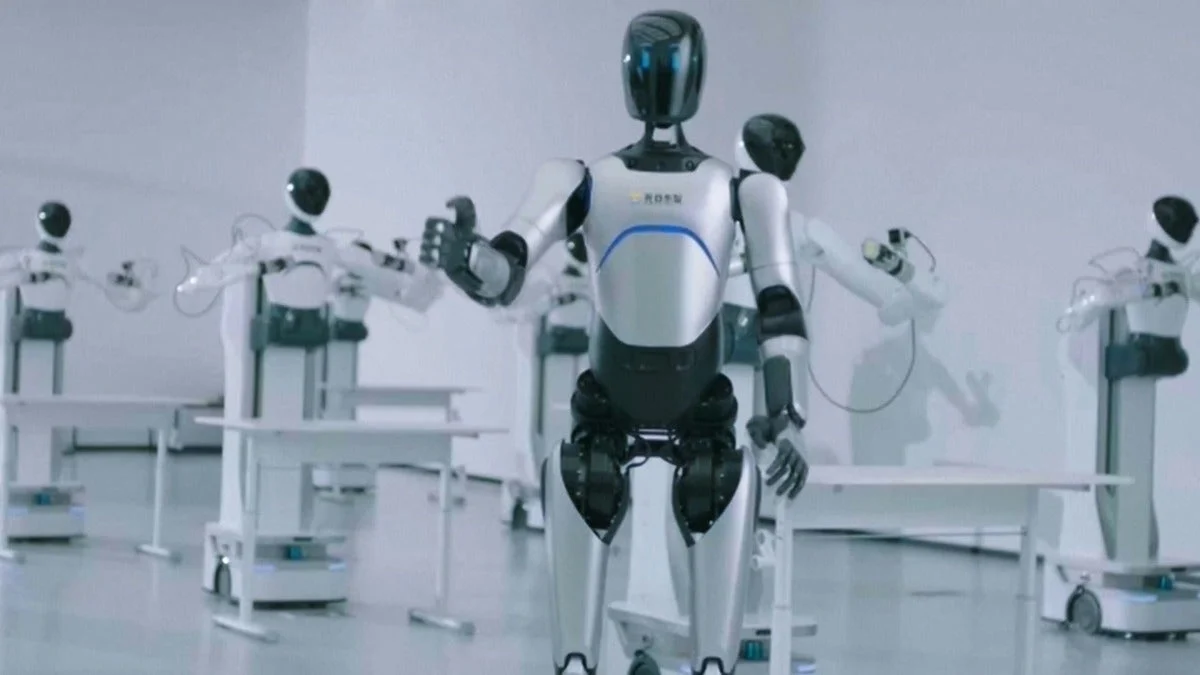
Walking through the store is an exercise in suspended disbelief. The showroom is designed to be interactive, encouraging visitors to move past the glass barriers that usually separate humanity from high-end technology. The robots on display are not static models; they are active participants in the retail environment.
Visitors are greeted by humanoid units that perform tasks ranging from the mundane to the impressive. Some serve as sales assistants, guiding customers through the store, while others demonstrate high-level coordination by playing soccer or performing intricate musical pieces. The presence of robotic dogs and graceful, dancing humanoid figures highlights the progress made in gyroscopic balance and motor control.
This environment serves a dual purpose: it demystifies the technology for the general public and provides a testing ground for potential commercial buyers, such as factory owners or hotel managers, who wish to see the robots in action before investing in large-scale deployments.
Official Perspectives: The Human Element of AI
The impact of this facility has reached far beyond the borders of Hubei. Global interest has intensified, with international representatives visiting the site to gauge the viability of these robots in their own regions.
One notable visitor was Rajaobarielina Faratiana, the interim director of legal, consular, and litigation affairs for the Ministry of Foreign Affairs of Madagascar. Her interaction with a humanoid unit captured the essence of why this store is making waves globally.
"I was very impressed," Faratiana remarked during her visit, as reported by state media outlet CCTV. "I had a small interaction with the robot. I asked it its name and it answered. I asked, ‘What do you think about the weather?’ and it answered exactly as I expected, using real human words."
This ability to engage in coherent, context-aware, and emotionally resonant conversation is the "holy grail" of current AI development. By moving past the robotic, monotone responses of the past, these units are bridging the uncanny valley, making them suitable not just for industrial assembly lines, but for companionship and service-oriented roles.
Supporting Data: Why Wuhan?
Wuhan’s selection as the site for this pilot program is no coincidence. As a major industrial city with a dense concentration of universities and tech talent, it provides the necessary talent pool to support the 7S model.
The industry data supporting this shift is compelling. By 2025, the demand for humanoid robots in China has spiked due to a combination of an aging workforce and the need for high-precision manufacturing. The "Optics Valley" location serves as an industrial cluster, allowing the 7S store to maintain a rapid feedback loop with hardware developers. If a customer requires a specialized gripper for a manufacturing robot, the solution can be engineered, prototyped, and tested within a short radius, fulfilling the "Customized Solutions" aspect of the 7S model.
Implications: A New Social Contract
The success of the 7S model raises significant questions about the future of labor and domestic life. By making robots accessible for "personal companionship," the store is effectively advocating for the normalization of AI in the home.
The Economic Impact
From an industrial standpoint, the store is a catalyst for productivity. When companies can "rent" or purchase robots that come with pre-installed, industry-specific skills—and receive regular updates for those skills—the barrier to entry for small and medium-sized enterprises (SMEs) drops significantly.
Ethical and Social Considerations
However, the rapid normalization of humanoids also brings forth ethical challenges. As robots become more adept at "speaking like humans," society must grapple with the psychological implications of companionship with non-sentient machines. The 7S store, by framing these robots as products that can be trained and personalized, is at the forefront of the conversation regarding the legal and moral status of AI in public life.
Conclusion: The Road Ahead
The 7S store in Wuhan is more than a retail experiment; it is a preview of the next decade of technological evolution. By integrating the entire lifecycle of the humanoid robot—from the sale to the ongoing training of the machine—the Chinese robotics industry is attempting to solve the biggest hurdle of automation: integration.
As the Hubei Humanoid Robot Innovation Center continues to iterate on its 7S framework, the global community will be watching closely. Whether these machines become ubiquitous helpers in our homes or standard components in our factories, one thing is clear: the era of the humanoid, once a distant dream of science fiction, is now open for business.
For the visitor standing in the center of the Wuhan showroom, watching a robot offer a coherent opinion on the weather, the message is clear: the future is not waiting to be built; it is already here, performing for us, answering our questions, and learning to live alongside us.