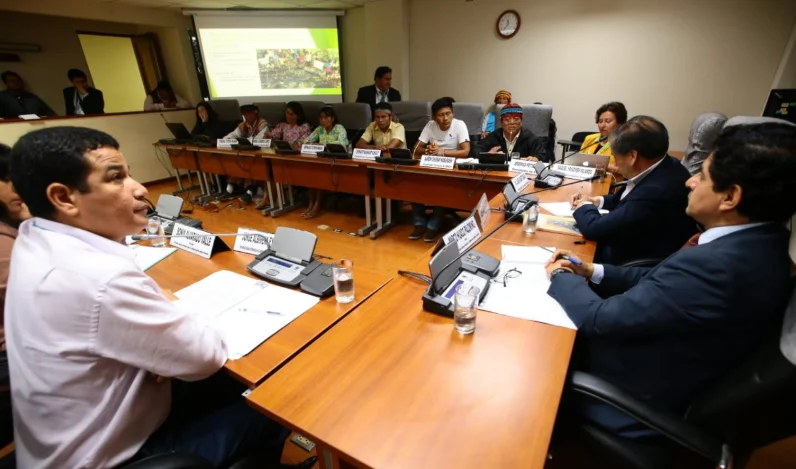
December 6, 2018 – The escalating tension between industrial energy extraction and the preservation of indigenous ancestral territories reached a critical juncture this week in the halls of the Peruvian Congress. During a session convened by the Commission of Andean, Amazonian, and Afro-Peruvian Peoples, Environment, and Ecology (CPAAAAE), the Federation of the Achuar Nationality of Peru (FENAP) and the Autonomous Territorial Government of the Wampis Nation (GTANW) presented a harrowing account of environmental degradation and systemic health crises affecting their communities in the Loreto region.
The core of the dispute centers on the controversial "Lote 64," an oil block where the environmental watchdog, the Agency for Environmental Assessment and Enforcement (OEFA), has finally committed to conducting inspections in early 2019. However, for the indigenous leaders present, this intervention is a long-overdue response to years of unheeded warnings regarding toxic legacy sites and the lack of social license for extractive operations.
The Main Facts: Unremediated Scars in the Rainforest
The grievances presented by the FENAP revolve around long-standing environmental "passives"—a term describing environmental damage caused by past operations that remains unaddressed. Specifically, the federation points to oil spills dating back to 2012, left behind by the company Talisman in the Situche Central sector of Lote 64, near the 2x and 3x oil wells in the community of Putuntsa.
Shiwiant Mashiant, president of the AIM basin organization—a constituent of FENAP—provided a devastating testimonial regarding the reach of this pollution. According to Mashiant, the contamination has infiltrated the primary water sources upon which the Achuar people and their livestock rely for survival. The water, once the lifeblood of the community, is now viewed with suspicion and dread.
Furthermore, the issue extends beyond the Lote 64 boundaries. Jeremías Petsein Peas, president of FENAP, highlighted additional, unaddressed contamination sites within the communities of Chuintar and Uwinsta, linked to the Norperuano Pipeline (ONP). These sites, currently under the responsibility of the state-owned Petroperú, remain largely unremediated, perpetuating a cycle of environmental hazard.
Chronology of a Conflict: From Neglect to Resistance
To understand the current urgency, one must examine the timeline of industrial activity and indigenous resistance in the region:
- 2012: Initial oil spills occur in the Situche Central sector of Lote 64 under the management of Talisman. The containment and remediation efforts are widely viewed as insufficient by local communities.
- 2018 (Prior to December): Frustration mounts as environmental degradation continues to impact health and subsistence activities. Indigenous groups, including the Achuar and Wampis, escalate their call for the total cancellation of Lote 64.
- August 2018: The Wampis and Achuar formally demand the annulment of the oil concession granted to Geopark, citing a complete lack of prior consultation, which is mandated by both national law and international treaties like ILO Convention 169.
- December 3, 2018: A pivotal working meeting is held at the Peruvian Congress. Indigenous leaders confront representatives of the OEFA and the Ministry of Health (MINSA), demanding immediate action.
- December 6, 2018: Following the congressional testimony, the OEFA publicly commits to a fiscalization schedule for the first quarter of 2019 to evaluate the Lote 64 damage.
Supporting Data: The Human Cost of Extraction
The environmental damage is not merely a matter of ecological statistics; it is a profound human rights issue. The testimony provided by FENAP leaders painted a grim picture of the physical toll on the Achuar population.
"There are health problems identified by the population, such as stomach ailments, skin rashes, and severe headaches, among others," stated Jeremías Petsein Peas. "The most vulnerable members of our society—our children and women—are suffering the most."
The lack of access to clean, safe water has forced families to rely on polluted streams, leading to a surge in preventable gastrointestinal and dermatological conditions. Despite these clear indicators of a health crisis, the state’s response has historically been reactive rather than preventative.
Wrays Pérez, president of the Autonomous Territorial Government of the Wampis Nation (GTANW), highlighted the financial and structural apathy displayed by the state. "For the Amazon, there is no money provided to remediate the full impact of these environmental passives," Pérez argued. "Petroperú knows it has an obligation to remediate the Norperuano Pipeline, yet they do nothing."
Official Responses: Promises of Supervision
The pressure from the congressional session forced several government agencies to acknowledge the grievances, though the effectiveness of their response remains to be seen.
The Role of the OEFA
The Agency for Environmental Assessment and Enforcement (OEFA) has finally placed Lote 64 on its radar. The agency confirmed that it would initiate comprehensive fiscalization actions in the first quarter of 2019. The objective is to verify the extent of the unremediated passives left by Talisman and to ensure that current operators are adhering to environmental standards.
The Ministry of Health (MINSA)
Representatives from the Ministry of Health, also present at the session, made a formal commitment to perform a health diagnostic and provide medical attention to the affected communities. This is a crucial development, as it acknowledges the causal link between the industrial pollution and the localized health crises plaguing the indigenous populations.
Implications: A Fight for Sovereignty and Social License
The situation in Loreto raises fundamental questions about the future of the Amazon and the rights of the indigenous peoples who have served as its guardians for millennia.
The Question of "Social License"
Both the Achuar and Wampis nations maintain that Lote 64 lacks a "social license to operate." This term refers to the ongoing acceptance and approval of a project by the local community. The indigenous nations argue that they were never consulted regarding the contracts signed between the Peruvian state and companies like Geopark. This lack of consultation is a direct violation of the principle of Free, Prior, and Informed Consent (FPIC).
Legal and Strategic Support
The indigenous struggle is not happening in isolation. The FENAP is supported by the legal expertise of the International Institute for Law and Society (IIDS), while the GTANW is receiving counsel from the organization Peru EQUIDAD. These alliances are critical in translating local grievances into formal legal challenges that seek not only remediation but the outright cancellation of the Lote 64 concession.
The Broader Environmental Context
The case of Lote 64 is emblematic of a broader national struggle in Peru. The Norperuano Pipeline, a massive infrastructure project spanning the country, has been plagued by leaks and maintenance failures for years. By holding the state and companies accountable for these "old" passives, the Achuar and Wampis are setting a legal precedent that could force a reassessment of how environmental liability is handled across the entire Amazon basin.
Conclusion: A Future at Stake
As 2019 approaches, the eyes of the environmental and human rights communities are fixed on the Loreto region. The commitment by the OEFA to inspect Lote 64 is a victory for the tenacity of the Achuar and Wampis people, but it is only the first step.
For the leaders of the Wampis and Achuar, the goal is not just a cleaner landscape, but the recognition of their right to self-determination. They view the extraction of oil in their ancestral territories not as "development," but as a direct threat to the ecosystem that sustains them and a violation of the international agreements that protect their cultural and physical survival.
The battle for Lote 64 represents a clash between two worldviews: one that sees the Amazon as a resource to be tapped for national revenue, and another that sees it as a sacred, interdependent entity that must be protected for future generations. As the legal battles continue, the indigenous nations of the Amazon remain steadfast in their demand: clean water, restored health, and an end to the extractive encroachment upon their land. The upcoming inspections will serve as a litmus test for the Peruvian government’s willingness to prioritize the health of its citizens and the integrity of its environment over the interests of the fossil fuel industry.