In a significant move to bolster agricultural productivity and water security, the Ministry of Agrarian Development and Irrigation (MIDAGRI), through the National Water Authority (ANA), has successfully concluded a comprehensive maintenance project for irrigation infrastructure spanning over 320 kilometers in the regions of Arequipa and Ayacucho.
This ambitious initiative, which represents a critical investment in the rural economy, serves as a testament to the effectiveness of community-led infrastructure management. By facilitating the rehabilitation of water channels, the government aims to mitigate the challenges posed by water scarcity and inefficient distribution systems that have long hindered the potential of smallholder farmers in these high-altitude and arid zones.
Main Facts: A Strategic Investment in Water Management
The project, coordinated under the diligent oversight of the Local Water Administration (ALA) Ocoña-Pausa, focused on the critical maintenance of over 100 irrigation channels. The total financial allocation for these works reached S/ 2,439,448.59.
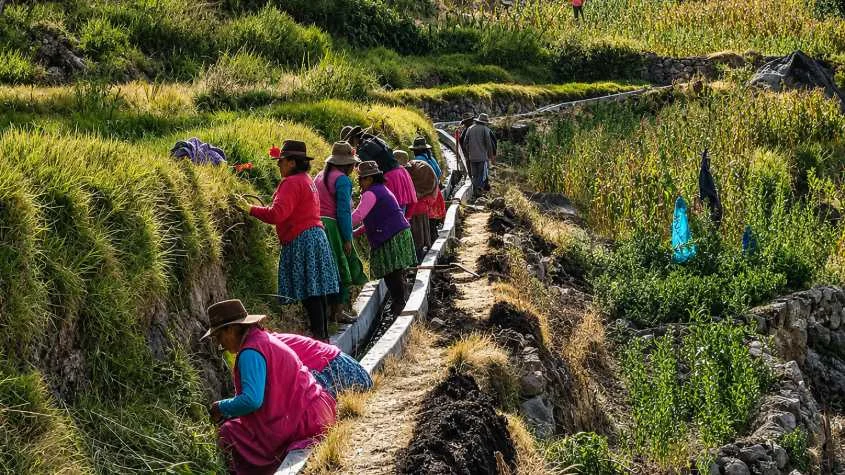
The primary objective was the clearing and desilting of irrigation channels, which had been obstructed by sedimentation and debris over time. These obstructions often lead to significant water loss due to seepage and overflow, directly impacting the volume of water reaching individual parcels. By restoring these channels, the ANA has successfully optimized the flow of water, ensuring that it is delivered efficiently and reliably to the farmers’ crops.
The geographical reach of this operation covered several provinces, including Paucar del Sara Sara, La Unión, Condesuyos, and Caravelí. These areas, characterized by complex topography, are now better equipped to handle seasonal water variations, thereby stabilizing the productivity of local agricultural activities.

Chronology of the Project
The implementation of this infrastructure maintenance followed a structured, phased approach designed to maximize transparency and efficiency:
- Planning and Organization (Early 2026): The ANA identified the critical zones requiring immediate attention. Recognizing that the vast geography would make centralized management difficult, the authority opted for the "Nucleo Ejecutor" (Executive Nucleus) model.
- Formation of Executive Nuclei: Seven distinct executive nuclei were established, involving local community members, agricultural cooperatives, and stakeholders in the provinces of Paucar del Sara Sara, La Unión, Condesuyos, and Caravelí.
- Execution Phase (Mid-2026): Work commenced on over 100 irrigation channels. The focus was on manual and mechanical desilting, structural repairs, and the removal of vegetation that impeded flow.
- Monitoring and Supervision: Throughout the process, the ALA Ocoña-Pausa provided ongoing technical assistance. Periodic audits were conducted to ensure that the S/ 2.4 million investment was being utilized strictly according to the approved budget and technical specifications.
- Project Conclusion and Evaluation: By the end of the third quarter of 2026, the 320 kilometers of maintenance were officially completed. Final inspections confirmed that the water flow capacity had significantly increased, meeting the project’s performance benchmarks.
- Expansion and Continuity (Late 2026): Building on the success of the initial phase, the ANA moved immediately to authorize two additional executive nuclei in Caravelí and Andaray to extend the project’s impact by another 73 kilometers.
Supporting Data: Impact and Reach
The success of this initiative is reflected in the tangible data provided by the Ministry of Agrarian Development and Irrigation. The scale of the operation provides a clear picture of its contribution to the rural economy:
- Financial Scope: An initial investment of S/ 2,439,448.59, followed by an additional planned injection of S/ 555,312.90 for the new nuclei in Caravelí and Andaray.
- Employment Generation: The project created over 27,000 "jornales" (daily wages) of temporary employment. This provided a crucial income boost for local agricultural families, keeping the labor force engaged in productive work within their own communities. The upcoming phase is projected to generate an additional 4,900 jornales.
- Direct Beneficiaries: More than 8,500 families have directly benefited from the improved irrigation flow. With the expansion to Caravelí and Andaray, this number is set to grow by an additional 1,300 families, bringing the total impact to nearly 10,000 households.
- Infrastructure Restored: A total of 320 kilometers of channel infrastructure has been rehabilitated, with another 73 kilometers currently in the pipeline.
Official Responses and Administrative Strategy
The National Water Authority (ANA) has championed the "Executive Nucleus" model as the cornerstone of its regional development strategy. By organizing local citizens into temporary committees, the ANA fosters a sense of ownership and accountability among those who depend on the infrastructure most.
According to representatives from the ALA Ocoña-Pausa, the technical supervision provided throughout the lifecycle of the project is what distinguishes this model from traditional public works. "The nuclei are not just labor groups; they are the managers of their own progress," a spokesperson stated. "By receiving guidance from our engineers and administrators, the community learns how to maintain these systems long-term, ensuring that the government’s investment is not squandered by neglect."
This approach also ensures that the funds reach the intended targets without the bureaucratic delays often associated with large-scale public contracts. By keeping the administrative processes localized, the ANA has managed to maintain high quality control while simultaneously boosting local economic activity.

Implications for the Future of Agriculture
The implications of this maintenance work extend far beyond simple channel cleaning. In the context of global climate change, where rainfall patterns are increasingly erratic and water stress is becoming a common reality in the Andean regions, these improvements are vital for food security.
1. Enhanced Agricultural Productivity
Reliable water delivery means that farmers can diversify their crops, plant during optimal windows, and increase their yield per hectare. This shift from subsistence to more market-oriented farming is a critical step toward poverty reduction in the Arequipa and Ayacucho regions.
2. Economic Reactivation
The creation of over 27,000 jornales during the project served as an immediate economic stimulus. In rural areas where off-farm employment is scarce, the infusion of cash into the local economy via these wages has allowed families to cover basic needs, invest in farm inputs like fertilizer or seeds, and maintain a higher standard of living during the transition periods between harvests.
3. Sustainable Water Governance
By involving the community in the maintenance of the infrastructure, the ANA is laying the groundwork for a more sustainable model of water governance. When farmers understand the mechanics of their irrigation systems and participate in their repair, they are more likely to participate in water user associations and advocate for the protection of water sources.
4. Scalability of the Model
The expansion into Caravelí and Andaray demonstrates that the ANA views this project as a pilot for future national efforts. The model of using executive nuclei to manage small-scale, decentralized infrastructure repairs is proving to be a scalable solution that can be replicated in other provinces across Peru facing similar infrastructure deficits.

Conclusion
The successful completion of over 320 kilometers of irrigation channel maintenance in Arequipa and Ayacucho stands as a hallmark of effective government intervention in rural development. Through a combination of strategic financial investment, community-based management, and rigorous technical oversight, the Ministry of Agrarian Development and Irrigation and the National Water Authority have provided a lifeline to thousands of farming families.
As the program expands into new districts, the focus remains on the dual goals of infrastructure integrity and human development. The commitment to invest another S/ 555,000 in the coming months signals that this is not a one-time relief effort, but a sustained, long-term commitment to modernizing Peru’s agricultural foundation. By ensuring that water flows where it is needed most, the state is not only irrigating the land but also cultivating the conditions for economic resilience and growth in the heart of the Peruvian highlands.