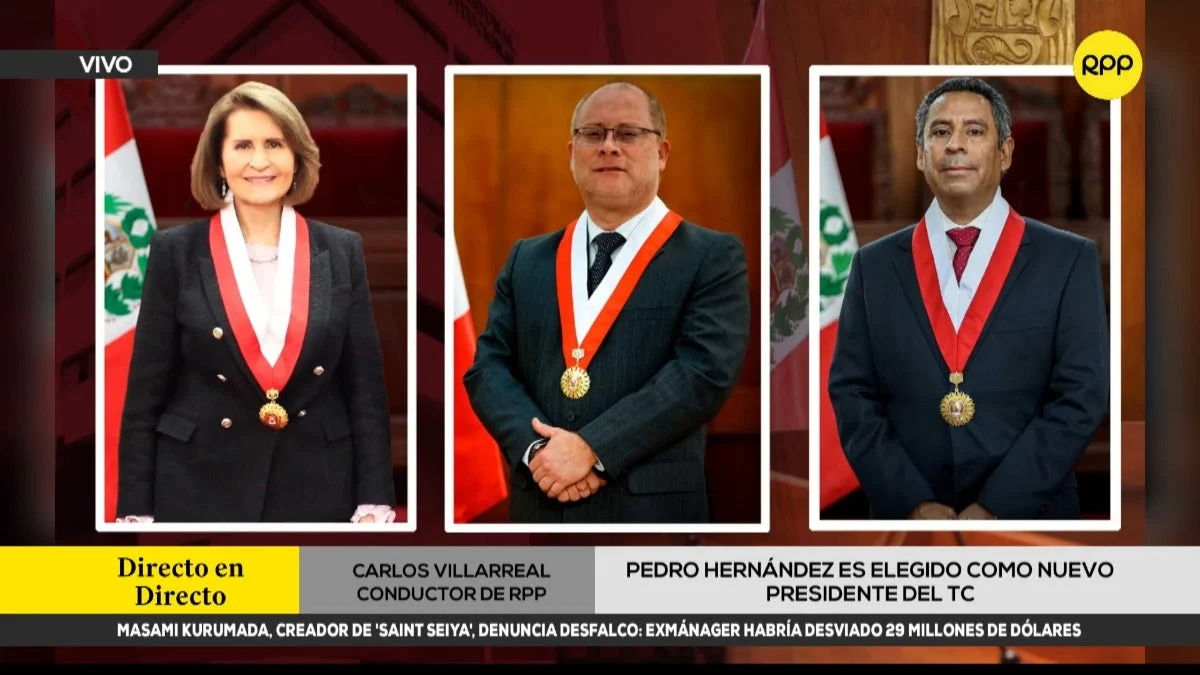
In a significant reshuffling of Peru’s highest constitutional authority, the Plenary of the Constitutional Tribunal (TC) has formally elected magistrate Pedro Hernández Chávez as its new president. The decision, reached during a session held this past Wednesday at the institution’s headquarters in San Isidro, marks a pivotal moment for the body responsible for safeguarding the fundamental rights of citizens and the constitutional order of the nation.
Joining Hernández Chávez in the new leadership structure is magistrate Luz Pacheco Zerga, who will serve as vice president, and magistrate Francisco Morales Saravia, who has been appointed as the director general of the Center for Constitutional Studies (CEC). The new authorities are scheduled to be sworn into their respective offices this Friday, September 6, at 10:00 a.m.
The Election Process: A New Chapter for the Tribunal
The election, which took place at 3:00 p.m. on Wednesday, saw the full participation of the seven sitting magistrates of the Tribunal: Helder Domínguez Haro, Francisco Morales Saravia, Gustavo Gutiérrez Ticse, Luz Pacheco Zerga, Manuel Monteagudo Valdez, César Ochoa Cardich, and the newly elected president, Pedro Hernández Chávez.
The internal voting process, conducted by a majority vote, reflects a consensus among the magistracy to renew the leadership of the institution. This transition comes at a time when the Constitutional Tribunal faces increasing pressure to resolve complex legal disputes that touch upon the political stability, legislative reforms, and individual liberties within Peru.
Chronology of the Leadership Transition
- September 4 (Wednesday): The Plenary of the Constitutional Tribunal convenes at the San Isidro headquarters to conduct the internal election of the new board of directors.
- September 4 (Wednesday Evening): Official announcement of the election results, naming Pedro Hernández Chávez as the new president, Luz Pacheco Zerga as vice president, and Francisco Morales Saravia as the director of the CEC.
- September 6 (Friday): Scheduled date for the formal swearing-in ceremony at 10:00 a.m. at the San Isidro institution.
- October 2024 (Forward): The new leadership team begins its mandate, overseeing the Tribunal’s docket and administrative operations.
Profiles of the New Leadership
Pedro Hernández Chávez: The New President
Pedro Hernández Chávez assumes the presidency with a mandate to maintain the independence of the Tribunal. His colleagues have expressed confidence in his ability to steer the institution through the legal complexities of the coming years. His background as a career jurist and his tenure as a magistrate have positioned him as a steady hand for the court’s administrative and judicial responsibilities.
Luz Pacheco Zerga: Vice Presidency
The election of Luz Pacheco Zerga as vice president is particularly noteworthy, especially following the recent context regarding the Tribunal’s previous administrative shifts. Her experience and legal expertise are expected to provide a crucial balance to the Tribunal’s leadership, ensuring that the institution continues to function with high standards of procedural integrity.
Francisco Morales Saravia: Steering the CEC
Francisco Morales Saravia’s appointment as Director General of the Center for Constitutional Studies (CEC) signals the institution’s commitment to academic research and the dissemination of constitutional doctrine. The CEC is a vital organ of the Tribunal, responsible for educating the legal community and the public on the importance of the Constitution and the rulings of the court.
Implications for Constitutional Governance in Peru
The appointment of a new leadership team at the Constitutional Tribunal carries profound implications for the Peruvian state. As the final arbiter of constitutional conflicts, the Tribunal’s decisions have long-lasting effects on the balance of powers.
Judicial Independence and Public Perception
The internal election process, while standard procedure, is highly scrutinized by civil society organizations, legal experts, and the international community. The perception of independence is paramount. The new leadership will need to navigate ongoing debates regarding judicial activism versus judicial restraint, particularly in cases involving executive and legislative branch disputes.
Addressing the Backlog of Cases
One of the most pressing challenges facing the new president, Pedro Hernández Chávez, is the management of the Tribunal’s case load. Ensuring that justice is delivered in a timely manner is a central tenet of the Tribunal’s mission. The new leadership must balance the need for thorough deliberation on landmark cases with the necessity of maintaining efficiency in the court’s daily proceedings.
The Role of the Center for Constitutional Studies (CEC)
Under the leadership of Francisco Morales Saravia, the CEC is expected to play a more active role in public engagement. In an era of digital information and heightened polarization, the CEC serves as a bridge between the technical legal world and the general public, clarifying the rationale behind the Tribunal’s decisions and promoting a culture of constitutionalism.
Supporting Data: The Constitutional Tribunal’s Structure
The Constitutional Tribunal of Peru is composed of seven magistrates, each serving a term of five years. These magistrates are elected by the Congress of the Republic by a vote of at least two-thirds of the legal number of its members. The structure is designed to be deliberative, with the Plenary acting as the ultimate decision-making body.
The Tribunal’s jurisdiction includes:
- Process of Unconstitutionality: Determining if laws or regulations infringe upon the Constitution.
- Amparo Process: Protecting fundamental rights that have been violated or threatened by authorities or individuals.
- Habeas Corpus: Safeguarding personal liberty.
- Compliance Process: Ensuring that authorities abide by laws or administrative acts.
- Competence Conflict: Resolving disputes between state entities regarding their constitutional functions.
The transition in leadership does not alter the fundamental mandate of the Tribunal, but it does influence the administrative priorities and the focus of the court during the tenure of the current board.
Official Responses and Stakeholder Views
While the transition has been framed as a routine procedural event, the legal community in Lima has been closely monitoring the process. Law professors and human rights organizations have emphasized that the legitimacy of the new leadership will be measured by their future rulings.
"The election of Pedro Hernández Chávez is a pivotal moment," noted one constitutional expert familiar with the court’s operations. "The Tribunal is the last bastion of constitutional stability in the country. The incoming president has the task of preserving the institution’s reputation as an impartial arbiter."
There has been little formal dissent regarding the election results, which were reached through a standard internal consensus-building process among the seven magistrates. The focus now shifts toward the Friday swearing-in ceremony, where the new leadership will outline their vision for the term ahead.
Future Challenges: Navigating Political Turbulence
The new leadership will take office amidst a period of significant political activity in Peru. The Tribunal is frequently called upon to mediate between the Executive and the Legislative branches, a role that often places the institution at the center of political controversies.
The Balancing Act
The primary challenge for President Hernández Chávez will be to maintain the Tribunal’s autonomy while fulfilling its duty to resolve constitutional deadlocks. As the country approaches future electoral cycles, the Tribunal’s rulings on electoral law and candidate qualifications will likely become flashpoints of national interest.
Technological Modernization
Beyond legal rulings, the new president will likely inherit the challenge of digitizing more of the Tribunal’s proceedings. The move toward a more transparent and accessible judicial system is a global trend that the Peruvian Constitutional Tribunal has been slowly adopting. Improving access to case files and live-streaming sessions remains a priority for increasing public trust.
Conclusion
The appointment of Pedro Hernández Chávez, Luz Pacheco Zerga, and Francisco Morales Saravia as the new leadership team of Peru’s Constitutional Tribunal marks the beginning of a new administrative era. As they prepare to assume their duties this Friday, the eyes of the nation remain fixed on their commitment to justice, their respect for the rule of law, and their ability to navigate the complex legal landscape of modern Peru.
The stability of the democratic system depends, in large part, on the efficacy and independence of the Constitutional Tribunal. With the new leadership now set, the institution moves forward, tasked with the heavy responsibility of ensuring that the Constitution remains the supreme guide for the nation’s path forward.
The ceremony on Friday will be more than a formal swearing-in; it will serve as the opening statement for a leadership team that must prove its mettle in one of the most demanding judicial environments in South America. Whether they choose to continue the current path or introduce reforms to the administrative and judicial processes, their impact will be felt throughout the Peruvian legal system for years to come.